AQA · GCSE · Combined Science
Course version: 8464 · Version from Sept 2018
The acceleration of an object is proportional to the resultant force…
Full specification wording
Newton's Second Law: The acceleration of an object is proportional to the resultant force acting on the object, and inversely proportional to the mass of the object.
This statement describes the two proportionalities behind Newton’s Second Law.
Checked against the AQA 8464 specification (opens in a new tab) on .
- Point 2 of 13
- 4 key terms
Study notes
From the checked teaching notes for this specification point.
The idea
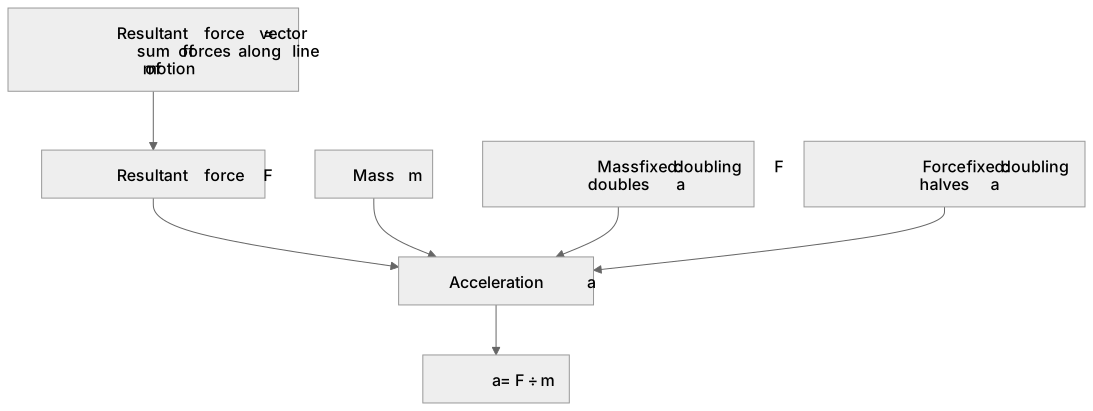
This statement describes the two proportionalities behind Newton’s Second Law. Acceleration is proportional to the resultant force: with mass fixed, doubling the resultant force doubles the acceleration, and halving it halves the acceleration. Acceleration is inversely proportional to mass: with resultant force fixed, doubling the mass halves the acceleration, and halving the mass doubles it. These combine as a = F ÷ m, where F is the resultant force in newtons (N), m is mass in kilograms (kg) and a is acceleration in metres per second squared (m/s²). For example, a resultant force of 12 N on a 3 kg object gives a = 12 N ÷ 3 kg = 4 m/s². If the same 12 N acts on 6 kg, a = 2 m/s². The force must be the resultant, found by combining all forces acting along the line of motion.
What earns the marks
- Explain that acceleration is directly proportional to the resultant force when mass is constant.
- Explain that acceleration is inversely proportional to mass when the resultant force is constant.
- Combine the two proportionalities into the relationship a = F ÷ m, or equivalently F = m × a.
- Identify the resultant force as the vector sum of all forces acting along the line of motion.
- Use consistent SI units: newtons for force, kilograms for mass and m/s² for acceleration.
- Predict the effect on acceleration of changing resultant force or mass by a given factor.
Common mistakes and how to put them right
Treating acceleration as proportional to mass.
Put it right by recalling that greater mass gives smaller acceleration for the same resultant force.
Forgetting to combine opposing forces before applying the relationship.
Put it right by subtracting a smaller opposing force from a larger driving force.
Mixing units, such as using grams with newtons.
Put it right by converting all masses to kilograms before calculating.
Exam tips
- Underline the words resultant force and mass in the question to decide which proportionality is being tested.
- Show the rearrangement you use, especially when finding mass or force, so your method is clear.
- Check whether your final acceleration is sensible: a small force on a large mass should give a small acceleration.
Try the lesson
The start of the Newton's Second Law: The acceleration of an object is proportional to the resultant force acting on the object, and inversely proportional to the mass of the object. lesson, made from checked teaching notes for this specification point.
Have a go first
According to Newton's Second Law, how does the acceleration of an object relate to the resultant force acting on it and its mass?
Listen
This statement describes the two proportionalities behind Newton’s Second Law. Acceleration is proportional to the resultant force: with mass fixed, doubling the resultant force doubles the acceleration, and halving it halves the acceleration. Acceleration is inversely proportional to mass: with resultant force fixed, doubling the mass halves the acceleration, and halving the mass doubles it. These combine as a = F ÷ m, where F is the resultant force in newtons (N), m is mass in kilograms (kg) and a is acceleration in metres per second squared (m/s²). For example, a resultant force of 12 N on a 3 kg object gives a = 12 N ÷ 3 kg = 4 m/s². If the same 12 N acts on 6 kg, a = 2 m/s². The force must be the resultant, found by combining all forces acting along the line of motion. A strong answer earns marks for these points. Explain that acceleration is directly proportional to the resultant force when mass is constant. Explain that acceleration is inversely proportional to mass when the resultant force is constant. Combine the two proportionalities into the relationship a = F ÷ m, or equivalently F = m × a. Identify the resultant force as the vector sum of all forces acting along the line of motion. A common slip: Treating acceleration as proportional to mass. Instead, recalling that greater mass gives smaller acceleration for the same resultant force. Exam tip: Underline the words resultant force and mass in the question to decide which proportionality is being tested.
See it
Key words
Say what each word means before you turn the card.
Resultant force
Try answering aloud or in your head before turning the card.
Acceleration
Try answering aloud or in your head before turning the card.
Mass
Try answering aloud or in your head before turning the card.
a = F ÷ m
Try answering aloud or in your head before turning the card.
See every definition
- Resultant force
- The force found by combining all forces acting along the line of motion.
- Acceleration
- A quantity proportional to the resultant force acting on an object and inversely proportional to the mass of the object.
- Mass
- A quantity measured in kilograms to which acceleration is inversely proportional when the resultant force is fixed.
- a = F ÷ m
- The relationship combining the two proportionalities, where F is the resultant force in newtons, m is mass in kilograms and a is acceleration in metres per second squared.
Label the diagram
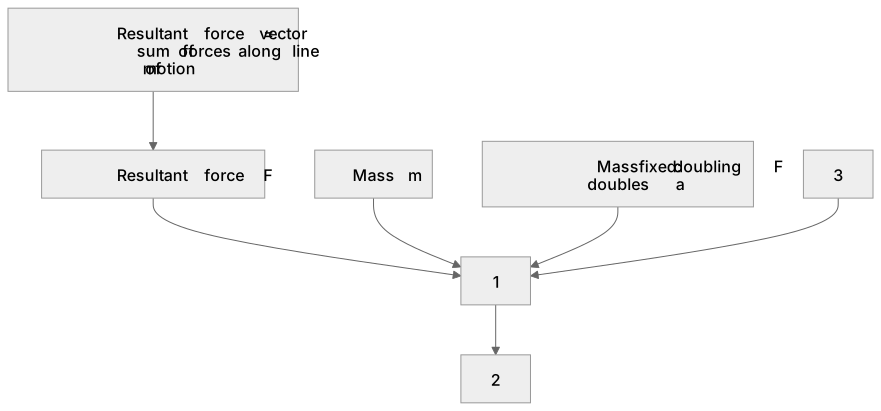
Some boxes have lost their names. Pick the right name for each number.
1Box 1
2Box 2
3Box 3
There is more to this lesson
The full lesson goes on to check your understanding and help you earn the marks. Create a free account to carry on, with your progress saved.
A week of Premium from your first lesson · Then the free plan continues · No card, no charge
Test your understanding of Newton's Second Law: The acceleration of an object is proportional to the resultant force acting on the object, and inversely proportional to the mass of the object.
Active recall beats re-reading. Take an instant quiz now to test what you’ve learned and lock it into long-term memory.
A week of Premium from your first lesson · Then the free plan continues · No card, no charge