AQA · GCSE · Combined Science
Course version: 8464 · Version from Sept 2018
Millisieverts (mSv) = 1 sievert (Sv)
Full specification wording
Properties of electromagnetic waves 2: 1000 millisieverts (mSv) = 1 sievert (Sv)
Radiation dose is measured in sieverts (Sv), but many everyday exposures are much smaller than one sievert, so the millisievert (mSv) is used.
Checked against the AQA 8464 specification (opens in a new tab) on .
- Point 5 of 7
Study notes
From the checked teaching notes for this specification point.
The idea
Radiation dose is measured in sieverts (Sv), but many everyday exposures are much smaller than one sievert, so the millisievert (mSv) is used. The prefix milli- means one thousandth, so 1 mSv is 0.001 Sv and 1000 mSv make 1 Sv. To convert millisieverts to sieverts, divide by 1000; to convert sieverts to millisieverts, multiply by 1000. For example, a dose of 2500 mSv is 2.5 Sv, and a dose of 0.04 Sv is 40 mSv. Being able to convert between these units lets you compare doses of ultraviolet, X-ray or gamma radiation fairly when judging the risk of harm to body tissue.
What earns the marks
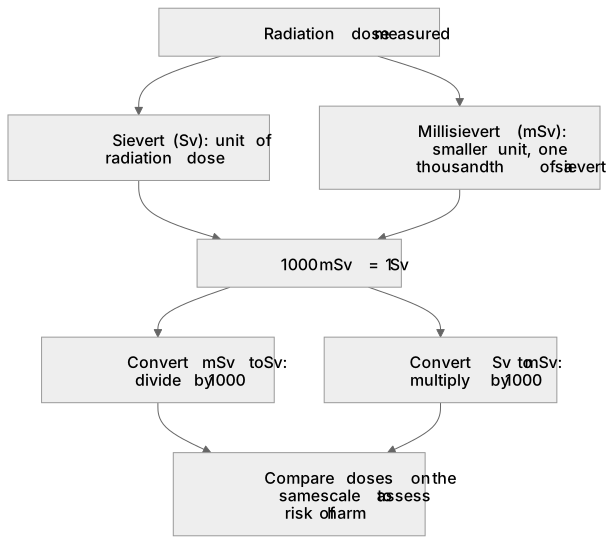
- The sievert (Sv) is the unit of radiation dose.
- The millisievert (mSv) is a smaller unit of radiation dose, equal to one thousandth of a sievert.
- 1000 mSv = 1 Sv, so 1 mSv = 0.001 Sv.
- To convert mSv to Sv, divide the value in mSv by 1000.
- To convert Sv to mSv, multiply the value in Sv by 1000.
- Converting units allows doses to be compared on the same scale when assessing risk of harm.
Common mistakes and how to put them right
Multiplying by 1000 when converting mSv to Sv.
Put it right by dividing by 1000, because 1 mSv is smaller than 1 Sv.
Writing 1000 Sv = 1 mSv.
Put it right by remembering that the millisievert is the smaller unit, so 1000 mSv = 1 Sv.
Ignoring the unit when comparing doses.
Put it right by converting all values to the same unit, usually Sv or mSv, before comparing.
Exam tips
- Write the conversion factor 1000 mSv = 1 Sv at the start of a calculation so you do not invert it.
- Check whether the question gives a dose in mSv or Sv, and convert before comparing or calculating risk.
- Give the unit with your answer, and use mSv for small doses and Sv for large doses to keep numbers sensible.
Try the lesson
The start of the Properties of electromagnetic waves 2: 1000 millisieverts (mSv) = 1 sievert (Sv) lesson, made from checked teaching notes for this specification point.
Have a go first
A patient receives a radiation dose of 3000 mSv. What is this dose in sieverts?
Listen
Radiation dose is measured in sieverts (Sv), but many everyday exposures are much smaller than one sievert, so the millisievert (mSv) is used. The prefix milli- means one thousandth, so 1 mSv is 0.001 Sv and 1000 mSv make 1 Sv. To convert millisieverts to sieverts, divide by 1000; to convert sieverts to millisieverts, multiply by 1000. For example, a dose of 2500 mSv is 2.5 Sv, and a dose of 0.04 Sv is 40 mSv. Being able to convert between these units lets you compare doses of ultraviolet, X-ray or gamma radiation fairly when judging the risk of harm to body tissue. A strong answer earns marks for these points. The sievert (Sv) is the unit of radiation dose. The millisievert (mSv) is a smaller unit of radiation dose, equal to one thousandth of a sievert. 1000 mSv = 1 Sv, so 1 mSv = 0.001 Sv. To convert mSv to Sv, divide the value in mSv by 1000. A common slip: Multiplying by 1000 when converting mSv to Sv. Instead, dividing by 1000, because 1 mSv is smaller than 1 Sv. Exam tip: Write the conversion factor 1000 mSv = 1 Sv at the start of a calculation so you do not invert it.
See it
Label the diagram
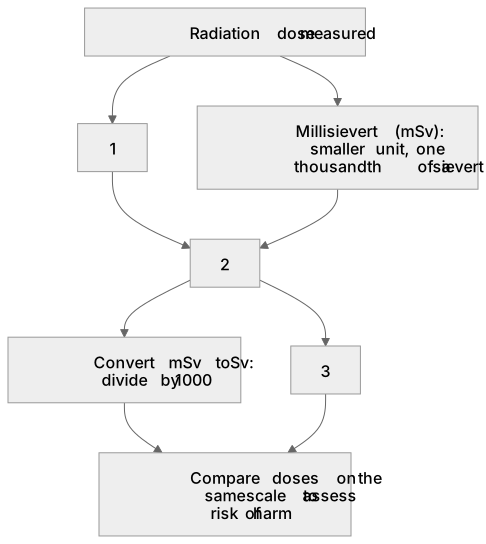
Some boxes have lost their names. Pick the right name for each number.
1Box 1
2Box 2
3Box 3
There is more to this lesson
The full lesson goes on to check your understanding and help you earn the marks. Create a free account to carry on, with your progress saved.
A week of Premium from your first lesson · Then the free plan continues · No card, no charge
Test your understanding of Properties of electromagnetic waves 2: 1000 millisieverts (mSv) = 1 sievert (Sv)
Active recall beats re-reading. Take an instant quiz now to test what you’ve learned and lock it into long-term memory.
A week of Premium from your first lesson · Then the free plan continues · No card, no charge