AQA · GCSE · Combined Science
Course version: 8464 · Version from Sept 2018
Changes in atoms and the nuclei of atoms can result in electromagnetic…
Full specification wording
Properties of electromagnetic waves 2: Changes in atoms and the nuclei of atoms can result in electromagnetic waves being generated or absorbed over a wide frequency range. Gamma rays originate from changes in the nucleus of an atom.
Electromagnetic waves are produced when energy levels in atoms or nuclei change.
Checked against the AQA 8464 specification (opens in a new tab) on .
- Point 3 of 7
- 3 key terms
Study notes
From the checked teaching notes for this specification point.
The idea
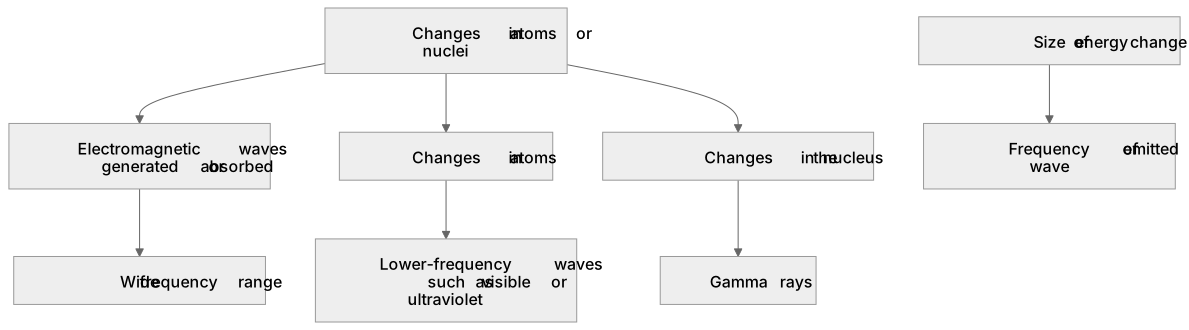
Electromagnetic waves are produced when energy levels in atoms or nuclei change. In an atom, electrons dropping to lower energy levels emit visible or ultraviolet light, while absorption occurs when electrons jump to higher levels. In the nucleus, rearrangements of protons and neutrons release energy as gamma rays. For example, after alpha or beta decay, a nucleus may be left in an excited state and emit a gamma ray as it settles. Gamma rays have the highest frequencies and shortest wavelengths in the electromagnetic spectrum. The key idea is that the size of the energy change determines the frequency: large nuclear energy changes give gamma rays, smaller atomic energy changes give lower-frequency waves.
What earns the marks
- Changes in atoms can generate or absorb electromagnetic waves, such as visible light or ultraviolet.
- Changes in atomic nuclei can generate or absorb electromagnetic waves, typically gamma rays.
- Electromagnetic waves are produced over a wide range of frequencies because energy changes vary in size.
- Gamma rays originate from changes in the nucleus of an atom, for example after radioactive decay.
- The frequency of the emitted wave is related to the size of the energy change in the atom or nucleus.
Common mistakes and how to put them right
Saying gamma rays come from electron transitions.
Put it right: Gamma rays originate from changes in the nucleus, while electron transitions produce lower-frequency waves such as visible or ultraviolet.
Thinking all electromagnetic waves come from the same part of the atom.
Put it right: Different parts (electron shells versus nucleus) produce different frequency ranges.
Confusing absorption with emission.
Put it right: Absorption occurs when energy is taken in to raise an energy level, while emission occurs when energy is released as a wave.
Exam tips
- Name the part of the atom responsible for gamma rays: the nucleus.
- Use the phrase 'changes in energy levels' when explaining how electromagnetic waves are generated or absorbed.
- Link the wide frequency range to the different sizes of energy changes in atoms and nuclei.
Try the lesson
The start of the Properties of electromagnetic waves 2: Changes in atoms and the nuclei of atoms can result in electromagnetic waves being generated or absorbed over a wide frequency range. Gamma rays originate from changes in the nucleus of an atom. lesson, made from checked teaching notes for this specification point.
Have a go first
Which part of an atom is the origin of gamma rays?
Listen
Electromagnetic waves are produced when energy levels in atoms or nuclei change. In an atom, electrons dropping to lower energy levels emit visible or ultraviolet light, while absorption occurs when electrons jump to higher levels. In the nucleus, rearrangements of protons and neutrons release energy as gamma rays. For example, after alpha or beta decay, a nucleus may be left in an excited state and emit a gamma ray as it settles. Gamma rays have the highest frequencies and shortest wavelengths in the electromagnetic spectrum. The key idea is that the size of the energy change determines the frequency: large nuclear energy changes give gamma rays, smaller atomic energy changes give lower-frequency waves. A strong answer earns marks for these points. Changes in atoms can generate or absorb electromagnetic waves, such as visible light or ultraviolet. Changes in atomic nuclei can generate or absorb electromagnetic waves, typically gamma rays. Electromagnetic waves are produced over a wide range of frequencies because energy changes vary in size. Gamma rays originate from changes in the nucleus of an atom, for example after radioactive decay. A common slip: Saying gamma rays come from electron transitions. Instead, gamma rays originate from changes in the nucleus, while electron transitions produce lower-frequency waves such as visible or ultraviolet. Exam tip: Name the part of the atom responsible for gamma rays: the nucleus.
See it
Key words
Say what each word means before you turn the card.
Energy level changes in atoms and nuclei
Try answering aloud or in your head before turning the card.
Origin of gamma rays from nuclear changes
Try answering aloud or in your head before turning the card.
Relationship between energy change and wave frequency
Try answering aloud or in your head before turning the card.
See every definition
- Energy level changes in atoms and nuclei
- Changes in atoms and the nuclei of atoms can result in electromagnetic waves being generated or absorbed over a wide frequency range.
- Origin of gamma rays from nuclear changes
- Gamma rays originate from changes in the nucleus of an atom.
- Relationship between energy change and wave frequency
- The frequency of the emitted wave is related to the size of the energy change in the atom or nucleus.
Label the diagram
Some boxes have lost their names. Pick the right name for each number.
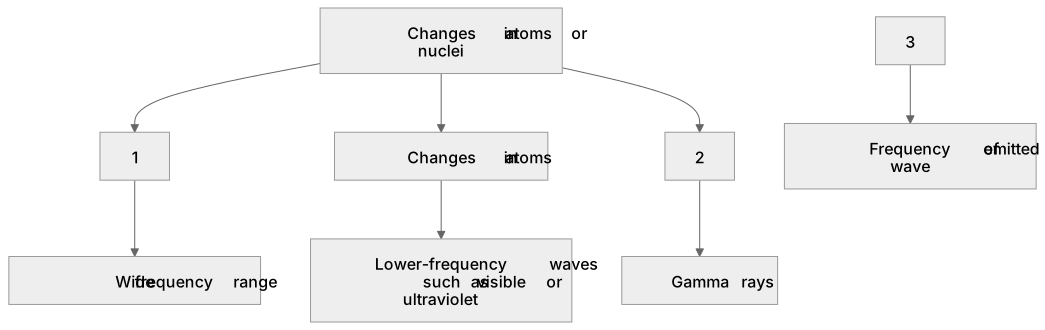
1Box 1
2Box 2
3Box 3
There is more to this lesson
The full lesson goes on to check your understanding and help you earn the marks. Create a free account to carry on, with your progress saved.
A week of Premium from your first lesson · Then the free plan continues · No card, no charge
Test your understanding of Properties of electromagnetic waves 2: Changes in atoms and the nuclei of atoms can result in electromagnetic waves being generated or absorbed over a wide frequency range. Gamma rays originate from changes in the nucleus of an atom.
Active recall beats re-reading. Take an instant quiz now to test what you’ve learned and lock it into long-term memory.
A week of Premium from your first lesson · Then the free plan continues · No card, no charge