AQA · GCSE · Combined Science
Course version: 8464 · Version from Sept 2018
(HT only) Limiting factors are important in the economics of enhancing the…
Full specification wording
Rate of photosynthesis: (HT only) Limiting factors are important in the economics of enhancing the conditions in greenhouses to gain the maximum rate of photosynthesis while still maintaining profit.
In a greenhouse, growers raise light intensity, carbon dioxide concentration and temperature to increase photosynthesis.
Checked against the AQA 8464 specification (opens in a new tab) on .
- Point 9 of 10
- 3 key terms
Study notes
From the checked teaching notes for this specification point.
The idea
In a greenhouse, growers raise light intensity, carbon dioxide concentration and temperature to increase photosynthesis. Each factor eventually becomes limiting, so adding more gives diminishing returns. The economics involve comparing the extra yield gained against the cost of providing the enhanced condition, such as heating, lighting or CO₂ enrichment. Maximum profit occurs when the marginal gain from further enhancement no longer exceeds its cost. For example, adding CO₂ boosts photosynthesis until another factor, like light or temperature, limits the rate. You must explain how limiting factors determine optimum conditions and why unlimited enhancement is not economically sensible.
What earns the marks
- Identifies light intensity, carbon dioxide concentration and temperature as factors that can be enhanced in a greenhouse to increase the rate of photosynthesis.
- Explains that the rate of photosynthesis increases as a limiting factor is raised until another factor becomes limiting, so further increases have little or no effect.
- Applies the idea of limiting factors to explain why a grower would not increase all conditions indefinitely, because the cost of enhancement may exceed the value of extra growth.
- Uses the concept of profit as the difference between income from increased yield and the cost of providing enhanced conditions, such as heating, lighting or CO₂ enrichment.
- Describes an optimum where the rate of photosynthesis is maximised for the lowest additional cost, rather than simply maximised at any cost.
Common mistakes and how to put them right
Stating that increasing any factor always increases the rate of photosynthesis indefinitely.
Put it right by noting that once another factor becomes limiting, further increases have little or no effect on the rate.
Confusing profit with yield, assuming maximum yield always gives maximum profit.
Put it right by stating profit also depends on the cost of heating, lighting or adding CO₂, so maximum profit may occur at a lower yield.
Ignoring the cost of enhanced conditions and treating greenhouse management as purely biological.
Put it right by comparing the cost of enhancement with the extra income from improved growth.
Exam tips
- As this is Higher Tier only, when a question asks about greenhouses, link each enhanced condition to a named limiting factor and then to a cost or benefit.
- Use comparative language such as 'increases until', 'plateaus' and 'no longer cost-effective' to show understanding of diminishing returns.
Try the lesson
The start of the Rate of photosynthesis: (HT only) Limiting factors are important in the economics of enhancing the conditions in greenhouses to gain the maximum rate of photosynthesis while still maintaining profit. lesson, made from checked teaching notes for this specification point.
Have a go first
Why must a commercial grower carefully evaluate the cost of adding artificial lighting to a greenhouse during the winter?
Listen
In a greenhouse, growers raise light intensity, carbon dioxide concentration and temperature to increase photosynthesis. Each factor eventually becomes limiting, so adding more gives diminishing returns. The economics involve comparing the extra yield gained against the cost of providing the enhanced condition, such as heating, lighting or CO₂ enrichment. Maximum profit occurs when the marginal gain from further enhancement no longer exceeds its cost. For example, adding CO₂ boosts photosynthesis until another factor, like light or temperature, limits the rate. You must explain how limiting factors determine optimum conditions and why unlimited enhancement is not economically sensible. A strong answer earns marks for these points. Identifies light intensity, carbon dioxide concentration and temperature as factors that can be enhanced in a greenhouse to increase the rate of photosynthesis. Explains that the rate of photosynthesis increases as a limiting factor is raised until another factor becomes limiting, so further increases have little or no effect. Applies the idea of limiting factors to explain why a grower would not increase all conditions indefinitely, because the cost of enhancement may exceed the value of extra growth. Uses the concept of profit as the difference between income from increased yield and the cost of providing enhanced conditions, such as heating, lighting or CO₂ enrichment. A common slip: Stating that increasing any factor always increases the rate of photosynthesis indefinitely. Instead, noting that once another factor becomes limiting, further increases have little or no effect on the rate. Exam tip: As this is Higher Tier only, when a question asks about greenhouses, link each enhanced condition to a named limiting factor and then to a cost or benefit.
See it
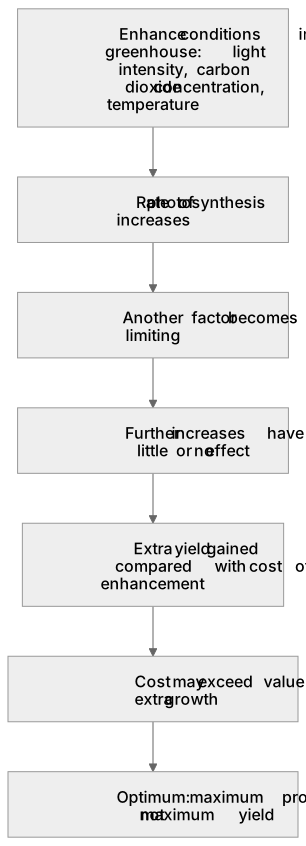
Put it in order
Put these steps in the order they happen.
- 1. Optimum: maximum profit, not maximum yield
- 2. Cost may exceed value of extra growth
- 3. Another factor becomes limiting
- 4. Extra yield gained compared with cost of enhancement
- 5. Enhance conditions in greenhouse: light intensity, carbon dioxide concentration, temperature
- 6. Rate of photosynthesis increases
- 7. Further increases have little or no effect
Key words
Say what each word means before you turn the card.
Profit
Try answering aloud or in your head before turning the card.
Optimum
Try answering aloud or in your head before turning the card.
Diminishing returns
Try answering aloud or in your head before turning the card.
See every definition
- Profit
- The difference between income from increased yield and the cost of providing enhanced conditions, such as heating, lighting or CO₂ enrichment.
- Optimum
- The point where the rate of photosynthesis is maximised for the lowest additional cost, rather than simply maximised at any cost.
- Diminishing returns
- Adding more of a factor gives little or no effect once another factor becomes limiting, so further enhancement is no longer cost-effective.
Label the diagram
Some boxes have lost their names. Pick the right name for each number.
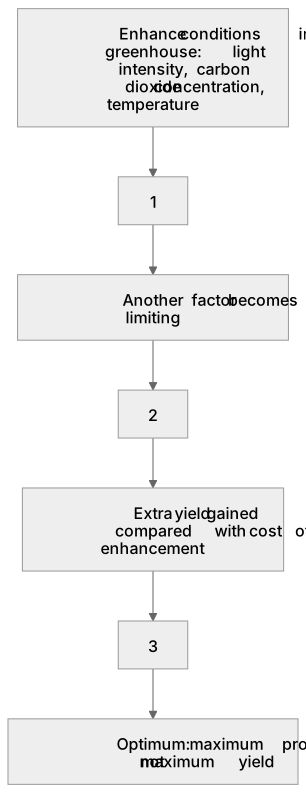
1Box 1
2Box 2
3Box 3
There is more to this lesson
The full lesson goes on to check your understanding and help you earn the marks. Create a free account to carry on, with your progress saved.
A week of Premium from your first lesson · Then the free plan continues · No card, no charge
Test your understanding of Rate of photosynthesis: (HT only) Limiting factors are important in the economics of enhancing the conditions in greenhouses to gain the maximum rate of photosynthesis while still maintaining profit.
Active recall beats re-reading. Take an instant quiz now to test what you’ve learned and lock it into long-term memory.
A week of Premium from your first lesson · Then the free plan continues · No card, no charge