AQA · GCSE · Combined Science
Course version: 8464 · Version from Sept 2018
(HT only) Students should understand and use inverse proportion – the…
Full specification wording
Rate of photosynthesis: (HT only) Students should understand and use inverse proportion – the inverse square law and light intensity in the context of photosynthesis.
Light intensity decreases with distance from a lamp.
Checked against the AQA 8464 specification (opens in a new tab) on .
- Point 8 of 10
- 3 key terms
Study notes
From the checked teaching notes for this specification point.
The idea
Light intensity decreases with distance from a lamp. The inverse square law states that intensity is inversely proportional to the square of the distance: intensity ∝ 1 ÷ distance². If distance doubles, intensity falls to one quarter; if distance trebles, intensity falls to one ninth. In photosynthesis, rate increases with light intensity until another factor limits. To use the law, measure distance from lamp to pondweed, calculate 1 ÷ d², and plot rate against this value; a straight line through the origin shows rate is proportional to light intensity. This explains why moving a lamp further away sharply reduces the rate.
What earns the marks
- State that light intensity is inversely proportional to the square of the distance from the light source.
- Use the relationship intensity ∝ 1 ÷ distance² to calculate relative intensity at different distances.
- Explain that doubling the distance reduces light intensity to one quarter of its original value.
- Describe how to plot rate of photosynthesis against 1 ÷ distance² to test whether light intensity limits the rate.
- Interpret a straight line through the origin on a rate against 1 ÷ distance² graph as evidence that rate is proportional to light intensity.
Common mistakes and how to put them right
Using intensity ∝ 1 ÷ distance instead of 1 ÷ distance².
Put it right by squaring the distance before dividing.
Thinking doubling distance halves intensity.
Put it right by stating intensity becomes one quarter.
Plotting rate against distance and expecting a straight line.
Put it right by plotting against 1 ÷ distance² to linearise the relationship.
Exam tips
- Write the relationship as intensity ∝ 1 ÷ d² and show the substitution clearly when calculating.
- As this is Higher Tier only, when explaining a graph, state that a straight line through the origin supports proportionality between rate and light intensity.
Try the lesson
The start of the Rate of photosynthesis: (HT only) Students should understand and use inverse proportion – the inverse square law and light intensity in the context of photosynthesis. lesson, made from checked teaching notes for this specification point.
Have a go first
A lamp is moved so that its distance from a plant is doubled. According to the inverse square law, what happens to the light intensity at the plant?
Listen
Light intensity decreases with distance from a lamp. The inverse square law states that intensity is inversely proportional to the square of the distance: intensity ∝ 1 ÷ distance². If distance doubles, intensity falls to one quarter; if distance trebles, intensity falls to one ninth. In photosynthesis, rate increases with light intensity until another factor limits. To use the law, measure distance from lamp to pondweed, calculate 1 ÷ d², and plot rate against this value; a straight line through the origin shows rate is proportional to light intensity. This explains why moving a lamp further away sharply reduces the rate. A strong answer earns marks for these points. State that light intensity is inversely proportional to the square of the distance from the light source. Use the relationship intensity ∝ 1 ÷ distance² to calculate relative intensity at different distances. Explain that doubling the distance reduces light intensity to one quarter of its original value. Describe how to plot rate of photosynthesis against 1 ÷ distance² to test whether light intensity limits the rate. A common slip: Using intensity ∝ 1 ÷ distance instead of 1 ÷ distance². Instead, squaring the distance before dividing. Exam tip: Write the relationship as intensity ∝ 1 ÷ d² and show the substitution clearly when calculating.
See it
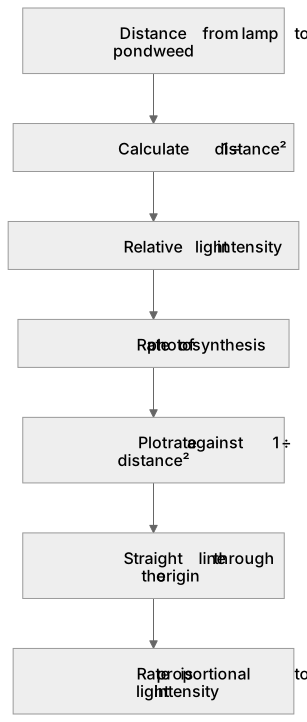
Put it in order
Put these steps in the order they happen.
- 1. Rate is proportional to light intensity
- 2. Straight line through the origin
- 3. Relative light intensity
- 4. Plot rate against 1 ÷ distance²
- 5. Distance from lamp to pondweed
- 6. Calculate 1 ÷ distance²
- 7. Rate of photosynthesis
Key words
Say what each word means before you turn the card.
Inverse square law
Try answering aloud or in your head before turning the card.
Light intensity and distance
Try answering aloud or in your head before turning the card.
Proportionality
Try answering aloud or in your head before turning the card.
See every definition
- Inverse square law
- Light intensity is inversely proportional to the square of the distance from the light source.
- Light intensity and distance
- Light intensity decreases with distance from a lamp, and doubling the distance reduces light intensity to one quarter of its original value.
- Proportionality
- A straight line through the origin on a rate against 1 ÷ distance² graph shows rate is proportional to light intensity.
Label the diagram
Some boxes have lost their names. Pick the right name for each number.
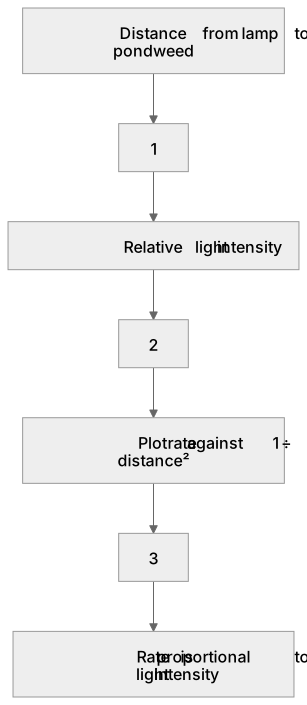
1Box 1
2Box 2
3Box 3
There is more to this lesson
The full lesson goes on to check your understanding and help you earn the marks. Create a free account to carry on, with your progress saved.
A week of Premium from your first lesson · Then the free plan continues · No card, no charge
Test your understanding of Rate of photosynthesis: (HT only) Students should understand and use inverse proportion – the inverse square law and light intensity in the context of photosynthesis.
Active recall beats re-reading. Take an instant quiz now to test what you’ve learned and lock it into long-term memory.
A week of Premium from your first lesson · Then the free plan continues · No card, no charge