AQA · GCSE · Combined Science
Course version: 8464 · Version from Sept 2018
Infrared – electrical heaters, cooking food, infrared cameras
Full specification wording
Uses and applications of electromagnetic waves: infrared – electrical heaters, cooking food, infrared cameras
Infrared is electromagnetic radiation with wavelengths just longer than red visible light.
Checked against the AQA 8464 specification (opens in a new tab) on .
- Point 4 of 8
- 4 key terms
Study notes
From the checked teaching notes for this specification point.
The idea
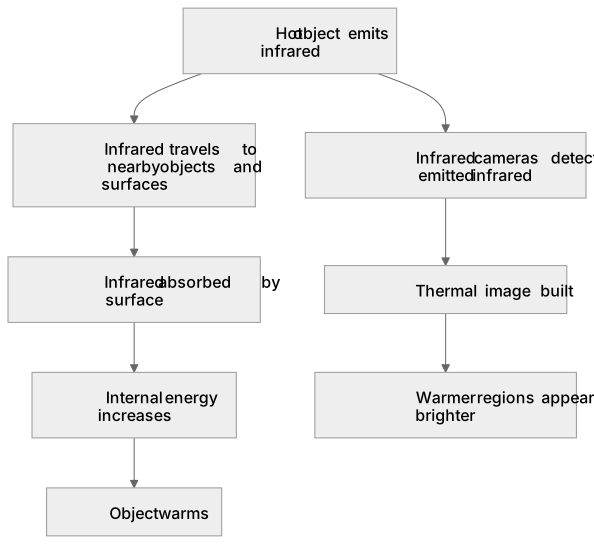
Infrared is electromagnetic radiation with wavelengths just longer than red visible light. All warm objects emit it, and its intensity rises with temperature. Electrical heaters contain a heating element that becomes hot; the element emits infrared, which travels to nearby objects and surfaces and is absorbed, increasing their internal energy and warming them. Cooking food works the same way: a grill element radiates infrared that is absorbed by the food surface, heating and browning it, while a microwave oven instead uses microwaves. Infrared cameras detect the infrared emitted by objects and build a thermal image, so warmer regions appear brighter. They are used in night vision, thermal imaging of buildings to find heat loss, and medical screening. Infrared can be reflected, absorbed or transmitted, and its heating effect depends on the surface absorbing it.
What earns the marks
- Infrared is electromagnetic radiation with a wavelength slightly longer than red visible light.
- All objects emit infrared; the hotter the object, the greater the intensity of infrared emitted.
- Electrical heaters transfer energy by infrared radiation from a hot element to surroundings, where absorption raises internal energy.
- Cooking food by grilling uses infrared absorbed at the food surface, heating and browning it.
- Infrared cameras detect emitted infrared and display a thermal image, with warmer areas shown differently from cooler areas.
- Infrared is part of the continuous electromagnetic spectrum and travels at the speed of light in a vacuum.
Common mistakes and how to put them right
Saying infrared is the same as red light.
Put it right: Red light is visible, whereas infrared is not detected by the eye.
Claiming infrared cameras emit infrared to see objects.
Put it right: They detect infrared emitted by objects, though some cameras include an illuminator.
Confusing infrared cooking with microwave cooking.
Put it right: Microwaves penetrate food and heat it throughout, while infrared mainly heats the surface.
Exam tips
- Link each use to the property of infrared: heating by absorption, or detection of emitted radiation.
- Use the phrase 'emitted by hot objects' when explaining heaters and cameras.
- Compare infrared with visible light or microwaves in one sentence to show understanding of the spectrum.
Try the lesson
The start of the Uses and applications of electromagnetic waves: infrared – electrical heaters, cooking food, infrared cameras lesson, made from checked teaching notes for this specification point.
Have a go first
Which type of electromagnetic wave is used by an electrical heater to transfer energy to a room?
Listen
Infrared is electromagnetic radiation with wavelengths just longer than red visible light. All warm objects emit it, and its intensity rises with temperature. Electrical heaters contain a heating element that becomes hot; the element emits infrared, which travels to nearby objects and surfaces and is absorbed, increasing their internal energy and warming them. Cooking food works the same way: a grill element radiates infrared that is absorbed by the food surface, heating and browning it, while a microwave oven instead uses microwaves. Infrared cameras detect the infrared emitted by objects and build a thermal image, so warmer regions appear brighter. They are used in night vision, thermal imaging of buildings to find heat loss, and medical screening. Infrared can be reflected, absorbed or transmitted, and its heating effect depends on the surface absorbing it. A strong answer earns marks for these points. Infrared is electromagnetic radiation with a wavelength slightly longer than red visible light. All objects emit infrared; the hotter the object, the greater the intensity of infrared emitted. Electrical heaters transfer energy by infrared radiation from a hot element to surroundings, where absorption raises internal energy. Cooking food by grilling uses infrared absorbed at the food surface, heating and browning it. Exam tip: Link each use to the property of infrared: heating by absorption, or detection of emitted radiation.
See it
Key words
Say what each word means before you turn the card.
Infrared
Try answering aloud or in your head before turning the card.
Absorption
Try answering aloud or in your head before turning the card.
Thermal image
Try answering aloud or in your head before turning the card.
Emission
Try answering aloud or in your head before turning the card.
See every definition
- Infrared
- Electromagnetic radiation with a wavelength slightly longer than red visible light, emitted by all objects, with intensity rising as temperature rises.
- Absorption
- Process in which infrared is taken in by a surface, increasing internal energy and warming the object.
- Thermal image
- Picture built by an infrared camera from the infrared emitted by objects, in which warmer regions appear brighter.
- Emission
- Giving out of infrared by objects, with hotter objects emitting a greater intensity of infrared.
Label the diagram
Some boxes have lost their names. Pick the right name for each number.
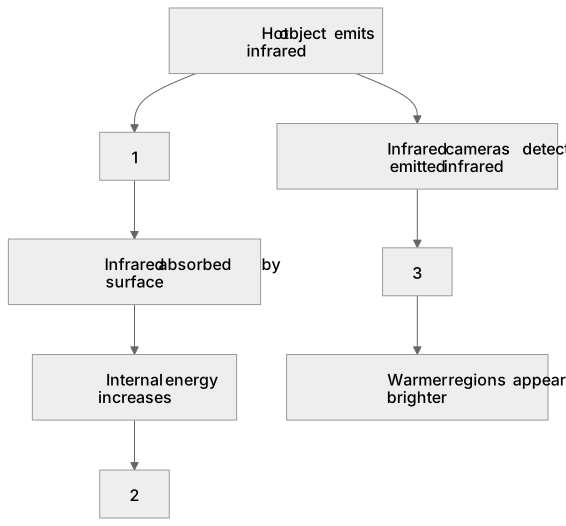
1Box 1
2Box 2
3Box 3
There is more to this lesson
The full lesson goes on to check your understanding and help you earn the marks. Create a free account to carry on, with your progress saved.
A week of Premium from your first lesson · Then the free plan continues · No card, no charge
Test your understanding of Uses and applications of electromagnetic waves: infrared – electrical heaters, cooking food, infrared cameras
Active recall beats re-reading. Take an instant quiz now to test what you’ve learned and lock it into long-term memory.
A week of Premium from your first lesson · Then the free plan continues · No card, no charge