AQA · GCSE · Combined Science
Course version: 8464 · Version from Sept 2018
Visible light – fibre optic communications
Full specification wording
Uses and applications of electromagnetic waves: visible light – fibre optic communications
Visible light is the narrow band of the electromagnetic spectrum detected by the human eye.
Checked against the AQA 8464 specification (opens in a new tab) on .
- Point 5 of 8
- 2 key terms
Study notes
From the checked teaching notes for this specification point.
The idea
Visible light is the narrow band of the electromagnetic spectrum detected by the human eye. In fibre optic communication, light carrying a signal travels along a thin glass or plastic fibre. The light rays bounce back and forth off the inside walls of the fibre, reflecting completely so that the light stays inside the core, even around bends. Pulses of light encode digital information, allowing signals to travel long distances with little loss for telephone and internet networks.
What earns the marks
- Visible light is the part of the electromagnetic spectrum detected by the human eye.
- Optical fibres are thin strands of glass or plastic used to transmit pulses of light over long distances.
- Light rays travel along the fibre by reflecting completely off the inside surface of the fibre.
- (HT only) Visible light is suitable for optical fibres because its high frequency allows it to carry a large amount of information per second.
- (HT only) Visible light is also suitable because it undergoes total internal reflection with low signal loss in glass or plastic.
Common mistakes and how to put them right
Saying light reflects off the outside of the fibre.
Put it right by stating that light reflects off the inside surface of the fibre.
Thinking light travels in a perfectly straight line through a bent fibre.
Put it right by explaining that light travels in straight lines but bounces off the internal walls to navigate bends.
Confusing the use of visible light in fibres with radio waves in aerials.
Put it right: Visible light is contained within the fibre, whereas radio waves are broadcast through the air.
(HT only) Stating visible light has a longer wavelength than microwaves.
Put it right by remembering visible light has a shorter wavelength and higher frequency, which increases its data capacity.
Exam tips
- State that light reflects off the inside walls of the optical fibre to travel along it.
- Remember that optical fibres use pulses of light to transmit digital information.
- (HT only) When asked to explain suitability, link the high frequency and short wavelength of visible light to the large amount of information it can carry.
Try the lesson
The start of the Uses and applications of electromagnetic waves: visible light – fibre optic communications lesson, made from checked teaching notes for this specification point.
Have a go first
Which type of electromagnetic wave is carried along a fibre optic cable to send telephone and internet signals?
Listen
Visible light is the narrow band of the electromagnetic spectrum detected by the human eye. In fibre optic communication, light carrying a signal travels along a thin glass or plastic fibre. The light rays bounce back and forth off the inside walls of the fibre, reflecting completely so that the light stays inside the core, even around bends. Pulses of light encode digital information, allowing signals to travel long distances with little loss for telephone and internet networks. A strong answer earns marks for these points. Visible light is the part of the electromagnetic spectrum detected by the human eye. Optical fibres are thin strands of glass or plastic used to transmit pulses of light over long distances. Light rays travel along the fibre by reflecting completely off the inside surface of the fibre. HT only) Visible light is suitable for optical fibres because its high frequency allows it to carry a large amount of information per second. A common slip: Saying light reflects off the outside of the fibre. Instead, stating that light reflects off the inside surface of the fibre. Exam tip: State that light reflects off the inside walls of the optical fibre to travel along it.
See it
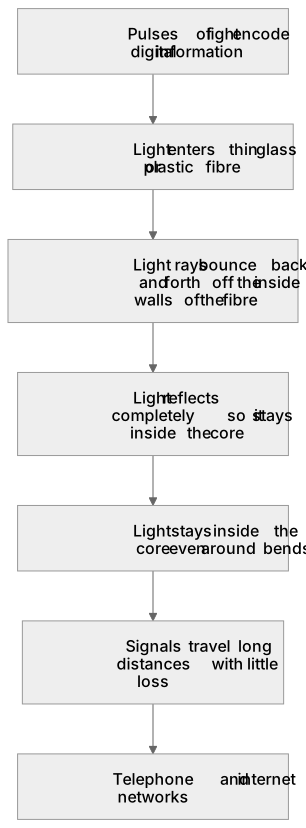
Put it in order
Put these steps in the order they happen.
- 1. Telephone and internet networks
- 2. Signals travel long distances with little loss
- 3. Light rays bounce back and forth off the inside walls of the fibre
- 4. Light stays inside the core even around bends
- 5. Pulses of light encode digital information
- 6. Light enters thin glass or plastic fibre
- 7. Light reflects completely so it stays inside the core
Key words
Say what each word means before you turn the card.
Visible light
Try answering aloud or in your head before turning the card.
Optical fibres
Try answering aloud or in your head before turning the card.
See every definition
- Visible light
- The narrow band of the electromagnetic spectrum detected by the human eye.
- Optical fibres
- Thin strands of glass or plastic used to transmit pulses of light over long distances.
Label the diagram
Some boxes have lost their names. Pick the right name for each number.
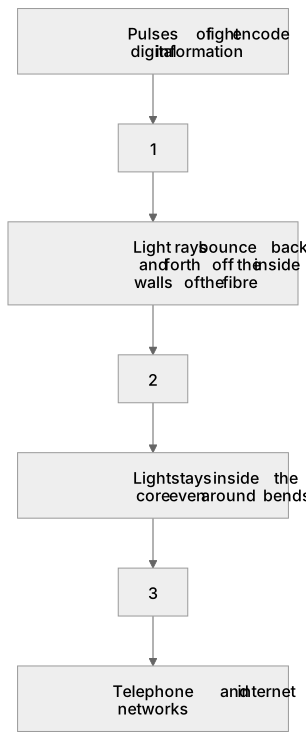
1Box 1
2Box 2
3Box 3
There is more to this lesson
The full lesson goes on to check your understanding and help you earn the marks. Create a free account to carry on, with your progress saved.
A week of Premium from your first lesson · Then the free plan continues · No card, no charge
Test your understanding of Uses and applications of electromagnetic waves: visible light – fibre optic communications
Active recall beats re-reading. Take an instant quiz now to test what you’ve learned and lock it into long-term memory.
A week of Premium from your first lesson · Then the free plan continues · No card, no charge