Pearson Edexcel · GCSE · Computer Science
Course version: 1CP2 · Version from Sept 2020
Understand the limitations of binary representation of data when…
Full specification wording
Data representation: 2.2.4 understand the limitations of binary representation of data when constrained by the number of available bits
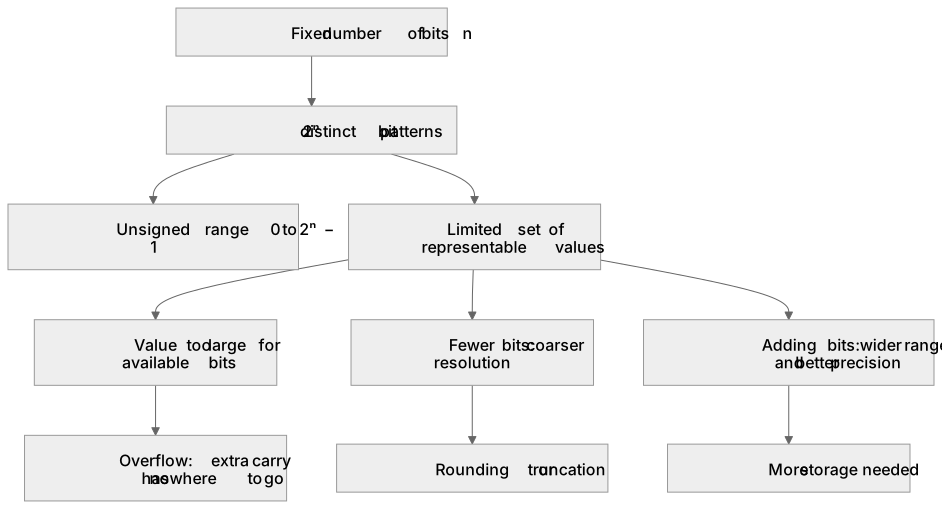
A fixed number of bits can store only a fixed set of values, so binary representation always has limits.
Checked against the Pearson Edexcel 1CP2 specification (opens in a new tab) on .
- Point 4 of 4
- 4 key terms
Study notes
From the checked teaching notes for this specification point.
The idea
A fixed number of bits can store only a fixed set of values, so binary representation always has limits. With n bits there are 2ⁿ different patterns, so the range of unsigned integers runs from 0 to 2ⁿ − 1. For example, 8 bits give 256 patterns, covering 0 to 255, so the value 256 cannot be stored in 8 bits. If a result exceeds the largest storable value, overflow occurs and the extra carry has nowhere to go. Fewer bits also mean coarser resolution: a 4-bit sample has only 16 amplitude levels, while 8 bits give 256. Rounding or truncation happens when a value cannot be represented exactly, such as a fraction stored with a limited number of fractional bits. Adding bits widens the range and improves precision, but every extra bit doubles the number of patterns and increases storage.
What earns the marks
- With n bits there are 2ⁿ distinct bit patterns, so the number of representable values is limited by the number of available bits.
- For unsigned integers, n bits represent the range 0 to 2ⁿ − 1; for example, 8 bits represent 0 to 255.
- Overflow occurs when a calculation produces a value outside the range that the available bits can represent, so the result cannot be stored correctly.
- A smaller number of bits gives coarser resolution, so values such as measurements or sound amplitudes are rounded to the nearest representable level.
- Increasing the number of bits widens the range and improves precision, but it also increases the storage needed for each value.
- Limitations apply to all data types, including integers, characters and sampled sound, because each uses a fixed number of bits per value.
Common mistakes and how to put them right
Thinking n bits store 2n values.
Put it right: The number of patterns is 2ⁿ, so 8 bits give 256 patterns, not 16.
Believing the largest unsigned value is 2ⁿ.
Put it right: The range is 0 to 2ⁿ − 1, so 8 bits stop at 255.
Assuming overflow changes the value to the correct larger number.
Put it right: Overflow means the result cannot be represented in the available bits, so the stored pattern is wrong.
Confusing range with precision.
Put it right: Adding bits increases both the largest value and the number of levels, but these are separate effects.
Exam tips
- Calculate the number of patterns as 2ⁿ and the unsigned range as 0 to 2ⁿ − 1 before choosing an answer.
- Identify overflow by comparing the required value with the maximum representable value for the given number of bits.
- When a question mentions quality or accuracy, link the limitation to rounding or truncation caused by too few bits.
Try the lesson
The start of the Data representation: 2.2.4 understand the limitations of binary representation of data when constrained by the number of available bits lesson, made from checked teaching notes for this specification point.
Have a go first
An 8-bit register stores an unsigned binary integer. What is the maximum denary value that can be held in this register?
Listen
A fixed number of bits can store only a fixed set of values, so binary representation always has limits. With n bits there are 2ⁿ different patterns, so the range of unsigned integers runs from 0 to 2ⁿ − 1. For example, 8 bits give 256 patterns, covering 0 to 255, so the value 256 cannot be stored in 8 bits. If a result exceeds the largest storable value, overflow occurs and the extra carry has nowhere to go. Fewer bits also mean coarser resolution: a 4-bit sample has only 16 amplitude levels, while 8 bits give 256. Rounding or truncation happens when a value cannot be represented exactly, such as a fraction stored with a limited number of fractional bits. Adding bits widens the range and improves precision, but every extra bit doubles the number of patterns and increases storage. A strong answer earns marks for these points. With n bits there are 2ⁿ distinct bit patterns, so the number of representable values is limited by the number of available bits. For unsigned integers, n bits represent the range 0 to 2ⁿ − 1; for example, 8 bits represent 0 to 255. Overflow occurs when a calculation produces a value outside the range that the available bits can represent, so the result cannot be stored correctly. A smaller number of bits gives coarser resolution, so values such as measurements or sound amplitudes are rounded to the nearest representable level. Exam tip: Calculate the number of patterns as 2ⁿ and the unsigned range as 0 to 2ⁿ − 1 before choosing an answer.
See it
Key words
Say what each word means before you turn the card.
Range of unsigned integers from 0 to 2ⁿ − 1
Try answering aloud or in your head before turning the card.
Overflow
Try answering aloud or in your head before turning the card.
Coarser resolution
Try answering aloud or in your head before turning the card.
Rounding or truncation
Try answering aloud or in your head before turning the card.
See every definition
- Range of unsigned integers from 0 to 2ⁿ − 1
- With n bits there are 2ⁿ different patterns, so the range of unsigned integers runs from 0 to 2ⁿ − 1.
- Overflow
- Occurs when a result exceeds the largest storable value, so the extra carry has nowhere to go and the result cannot be stored correctly.
- Coarser resolution
- A smaller number of bits gives coarser resolution, so values such as measurements or sound amplitudes are rounded to the nearest representable level.
- Rounding or truncation
- Happens when a value cannot be represented exactly, such as a fraction stored with a limited number of fractional bits.
Label the diagram
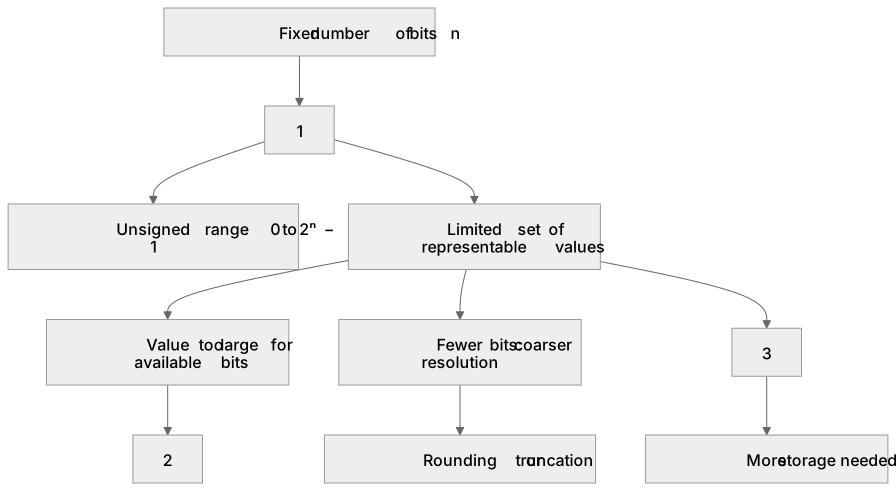
Some boxes have lost their names. Pick the right name for each number.
1Box 1
2Box 2
3Box 3
There is more to this lesson
The full lesson goes on to check your understanding and help you earn the marks. Create a free account to carry on, with your progress saved.
A week of Premium from your first lesson · Then the free plan continues · No card, no charge
Test your understanding of Data representation: 2.2.4 understand the limitations of binary representation of data when constrained by the number of available bits
Active recall beats re-reading. Take an instant quiz now to test what you’ve learned and lock it into long-term memory.
A week of Premium from your first lesson · Then the free plan continues · No card, no charge