OCR · GCSE · Economics
Essay Writing and Structured Answers
Master the art of high-scoring essays for OCR GCSE Economics. This guide breaks down the techniques examiners want to see, from nailing Assessment Objectives to building powerful analytical arguments, ensuring you can turn your economic knowledge into top marks.
- 4 min read
- 3 worked examples
- 5 practice questions
- 6 key terms
Study Notes

Overview
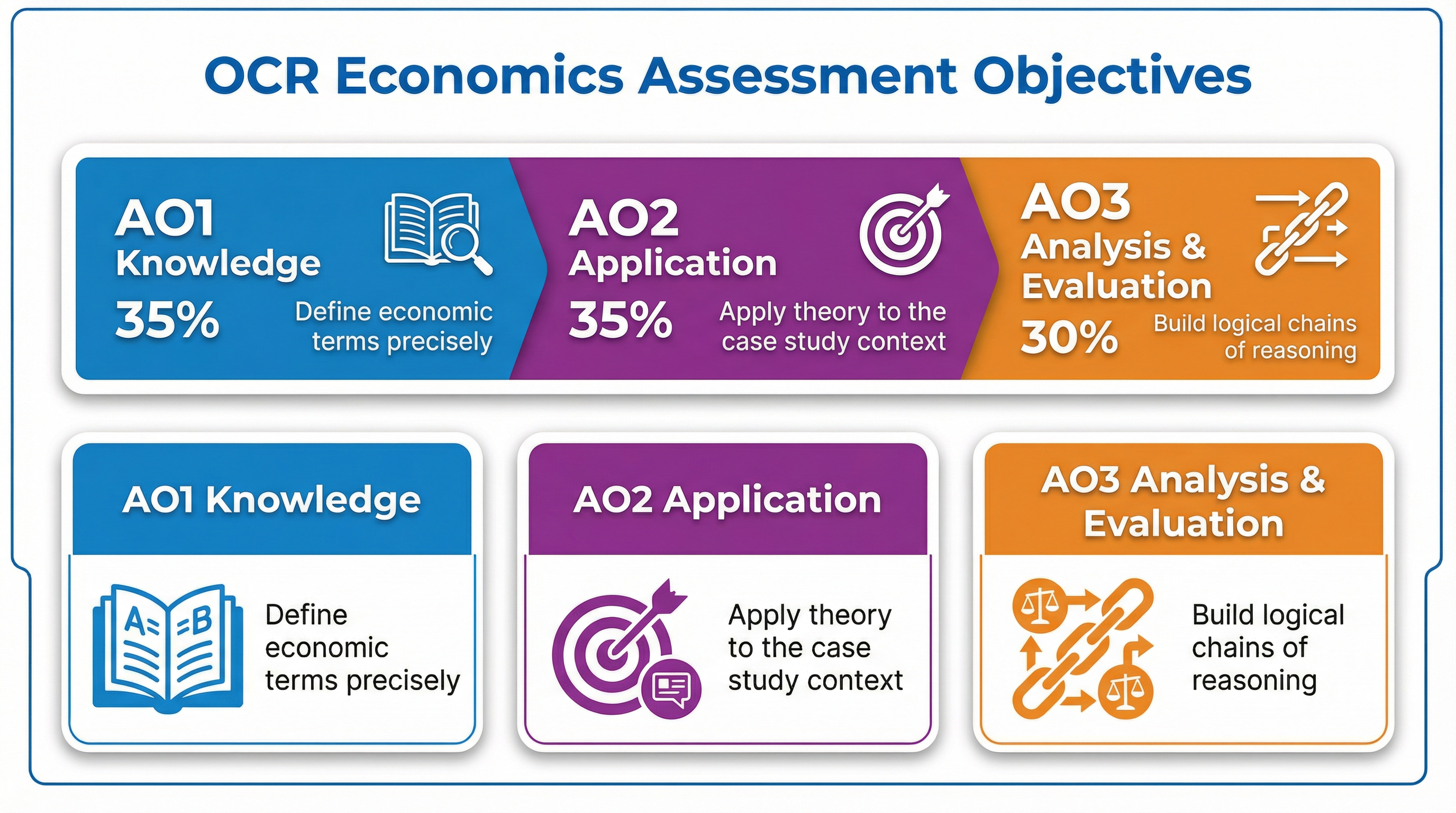
Welcome to your guide on mastering structured answers and essays in OCR GCSE Economics (J205). This is not just about knowing the content; it is about communicating that knowledge effectively under exam pressure. Examiners are looking for three key skills: precise knowledge (AO1), contextual application (AO2), and logical analysis and evaluation (AO3). This guide will deconstruct these requirements, providing you with the frameworks and techniques needed to build high-tariff responses. We will explore how to integrate case study data, develop sustained chains of reasoning using the 'BLT' method, and construct balanced judgements that secure the highest marks. By focusing on these core skills, you will learn to think and write like an economist, moving beyond simple statements to deliver the nuanced, evidence-based arguments that are essential for success.
Deconstructing the Assessment Objectives
Understanding the Assessment Objectives (AOs) is the single most important step to improving your marks. They are the rules of the game, and your answers are scored against them directly. Think of your total mark as a combination of points awarded across the three AOs.
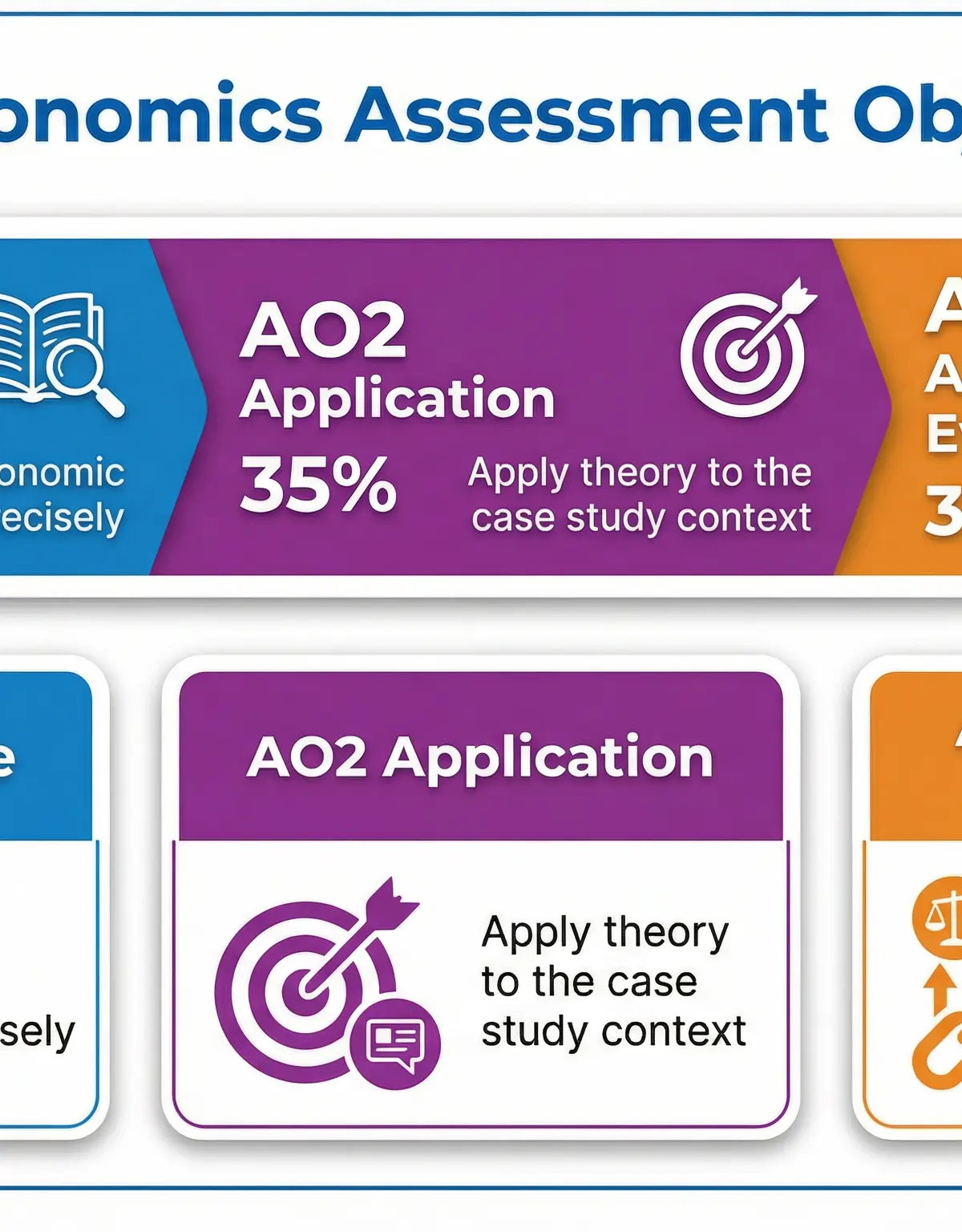
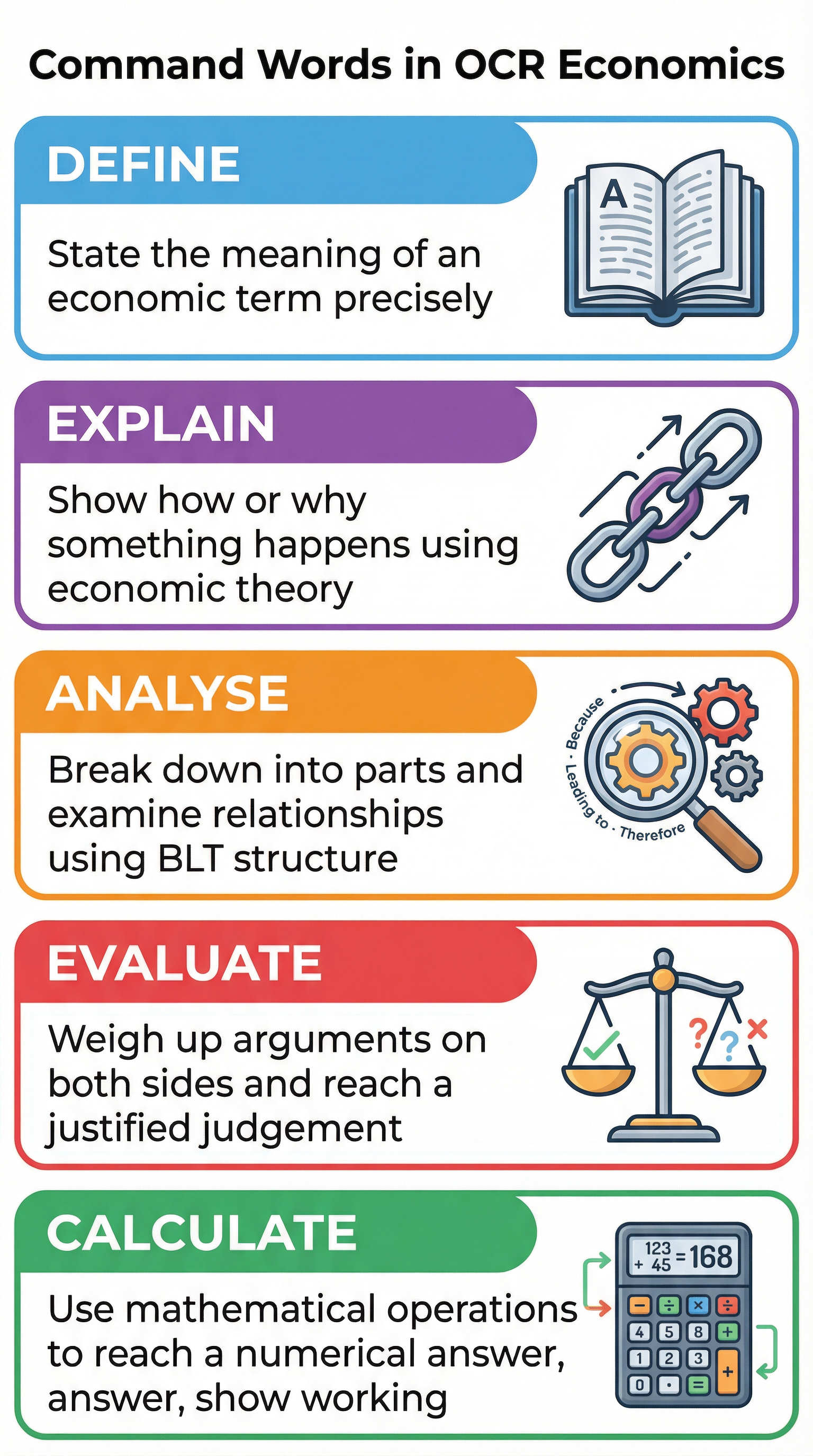
AO1: Knowledge and Understanding (35%)
What it is: This is about demonstrating your understanding of economic concepts, terms, and theories.
How to show it: Start high-tariff answers with a precise definition. For example, if a question is about productivity, begin with: "Productivity is defined as the output per unit of input (e.g., per worker) over a period of time." This immediately signals to the examiner that you have the foundational knowledge.
Examiner Tip: Credit is given for accurate definitions. Do not waste time with long introductions; a sharp, one-sentence definition is perfect.
AO2: Application (35%)
What it is: This involves applying your economic knowledge to the specific context provided in the case study.
How to show it: This is where you must use the information given to you. If the case study mentions that a firm’s revenue increased from £2m to £2.5m, you must use those numbers. Instead of saying "the firm's revenue grew," write "the firm's revenue grew by £500,000." Name the business or country in the question. This is the difference between a generic, Level 2 response and a specific, Level 3 or 4 response.
Examiner Tip: Candidates who do not reference the context cannot achieve high marks. The case study is not just background reading; it is the core of your answer.
AO3: Analysis and Evaluation (30%)
What it is: This is the skill of developing logical arguments and making justified judgements.
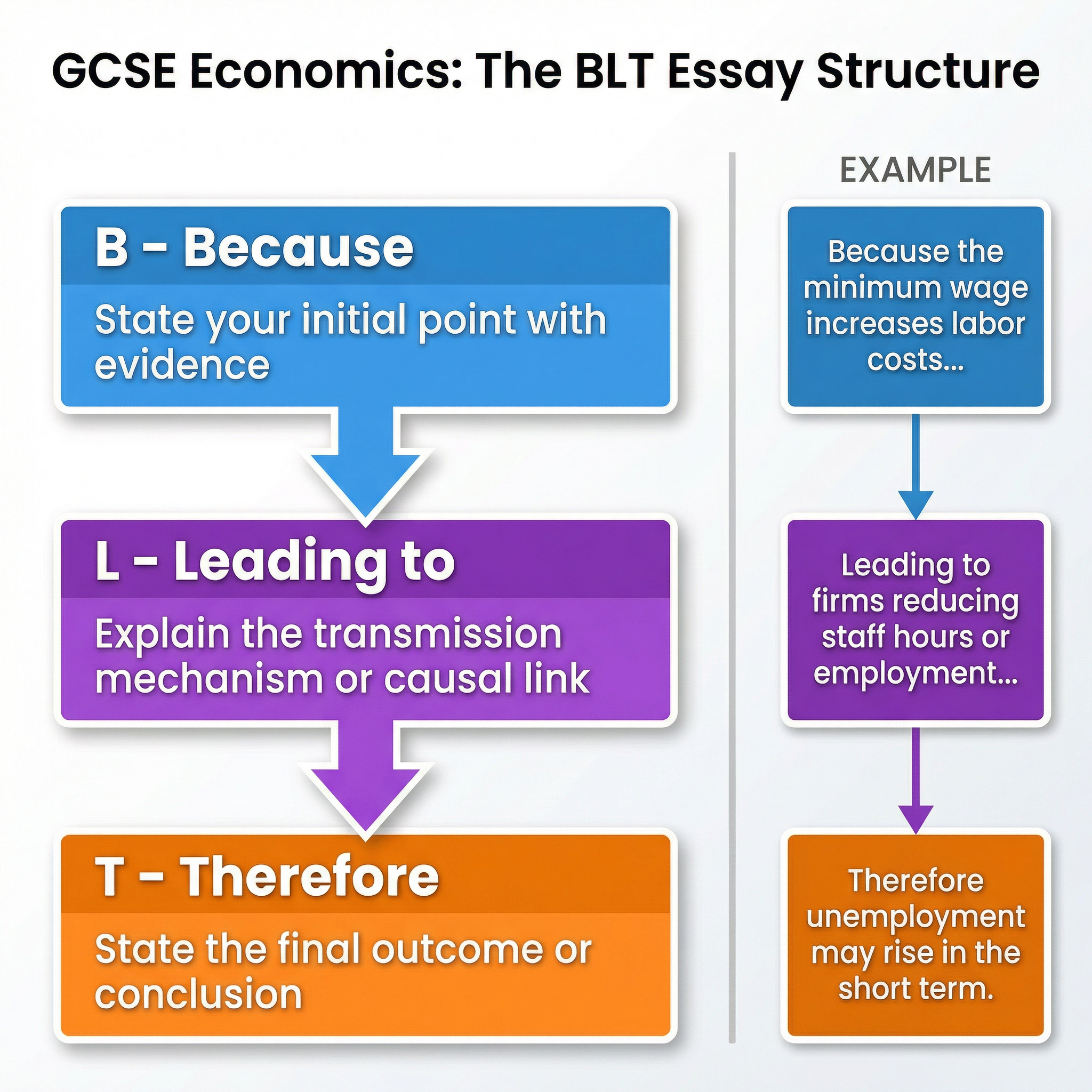
Analysis: This requires you to explain the transmission mechanisms – the step-by-step process of how one economic event leads to another. The best tool for this is the BLT structure.
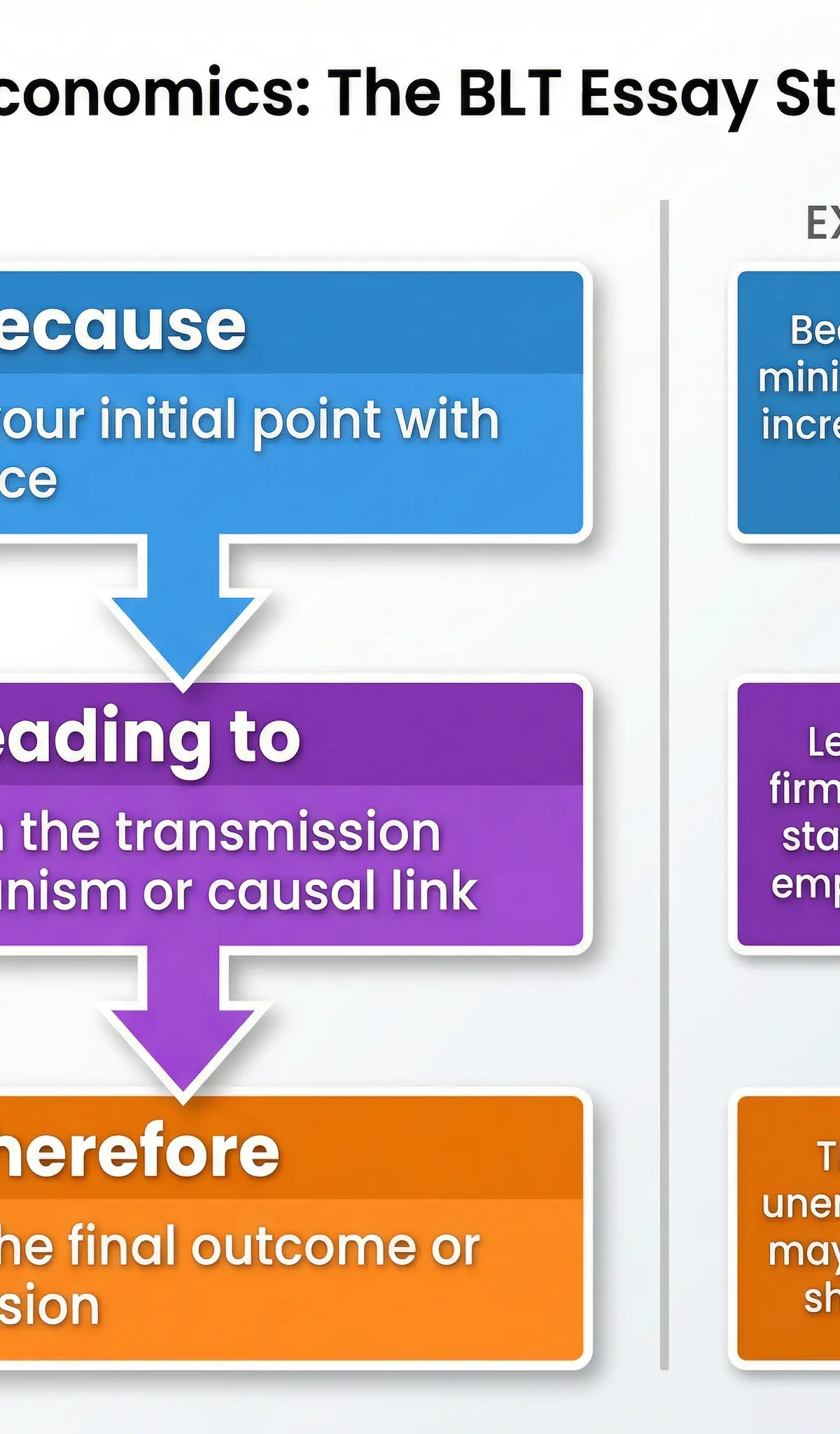
Evaluation: This is required for the highest-mark questions (e.g., 12 marks). You must weigh up both sides of an argument (e.g., costs and benefits, pros and cons) and come to a supported conclusion. Consider different stakeholder perspectives (consumers, firms, government) and timeframes (short-run vs. long-run).
Examiner Tip: A conclusion must be a judgement, not a summary. For example: "In conclusion, while the introduction of a minimum wage may cause some unemployment in the short run, the long-term benefits of reduced poverty are likely to be more significant." This shows you have weighed the evidence and made a decision.
Visual Resources
3 diagrams and illustrations
Interactive Diagrams
1 interactive diagram to visualise key concepts
Conceptual Flow Outline
Flowchart showing the potential consequences of a minimum wage increase.
Worked Examples
3 worked examples — open one to explore the question and available guidance.
Practice Questions
Test your understanding — click to reveal model answers
Analyse how a decrease in interest rates could affect car manufacturers in the UK. (6 marks)
Hint: Think about the impact on both consumers buying cars and the manufacturers themselves. Provide two distinct points.
Evaluate whether the UK government should subsidise electric car manufacturers. (12 marks)
Hint: This is an evaluation question. You need to consider arguments FOR and AGAINST the subsidy, and then make a final, justified judgement.
Define 'opportunity cost'. (2 marks)
Hint: What is the 'next best' thing?
Analyse how the appreciation of the pound sterling (£) against the euro (€) could affect a UK business that exports furniture to France. (6 marks)
Hint: Use the SPICEE mnemonic. What happens to the price of UK exports when the pound gets stronger?
Explain two potential benefits of specialisation for a business. (4 marks)
Hint: Think about efficiency and cost.