
Study Notes

Overview
Welcome to your deep dive into evaluating the effectiveness of writing for Edexcel GCSE English Language. This skill, assessed in Paper 1, Question 4, is your opportunity to demonstrate sophisticated critical thinking. It requires you to respond to a statement about a text and judge 'to what extent' you agree with it. This isn't about simply identifying language features; it's about weighing up how successful the writer has been in achieving a particular effect on the reader. Marks are awarded for a sustained, personal, and critical evaluation, supported by judicious textual evidence.
Reading Skills
Identifying Information & Ideas
To evaluate a text, you first need to understand it. This means locating both explicit information (what is directly stated) and implicit information (what is suggested or implied). In an unseen text, quickly grasping the writer's main ideas and the overall tone is the foundation for any high-level analysis.
Analysing Language
Language is the writer's toolkit. To evaluate its effectiveness, you must be able to identify specific features and, crucially, analyse their impact on the reader. Examiners credit candidates who can move beyond 'feature-spotting' to a nuanced explanation of why a writer's choice is effective.
Key Language Features to Identify
| Feature | Definition | Effect on Reader | Example |
|---|---|---|---|
| Metaphor | A figure of speech where a word or phrase is applied to an object or action to which it is not literally applicable. | Creates a powerful, often complex image in the reader's mind, adding layers of meaning. | 'The classroom was a zoo.' |
| Simile | A figure of speech involving the comparison of one thing with another thing of a different kind, used to make a description more emphatic or vivid. | Makes an abstract idea more concrete and relatable for the reader by linking it to a familiar image. | 'He was as brave as a lion.' |
| Pathetic Fallacy | The attribution of human feelings and responses to inanimate things or animals, especially in nature. | The weather or environment reflects the mood of the characters or the scene, intensifying the atmosphere. | 'The angry clouds gathered overhead.' |
| Personification | The attribution of a personal nature or human characteristics to something non-human. | Brings an inanimate object to life, allowing the reader to connect with it on an emotional level. | 'The wind whispered through the trees.' |
| Alliteration | The occurrence of the same letter or sound at the beginning of adjacent or closely connected words. | Can create a specific sound effect (e.g., harsh or soft) to influence the tone, or make a phrase more memorable. | 'The slippery snake slithered silently.' |
| Sibilance | A specific type of alliteration involving the repetition of soft consonant sounds like 's' or 'sh'. | Often creates a sinister, soft, or soothing sound, depending on the context. | 'The sea hissed and sighed on the shore.' |
| Juxtaposition | The fact of two things being seen or placed close together with contrasting effect. | Highlights the differences between two ideas or characters, often to create tension or irony. | Placing a description of extreme poverty next to one of lavish wealth. |
Analysing Structure
Structure is the writer's blueprint. It's how they organise and shape the text to guide the reader's journey. Analysing structure involves looking at the bigger picture: the beginning, the middle, and the end, and how they connect.
- Openings: How does the writer hook the reader from the very first sentence?
- Shifts in Focus: Where does the narrative perspective change? Is there a shift from a wide view to a close-up? From one character to another?
- Narrative Perspective: Is it first-person (I), third-person limited (he/she knows one character's thoughts), or third-person omniscient (he/she knows everyone's thoughts)? How does this choice affect what the reader knows?
- Sentence Length Variation: How does the writer use a mix of long, complex sentences and short, simple ones to control the pace and create tension or reflection?
- Paragraph Structure: Are paragraphs long and descriptive, or short and punchy? How does this contribute to the overall effect?
- Cyclical Structure: Does the text end where it began? If so, what has changed or been revealed in between?
- Flashback/Foreshadowing: How does the writer play with time to build suspense or provide context?
Evaluating Critically
This is the core skill for Question 4. It's about forming and expressing a well-supported opinion on the writer's methods. Use the following framework to build your argument:
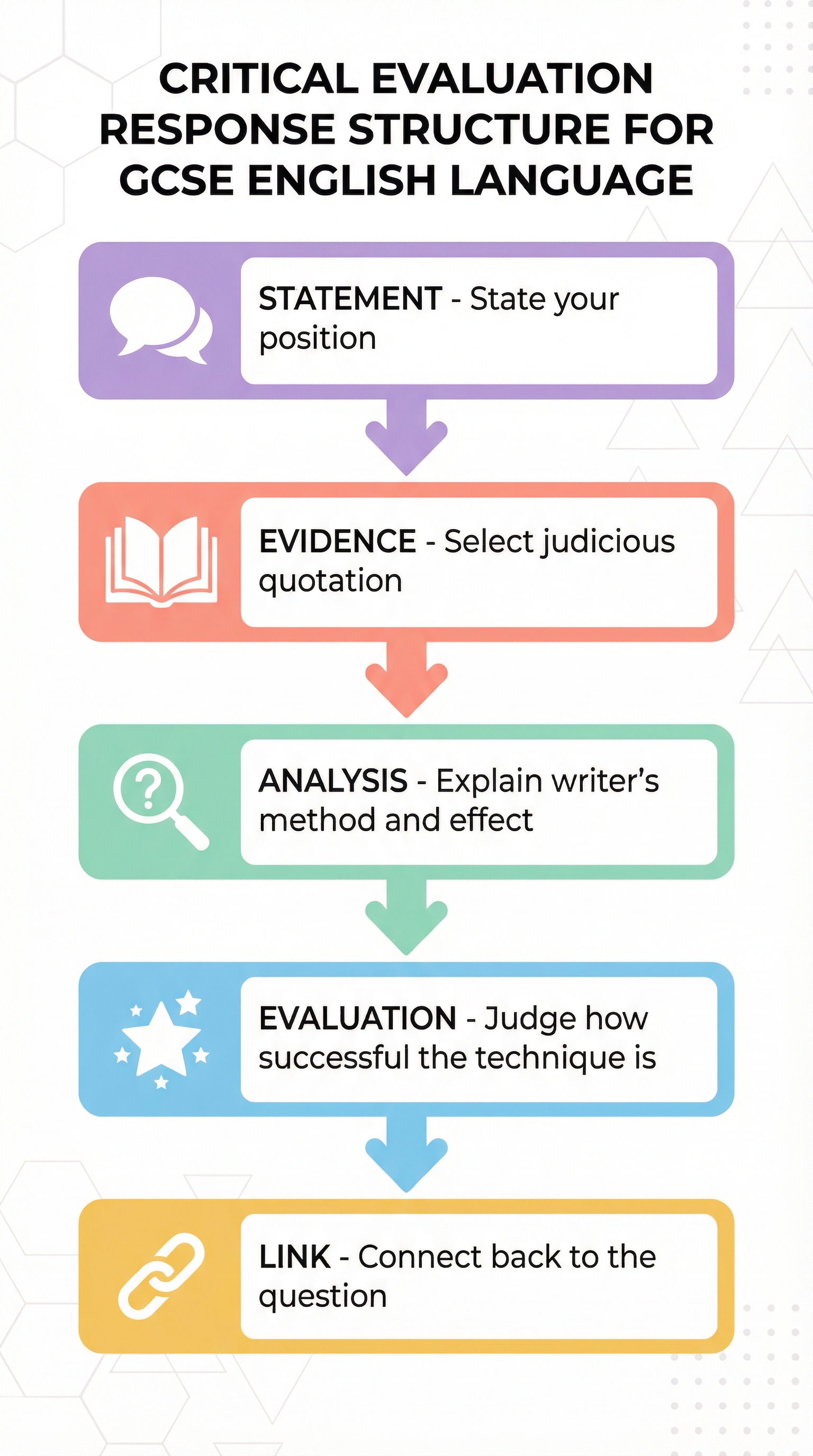
- Statement: Begin with your thesis. To what extent do you agree with the statement in the question?
- Evidence: Select a short, powerful quotation that directly supports your point.
- Analysis: Explain how the writer's language or structural choice works to create an effect.
- Evaluation: Judge how successful that choice is. Use evaluative adverbs like 'highly effective', 'subtly creates', or 'powerfully conveys'.
- Link: Circle back to the original statement to reinforce your argument.
Comparing Writers' Viewpoints
While not the focus of Q4, comparison is a key skill for Paper 2. The principles of evaluation are the same. When comparing, you must:
- Identify Viewpoints: What is each writer's perspective on the topic?
- Compare Methods: How do they use language and structure differently to convey their ideas?
- Evaluate Effectiveness: Who is more successful, and why? This evaluative element is what separates a good comparison from a simple list of similarities and differences.
Writing Skills
Creative Writing
For the creative writing task (Paper 1, Question 5), you need to demonstrate your own writing craft. Examiners want to see that you can apply the same techniques you analyse in the reading section.
- Show, Don't Tell: Instead of telling the reader a character is nervous, show them: 'His hands trembled as he reached for the glass.'
- Sensory Description: Engage all five senses—sight, sound, smell, touch, and taste—to create a vivid and immersive world.
- Varied Sentence Structures: Use a mix of simple, compound, and complex sentences to create rhythm and pace.
- Engaging Openings: Hook your reader from the first line.
- Satisfying Endings: Provide a sense of closure, perhaps by linking back to the opening.
- One-Scene Rule: For a short story, it's often most effective to focus on a single, dramatic moment in time rather than a long, complex plot.
Transactional/Non-Fiction Writing
For Paper 2, Question 5, you will be asked to write a non-fiction text for a specific purpose, audience, and form (e.g., a letter, article, speech, or leaflet).
- Purpose-Form-Audience (PFA): Always keep these three elements in mind. The purpose (e.g., to persuade, to argue, to advise) will determine your tone and techniques. The form dictates the layout and conventions. The audience determines your level of formality and vocabulary.
- AFOREST Persuasive Techniques: Use this acronym to remember key persuasive devices: Alliteration, Facts, Opinions, Rhetorical questions, Emotive language, Statistics, Three (rule of).
Technical Accuracy (SPaG)
Spelling, Punctuation, and Grammar (SPaG) are worth a significant number of marks in the writing tasks. Accuracy matters.
- Ambitious Punctuation: To hit the top bands, you need to use a variety of punctuation correctly. This includes semicolons (to link two closely related independent clauses), colons (to introduce a list or explanation), dashes (for emphasis or interruption), and parenthetical commas (to add extra information).
- Paragraph Cohesion: Use discourse markers (e.g., 'Furthermore', 'In contrast', 'As a result') to link your paragraphs and create a logical flow of ideas.