OCR · GCSE · English Language
Structuring a presentation effectively
This guide focuses on structuring a presentation effectively for OCR GCSE English Language (Component 02, Section B). It breaks down the key skills of organisation (AO5) and technical accuracy (AO6) needed to achieve top marks by crafting a cohesive, convincing, and rhetorically powerful speech.
- 4 min read
- 3 worked examples
- 5 practice questions
- 8 key terms
Study Notes

Overview
In OCR GCSE English Language Component 02, Section B, candidates are often tasked with writing the text for a presentation or speech. This task is a direct assessment of your ability to organise content persuasively (AO5) and use language with precision and flair (AO6). Unlike an essay, a presentation must be crafted for the ear; it requires a convincing voice, a clear structure, and a register that is both authoritative and engaging. Examiners are looking for a sophisticated control of text structure, moving beyond simple, formulaic approaches to demonstrate a sustained and developed line of reasoning.
This guide will equip you with the skills to deconstruct the task, plan a high-level response, and execute it with confidence. We will cover the essential four-part structure, the use of sophisticated discourse markers, and the rhetorical devices that elevate your writing from competent to compelling.
Writing Skills for Presentation
The core of a successful presentation lies in its structure. A well-organised speech guides the audience effortlessly from one point to the next, building a convincing argument that culminates in a powerful conclusion.
The Four-Part Structure
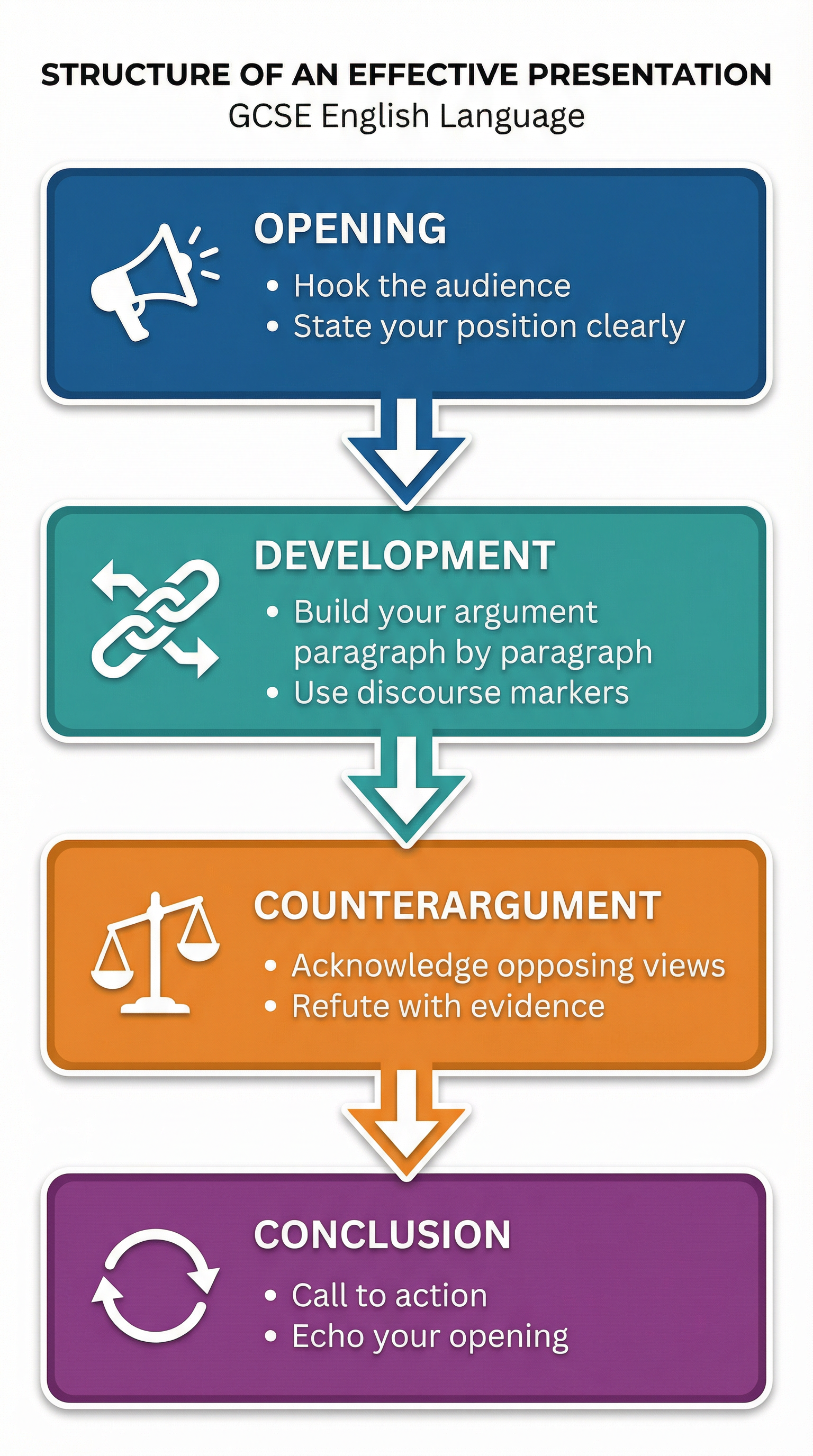
Examiners reward candidates who demonstrate a clear and logical structure. A highly effective model is the four-part structure, which ensures your argument is balanced, comprehensive, and persuasive.
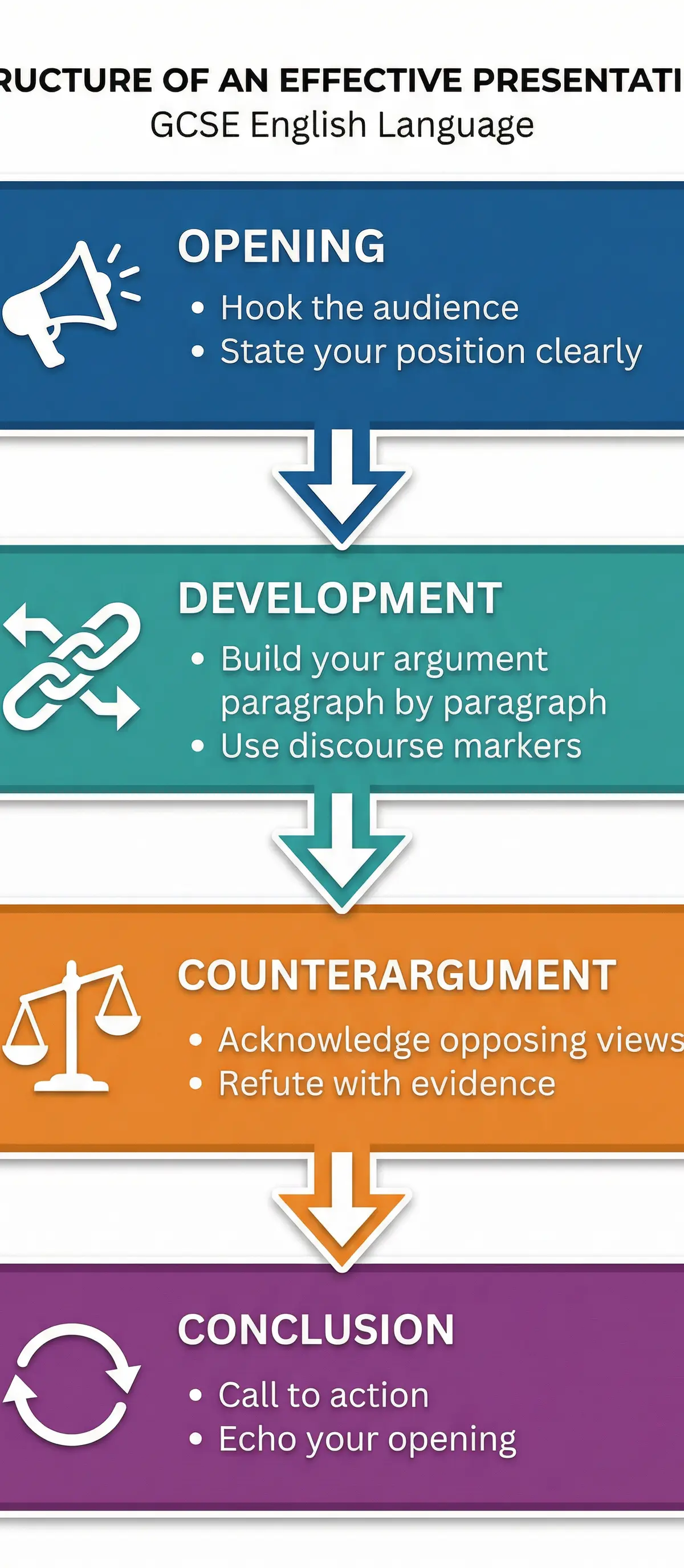
| Stage | Purpose | Key Techniques |
|---|---|---|
| 1. Opening | To grab the audience's attention and establish your core message. | - Rhetorical Question<br>- Bold declarative statement<br>- Surprising statistic or fact |
| 2. Development | To build your argument with evidence and well-sequenced points. | - Topic sentences for each paragraph<br>- Embedded evidence<br>- Varied sentence structures |
| 3. Counter-Argument | To show sophisticated thinking by acknowledging and refuting opposing views. | - Use phrases like "Some may argue..." |
- Immediately pivot with "However..." or "Nevertheless..." |
| 4. Conclusion | To leave a lasting impact and reinforce your message. | - Cyclical structure (echoing the opening)<br>- A clear 'Call to Action'<br>- Memorable final sentence |
Mastering Discourse Markers
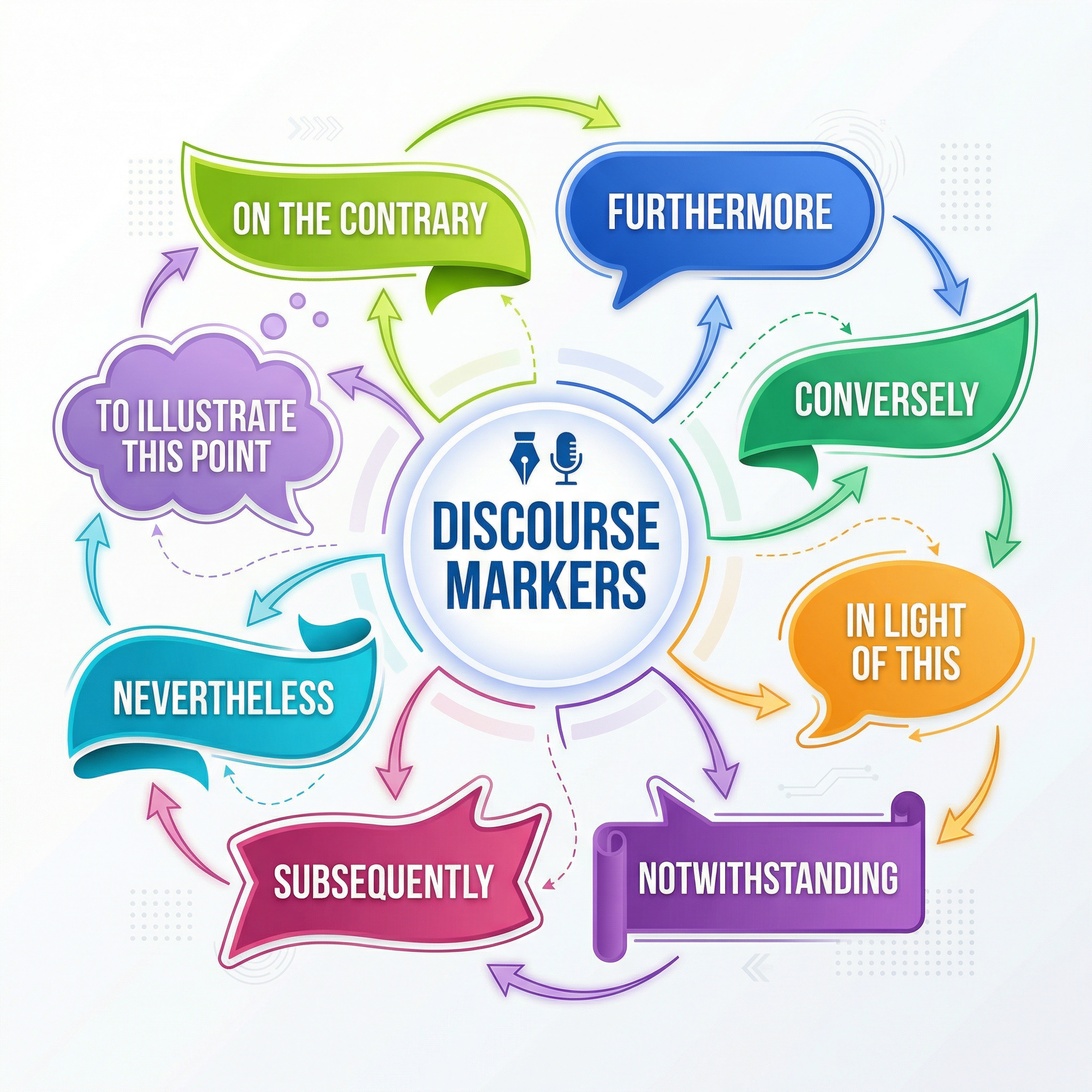
Discourse markers are the signposts of your argument. They create cohesion and guide the examiner through your line of reasoning. Instead of relying on basic connectives like 'Firstly' or 'Secondly', aim for more sophisticated and varied language.

Credit is given for integrated discourse markers that manage the overall cohesion of the argument seamlessly. This means choosing the right tool for the job:
- To Add an Idea: Furthermore, Moreover, In addition, In light of this...
- To Show Contrast: Conversely, Nevertheless, Notwithstanding, On the contrary...
- To Illustrate: For instance, To illustrate this point, A clear example is...
- To Conclude: In conclusion, To summarise, Ultimately...
Technical Accuracy (SPaG) for Impact
AO6 is not just about avoiding errors; it's about using punctuation and sentence structures deliberately to create rhetorical impact. Examiners will assess the deliberate manipulation of sentence length. A short, punchy sentence following a long, complex one can be incredibly effective for emphasis. Similarly, using ambitious punctuation like semi-colons to link closely related ideas, or a colon to introduce an explanation, demonstrates a high level of technical control.
Visual Resources
2 diagrams and illustrations
Interactive Diagrams
2 interactive diagrams to visualise key concepts
Conceptual Flow Outline
Flowchart for Planning and Writing a Presentation
Conceptual Flow Outline
Comparison of Structural Features by Mark Band
Worked Examples
3 worked examples — open one to explore the question and available guidance.
Practice Questions
Test your understanding — click to reveal model answers
Identify three different discourse markers you could use to introduce a counter-argument.
Hint: Think about words that signal a change in direction or an opposing view.
Rewrite the following sentence to correct the comma splice: 'The plan is risky, it might not work.'
Hint: You can use a full stop, a semi-colon, or a conjunction.
Write a single paragraph for a speech arguing that school holidays should be shorter. Include a topic sentence and a short, emphatic sentence for effect.
Hint: Start with a clear point, then develop it. End the paragraph with a short sentence to make your point memorable.
Plan a four-part structure for a presentation arguing that 'Voting should be made compulsory for all citizens over 18.'
Hint: Use the Opening, Development, Counter-Argument, Conclusion framework. Think about your hook and call to action.
Write the full text of a short, powerful conclusion for the presentation on compulsory voting. It must be cyclical and include a call to action.
Hint: Look back at the model answer for the previous question. Your conclusion should echo the opening about low voter turnout.
Test your understanding of Structuring a presentation effectively
Active recall beats re-reading. Take an instant quiz now to test what you’ve learned and lock it into long-term memory.
7 days Premium · Then free forever · No card, no charge