
Study Notes
Overview
In the WJEC GCSE English Language examination, Unit 3, titled 'Argumentation and Persuasion,' requires candidates to demonstrate their ability to write in a variety of forms. A common task is to write a speech or a formal presentation. Although this is a written task, the goal is to create a piece of text that is crafted to be spoken. Examiners are looking for a sustained, convincing, and appropriate tone that demonstrates a clear understanding of the specified audience and purpose. This skill is primarily assessed through two Assessment Objectives: AO5 (Communicate clearly, effectively and imaginatively, selecting and adapting tone, style and register for different forms, purposes and audiences) and AO6 (Use a range of vocabulary and sentence structures for clarity, purpose and effect, with accurate spelling and punctuation). This guide will equip you with the skills and techniques needed to excel in this task.
Writing Skills for Formal Presentations
Mastering Tone, Style, and Register (AO5)
AO5 is worth 60% of the marks for this task, making it the most important element to master. It is all about adapting your writing to fit the specific context given in the question. The key is the TAP strategy: Type, Audience, and Purpose.
- Type: What are you being asked to write? A speech for a school assembly? A formal presentation to governors? A talk for a local community group? The format dictates the conventions you must follow.
- Audience: Who are you addressing? Your language, tone, and even the examples you use must be tailored to them. Speaking to peers allows for a more informal and relatable tone, whereas addressing a board of governors requires a formal, respectful, and professional register.
- Purpose: What is the goal of your presentation? Are you arguing for a change, persuading your audience to adopt a viewpoint, or informing them about a specific issue? Your purpose will determine the rhetorical strategies you employ.
Using Rhetorical Devices for Effect
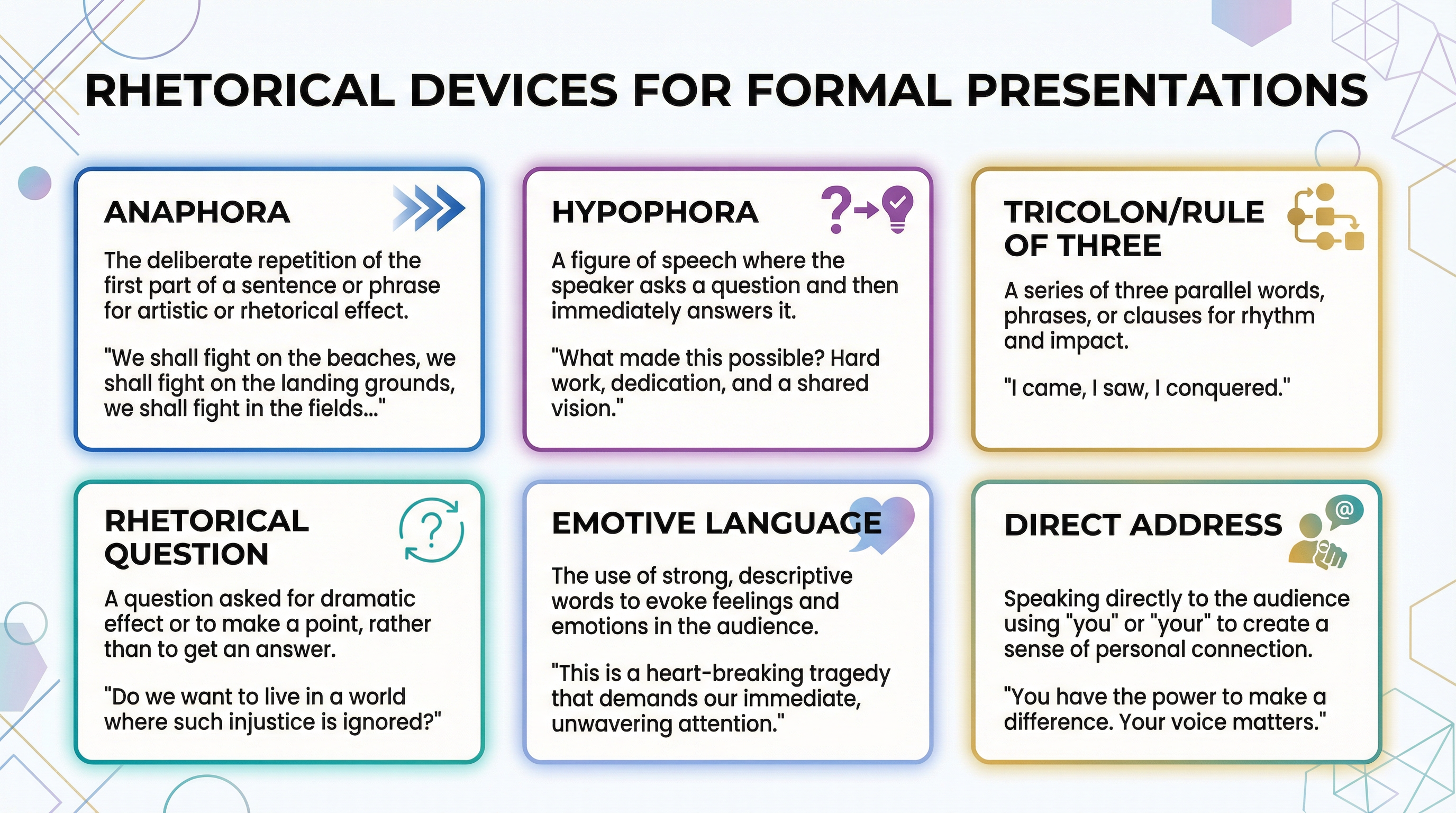
To achieve the higher bands for AO5, candidates must use a range of sophisticated rhetorical devices. These are the tools that make your writing persuasive and engaging. Here are some of the most effective devices to include:
| Feature | Definition | Effect on Audience | Example |
|---|---|---|---|
| Anaphora | The repetition of a word or phrase at the beginning of successive clauses. | Creates a powerful rhythm, builds momentum, and makes the message more memorable. | “We will not tire. We will not falter. We will not fail.” |
| Hypophora | A figure of speech in which a writer raises a question and then immediately answers it. | Engages the audience by creating curiosity and then guiding them to the writer’s intended conclusion. | “So, what is the solution? The solution lies in our collective action.” |
| Tricolon (Rule of Three) | A series of three parallel words, phrases, or clauses. | The human brain finds patterns of three satisfying and memorable, adding weight and finality to a point. | “This is a plan for the community, by the community, and with the community.” |
| Rhetorical Question | A question asked for effect rather than to elicit an answer. | Encourages the audience to think and agree with the speaker’s foregone conclusion. | “Can we really afford to ignore this problem any longer?” |
| Emotive Language | The use of words that are chosen to create an emotional response in the reader. | Fosters a connection with the audience, making the argument more personal and persuasive. | “This is a heart-breaking situation that demands our immediate attention.” |
| Direct Address | Speaking directly to the audience using pronouns like ‘you’ and ‘we’. | Creates a personal connection and a sense of shared responsibility or identity. | “You have the power to make a change. Your voice matters.” |
Structuring Your Presentation
A well-structured presentation is crucial for clarity and impact. Examiners award marks for structural control. Avoid simplistic structures like 'Firstly... Secondly... Thirdly...'. Instead, use sophisticated discourse markers to signpost your argument and create a logical flow.
- Opening: Start with a strong hook to grab the audience's attention. This could be a startling statistic, a rhetorical question, or a powerful statement.
- Development: Build your argument with clear, well-developed points. Each paragraph should focus on a single idea.
- Counter-Argument and Rebuttal: To reach the highest marks, you must show that you have considered other viewpoints. Introduce a counter-argument and then systematically dismantle it. This demonstrates intellectual rigour and strengthens your own position.
- Conclusion: End with a powerful and memorable summary of your key message. Reiterate your main points and leave the audience with a clear call to action or a thought-provoking final statement.
Technical Accuracy (AO6)
AO6 accounts for 40% of the marks and assesses your spelling, punctuation, and grammar (SPaG). To score highly, you must demonstrate control and ambition in your writing.
- Varied Sentence Structures: Avoid starting every sentence in the same way. Use a mix of simple, compound, and complex sentences. Start sentences with adverbs, subordinate clauses, or prepositional phrases to create a more sophisticated style.
- Ambitious Punctuation: Go beyond full stops and commas. Correctly use semicolons to link closely related independent clauses, colons to introduce lists or explanations, and dashes for emphasis or to add extra information.
- Paragraphing: Use paragraphs to structure your argument. Each new idea should begin a new paragraph. Use cohesive devices (discourse markers) to link your paragraphs together smoothly.
- Common Errors to Avoid: The most common error that limits candidates' marks is the comma splice. This is where two independent clauses are joined only by a comma. For example: 'The situation is urgent, we must act now.' This is incorrect. You must use a semicolon, a conjunction (like 'and' or 'but'), or a full stop to separate the clauses. Examiners are instructed to cap marks for AO6 at Band 2 or 3 if comma splicing is present.