Eduqas · GCSE · English Language
Course version: C700QS · Version from Mar 2026
Read a wide range of texts, fluently and with good understanding
Full specification wording
Introduction - Aims and objectives: read a wide range of texts, fluently and with good understanding
This aim describes the reading habit the course builds: you read widely, decode accurately and comprehend what a text is doing.
Checked against the Eduqas C700QS specification (opens in a new tab) on .
- Point 1 of 6
- 4 key terms
Study notes
From the checked teaching notes for this specification point.
The idea
This aim describes the reading habit the course builds: you read widely, decode accurately and comprehend what a text is doing. 'Wide range' means fiction and non-fiction, literary and transactional, print and digital, from different periods and voices. 'Fluently' means reading at a pace that keeps meaning intact, adjusting speed for dense or unfamiliar material. 'With good understanding' means you can follow the writer's ideas, purpose and viewpoint, and explain how language and structure create effects. In practice, build a reading log across genres, skim for gist, then re-read closely to annotate purpose, audience and technique. Assessment rewards accurate comprehension and analysis of how meaning is made, not just plot recall.
Common mistakes and how to put them right
Treating 'wide range' as reading only one genre such as novels.
Put it right: Deliberately read non-fiction, journalism, speeches and poetry too, and note the different conventions each uses.
Confusing fluency with speed.
Put it right: Fluency is accurate, expressive reading that preserves meaning, so slow down and re-read when a sentence is dense rather than racing through.
Summarising plot instead of showing understanding of purpose and effect.
Put it right: For each text, state what the writer is trying to do and identify the language or structural choice that achieves it.
Exam tips
- Keep a short reading log recording genre, purpose, audience and one technique per text so you can draw on a genuinely wide range under timed conditions.
- Practise skimming for gist in about a minute, then re-read closely to annotate, so fluency and close understanding work together.
- When analysing, always link a quoted word or phrase to its effect on the reader rather than listing features.
Try the lesson
The start of the Introduction - Aims and objectives: read a wide range of texts, fluently and with good understanding lesson, made from checked teaching notes for this specification point.
Have a go first
Read the text below.
"The local council has announced plans to build a new library in the town centre. Construction will begin next month and is expected to take a year. The current library will remain open until the new one is completed."
According to the text, what will happen to the current library while the new one is being built?
Listen
This aim describes the reading habit the course builds: you read widely, decode accurately and comprehend what a text is doing. Wide range' means fiction and non-fiction, literary and transactional, print and digital, from different periods and voices. Fluently' means reading at a pace that keeps meaning intact, adjusting speed for dense or unfamiliar material. With good understanding' means you can follow the writer's ideas, purpose and viewpoint, and explain how language and structure create effects. In practice, build a reading log across genres, skim for gist, then re-read closely to annotate purpose, audience and technique. Assessment rewards accurate comprehension and analysis of how meaning is made, not just plot recall. A common slip: Treating 'wide range' as reading only one genre such as novels. Instead, deliberately read non-fiction, journalism, speeches and poetry too, and note the different conventions each uses. Exam tip: Keep a short reading log recording genre, purpose, audience and one technique per text so you can draw on a genuinely wide range under timed conditions.
See it
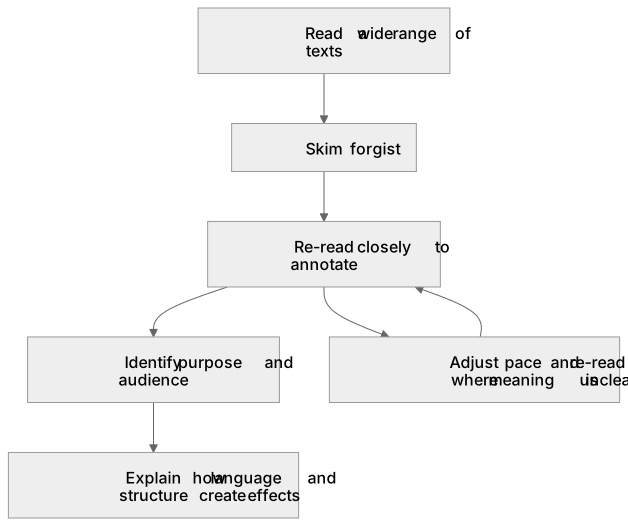
Key words
Say what each word means before you turn the card.
Wide range
Try answering aloud or in your head before turning the card.
Fluently
Try answering aloud or in your head before turning the card.
With good understanding
Try answering aloud or in your head before turning the card.
Analysis
Try answering aloud or in your head before turning the card.
See every definition
- Wide range
- Fiction and non-fiction, literary and transactional, print and digital, from different periods and voices.
- Fluently
- Reading at a pace that keeps meaning intact, adjusting speed for dense or unfamiliar material.
- With good understanding
- Following the writer's ideas, purpose and viewpoint, and explaining how language and structure create effects.
- Analysis
- Explaining how meaning is made rather than just recalling plot.
Label the diagram
Some boxes have lost their names. Pick the right name for each number.
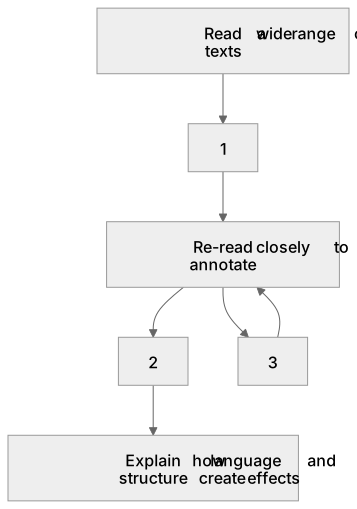
1Box 1
2Box 2
3Box 3
There is more to this lesson
The full lesson goes on to check your understanding and help you earn the marks. Create a free account to carry on, with your progress saved.
A week of Premium from your first lesson · Then the free plan continues · No card, no charge
Test your understanding of Introduction - Aims and objectives: read a wide range of texts, fluently and with good understanding
Active recall beats re-reading. Take an instant quiz now to test what you’ve learned and lock it into long-term memory.
A week of Premium from your first lesson · Then the free plan continues · No card, no charge