Eduqas · GCSE · English Language
Writing
This study guide focuses on mastering the critical writing and reading skills required for GCSE English Language. It provides actionable frameworks, examiner insights, and multi-modal resources to help candidates secure top marks in both creative and transactional writing tasks.
- 6 min read
- 3 worked examples
- 5 practice questions
- 8 key terms
Study Notes
Overview
GCSE English Language is fundamentally a test of skills, not memory. Unlike Literature, you are not assessed on your knowledge of set texts, characters, or themes. Instead, you are evaluated on your ability to read unseen texts critically and to write with purpose, clarity, and imagination. This guide will walk you through the essential frameworks and techniques needed to maximize your marks in both the Reading and Writing components.
Listen to our comprehensive revision podcast for an in-depth discussion on these skills:
Reading Skills
Identifying Information & Ideas
The foundation of the reading paper is your ability to locate explicit and implicit information in unseen fiction and non-fiction texts.
- Explicit information is directly stated in the text.
- Implicit information requires you to read between the lines and infer meaning.
When asked to identify or list information, keep your answers brief and focused. Do not waste time writing lengthy paragraphs for low-tariff questions.
Analysing Language
When examiners ask "How does the writer use language?", they are looking for your ability to identify techniques, select judicious quotations, and, most importantly, analyse the effect on the reader. Avoid simply "feature-spotting" without explaining the impact.
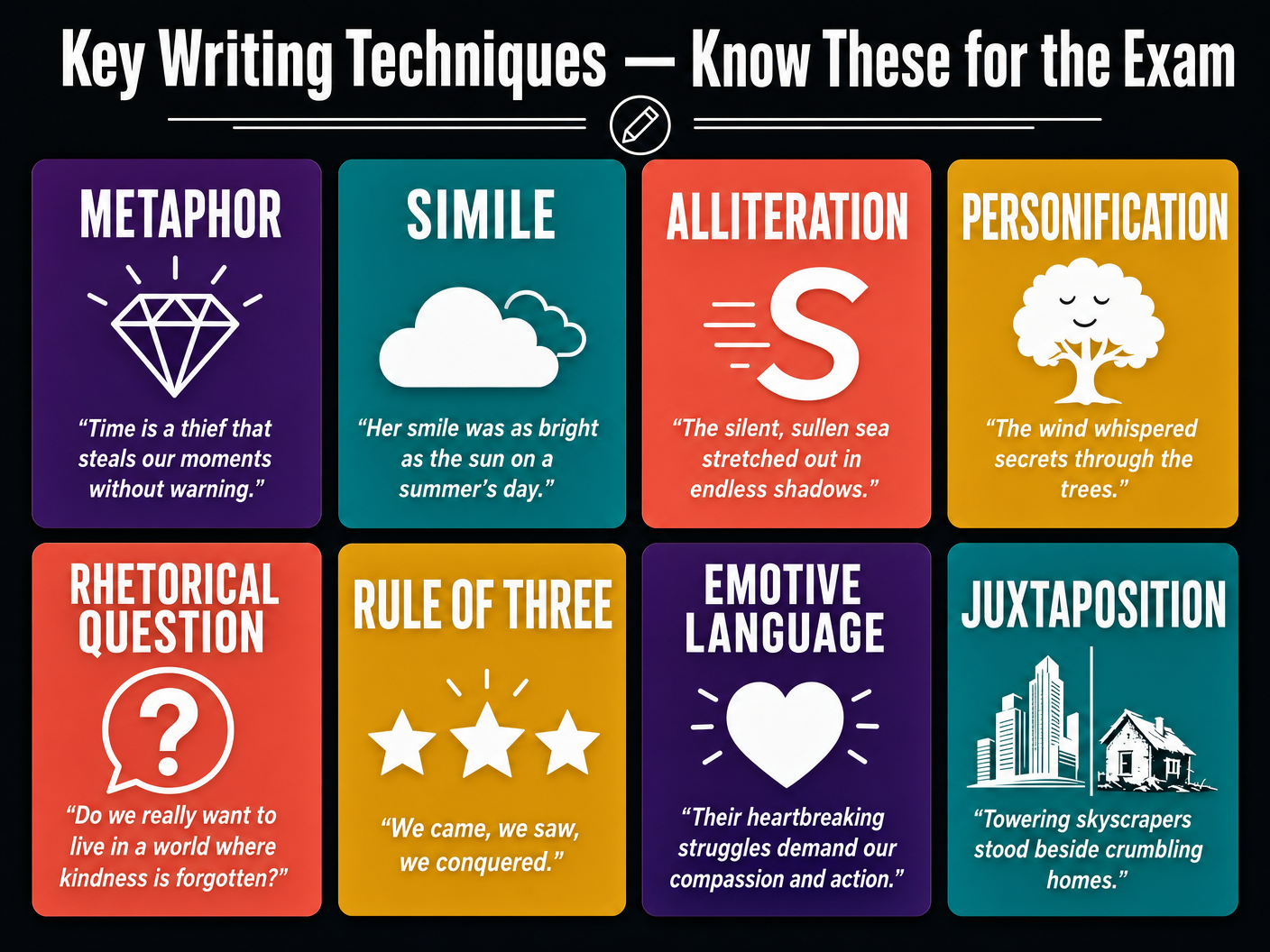
Key Language Features to Identify
| Feature | Definition | Effect on Reader | Example |
|---|---|---|---|
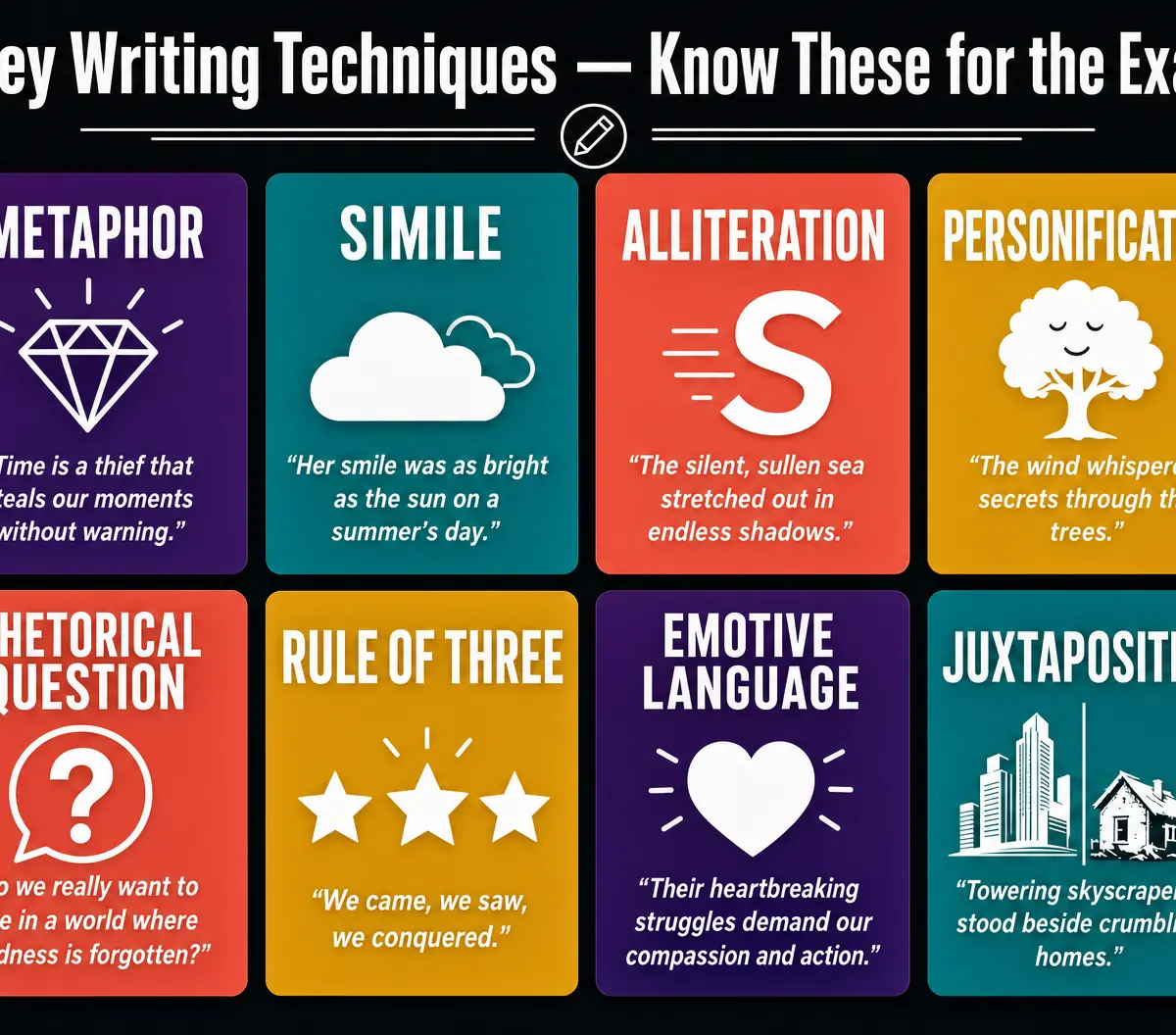
| Metaphor | Describing something as if it is something else. | Creates vivid imagery and helps the reader understand complex ideas through comparison. | "The city was a machine that chewed people up." |
| Simile | Comparing two things using 'like' or 'as'. | Enhances description by drawing a clear, relatable parallel. | "Her smile was as bright as the sun." |
| Personification | Giving human qualities to non-human things. | Brings the inanimate to life, often creating a specific mood or atmosphere. | "The wind whispered secrets through the trees." |
| Pathetic Fallacy | Giving human emotions to the weather or nature. | Sets the tone or reflects a character's internal emotional state. | "The sullen clouds gathered, heavy with impending doom." |
| Alliteration | Repetition of consonant sounds at the beginning of words. | Creates rhythm, emphasis, or a specific auditory effect (e.g., harshness, softness). | "The silent, sullen sea." |
| Sibilance | Repetition of 's' sounds. | Can create a sinister, hissing effect or a soft, soothing tone depending on context. | "The snake slithered silently." |
| Juxtaposition | Placing two contrasting ideas close together. | Highlights differences and creates tension or dramatic effect. | "Towering skyscrapers stood beside crumbling homes." |
Analysing Structure
Structure questions focus on how the text is put together and why the writer chose to order it that way. Look for:
- Openings: How does the text begin? Does it hook the reader?
- Shifts in Focus: Does the narrative move from the general to the specific, or from the external to the internal?
- Narrative Perspective: Is it first-person (intimate) or third-person (observational)?
- Sentence Length Variation: Short sentences create tension; long sentences can build detail or slow the pace.
- Paragraph Structure: How do the paragraphs link together? Are there sudden changes in topic?
- Cyclical Structure: Does the ending return to an idea or image from the beginning?
- Flashback/Foreshadowing: Does the writer manipulate time to build suspense or provide context?
Evaluating Critically
Evaluation questions require you to form and express an opinion about a writer's methods, supported by evidence. You are essentially arguing a case.
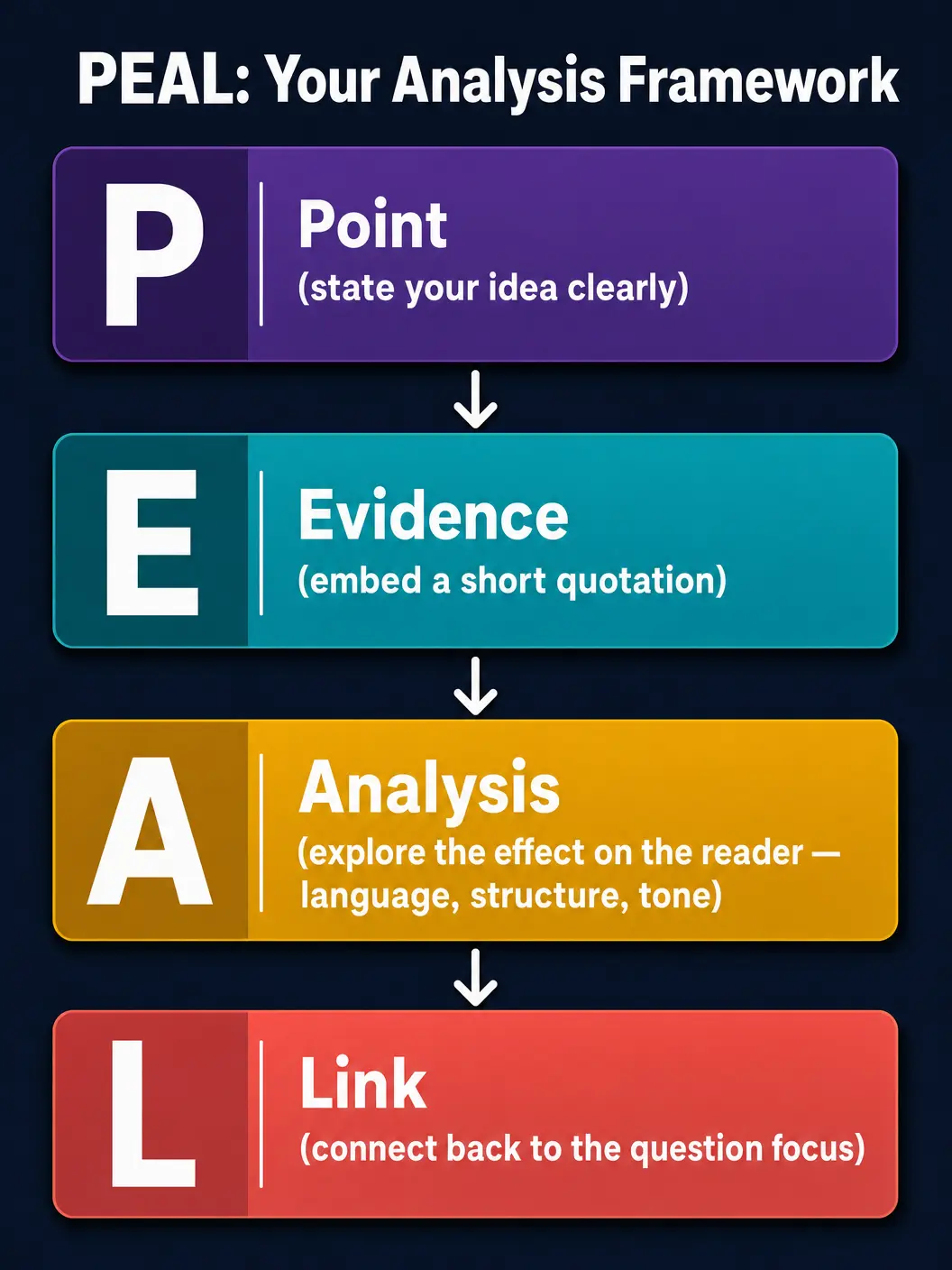
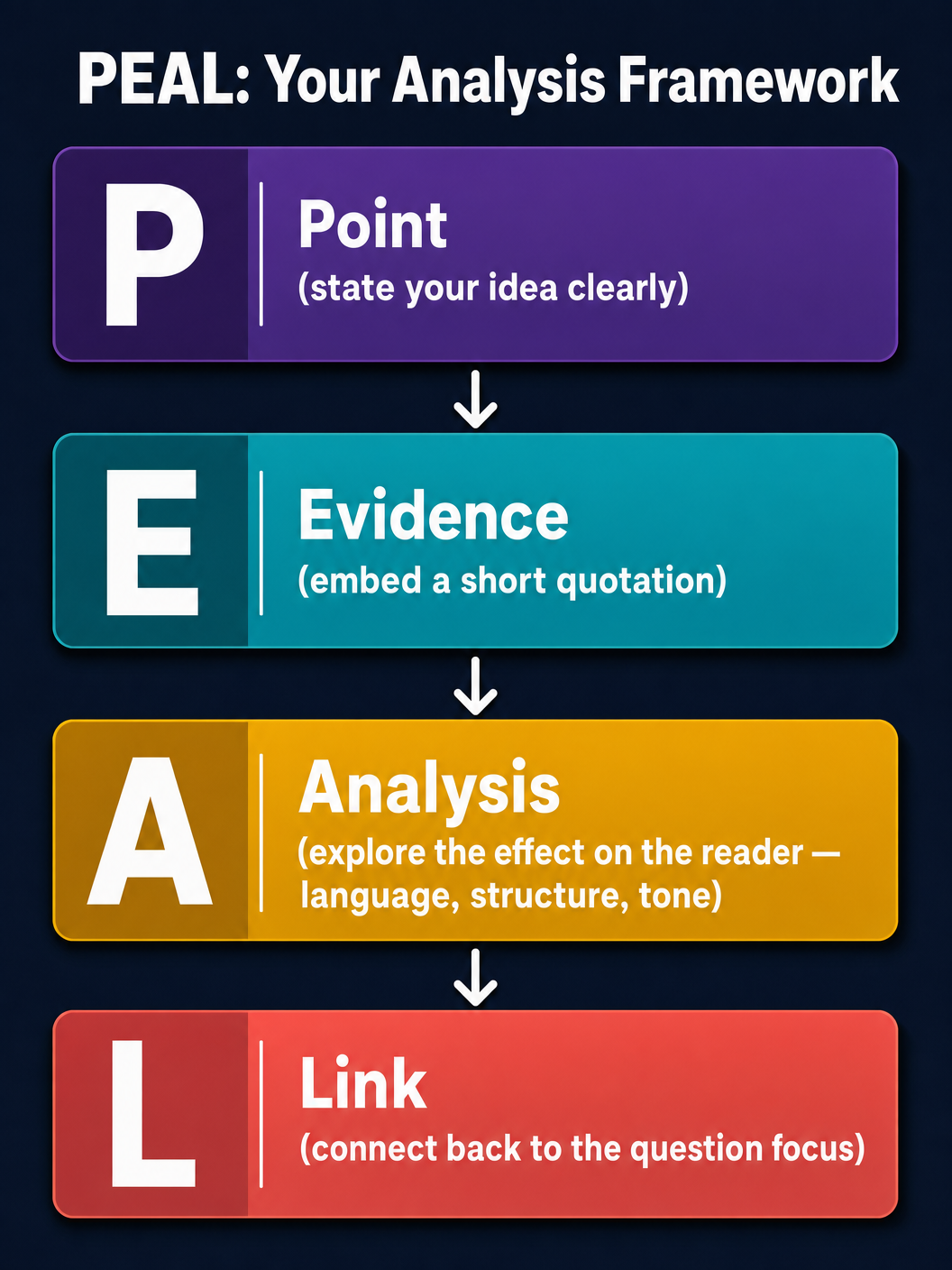
- Start with a clear statement (e.g., "To some extent, I agree that...").
- Provide evidence from the text.
- Analyse the methods the writer uses to create the effect.
- Link back to your overall evaluation.
Comparing Writers' Viewpoints
When comparing texts, use a clear framework:
- Identify Viewpoints: What does each writer think or feel about the topic?
- Compare Methods: How does each writer use language or structure to convey their viewpoint?
- Evaluate Effectiveness: Which text is more persuasive or impactful, and why?
Writing Skills
Creative Writing
Creative writing tasks usually ask for a narrative (a story) or a description. It is crucial not to confuse the two. A narrative requires a sequence of events and character development, while a description focuses on capturing a moment or atmosphere.
- Show, Don't Tell: Instead of stating an emotion, describe the physical reaction. (e.g., Instead of "He was angry," write "His jaw clenched and his knuckles turned white.")
- Sensory Description: Use sight, sound, smell, touch, and taste to create an immersive experience.
- Varied Sentence Structures: Mix short, punchy sentences for impact with longer, flowing sentences for detail.
- Engaging Openings: Start in media res (in the middle of the action) or with a striking image.
- Satisfying Endings: Avoid cliché endings like "it was all a dream." Aim for a resolution or a cyclical return to the opening.
- The One-Scene Rule: Keep your narrative focused on a single scene or a short time frame to maintain detail and control.
Transactional/Non-Fiction Writing
Transactional writing has a specific purpose (e.g., to persuade, argue, advise) and audience. You must adapt your tone, style, and register accordingly.
- Structure: Follow the conventions of the specified form (e.g., addresses and dates for a letter, headlines for an article).
- AFOREST Techniques: Use persuasive devices effectively (Alliteration, Facts, Opinions, Rhetorical questions, Emotive language, Statistics, Three - rule of).
- Purpose-Form-Audience (PAF): Always keep these three elements in mind. A formal speech requires a different approach than an article for a teenage magazine.
Technical Accuracy (SPaG)
Spelling, Punctuation, and Grammar (SPaG) account for a significant portion of your writing marks (AO6).
- Ambitious Punctuation: Move beyond full stops and commas. Use semicolons to link related clauses, colons to introduce lists or explanations, and dashes for dramatic effect or parenthetical asides.
- Paragraph Cohesion: Use discourse markers (e.g., "Furthermore," "However," "Consequently") to guide the reader through your ideas.
- Vocabulary: Choose precise, evocative words rather than relying on basic vocabulary. (e.g., use "devastated" instead of "sad").
Visual Resources
4 diagrams and illustrations
Interactive Diagrams
2 interactive diagrams to visualise key concepts
Conceptual Flow Outline
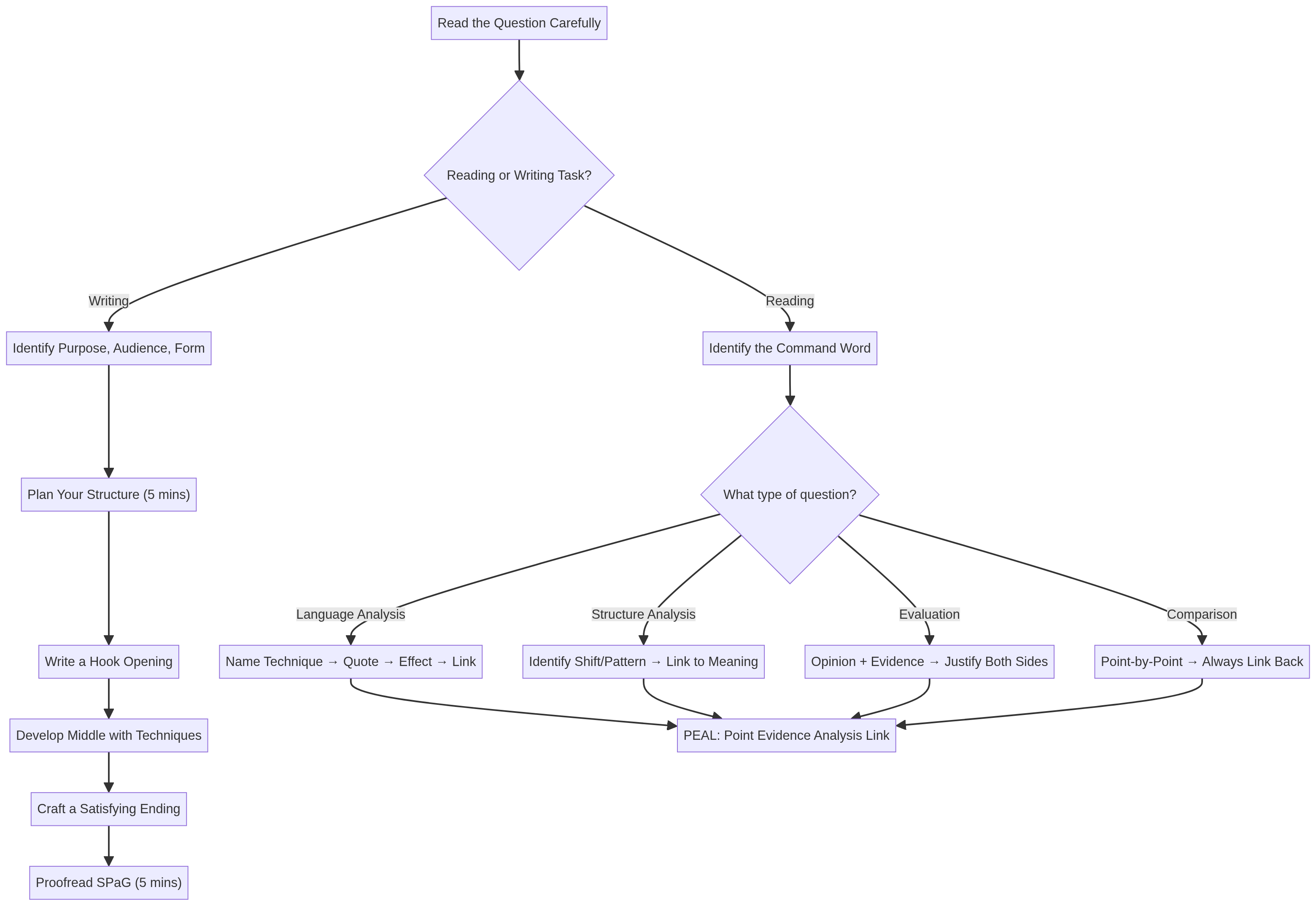
English Language exam approach flowchart
Conceptual Flow Outline
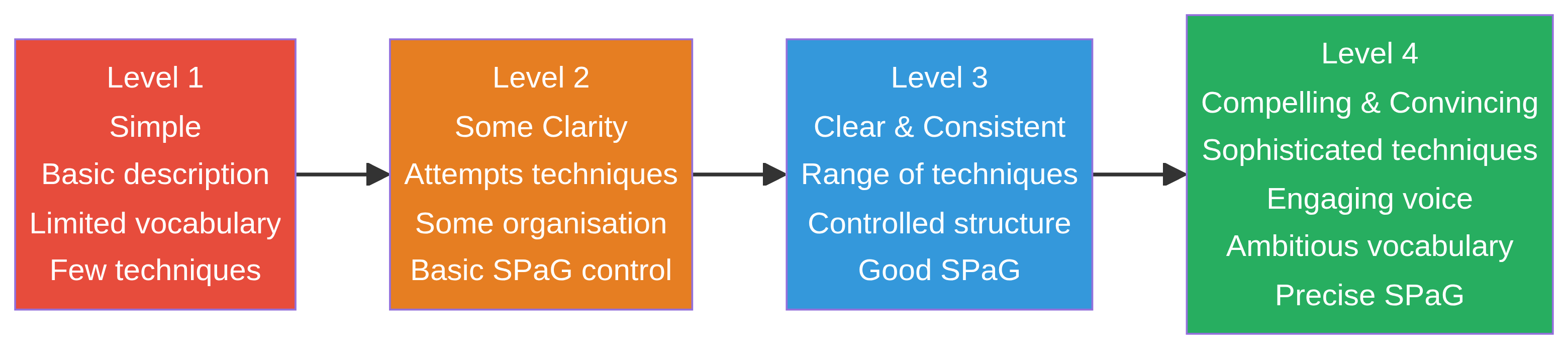
Writing Mark Scheme Levels Progression
Worked Examples
3 worked examples — open one to explore the question and available guidance.
Practice Questions
Test your understanding — click to reveal model answers
List four things we learn about the setting from the first paragraph.
Hint: Look only at paragraph one. Keep your answers brief and factual. You do not need to analyse.
How does the writer use language to describe the character's fear?
Hint: Identify 2-3 specific techniques (e.g., verbs, similes). Quote them and explain how they make the reader understand the intensity of the fear.
Write a description suggested by this picture: [An image of a busy, chaotic marketplace].
Hint: Use sensory description. Do not write a story with a plot; focus on capturing the atmosphere. Use ambitious vocabulary.
Evaluate the statement: 'The ending of the story is completely unexpected and shocking.'
Hint: Provide a balanced argument. Look for clues (foreshadowing) earlier in the text that might suggest the ending wasn't entirely unexpected.
Write a speech to your local council arguing for better facilities for young people in your area.
Hint: Remember PAF: Purpose (Argue), Audience (Local Council - formal), Form (Speech). Use rhetorical devices (AFOREST).