Introduction - Aims and objectives — Eduqas GCSE English Language
Teaching note checked against the official specification.
Test yourself on Introduction - Aims and objectives with EDUQAS GCSE practice questions.
A week of Premium from your first lesson · Then the free plan continues · No card, no charge
Introduction - Aims and objectives explained
Introduction - Aims and objectives covers 6 specification points, including Read a wide range of texts, fluently and with… and Read critically, and use knowledge gained from….
Read the full explanation
Open a point below for its explanation and revision guidance.
read a wide range of texts, fluently and with good understanding
This aim describes the reading habit the course builds: you read widely, decode accurately and comprehend what a text is doing. 'Wide range' means fiction and non-fiction, literary and transactional, print and digital, from different periods and voices. 'Fluently' means reading at a pace that keeps meaning intact, adjusting speed for dense or unfamiliar material. 'With good understanding' means you can follow the writer's ideas, purpose and viewpoint, and explain how language and structure create effects. In practice, build a reading log across genres, skim for gist, then re-read closely to annotate purpose, audience and technique. Assessment rewards accurate comprehension and analysis of how meaning is made, not just plot recall.
read critically, and use knowledge gained from wide reading to inform and improve their own writing
Critical reading means questioning a text rather than simply absorbing it: you weigh the writer's claims, spot bias, examine how language and structure position the reader, and judge how convincing the whole piece is. Wide reading then feeds your writing. When you notice how a columnist opens with a striking statistic, or how a novelist varies sentence length to build tension, you can borrow that technique deliberately in your own work. The two halves connect: analysis gives you a bank of moves, and writing lets you test them. A practical method is to keep a reading journal with three columns: what the writer did, why it worked, and how you could use it. In Eduqas GCSE English Language, this aim supports both critical response to texts and conscious crafting in transactional and creative writing.
write effectively and coherently using Standard English appropriately
Effective writing means shaping content, structure and style so a reader follows your meaning without effort. Coherence is the logical glue: paragraphs grouped by idea, discourse markers such as 'however', and pronouns that clearly refer back. Standard English is the agreed grammar, vocabulary and spelling used in formal published writing; it is a dialect or variety of English, not a judgement about regional speech. In an Eduqas response you might plan a letter: opening states purpose, body paragraphs develop arguments, close returns to the purpose. Adapt register to audience and form, keeping tense and viewpoint consistent. Accuracy supports coherence because errors force readers to re-read.
use grammar correctly, punctuate and spell accurately
Technical accuracy means controlling grammar, punctuation and spelling so meaning is unambiguous. Grammar covers agreement, tense consistency, complete sentences and correct word classes; punctuation marks boundaries and clarifies meaning, including commas, apostrophes, colons and semicolons; spelling draws on patterns, roots and proofreading. Accuracy is assessed through how far it supports communication, not by counting errors alone. A practical method: write, then read aloud to hear sentence boundaries, check every apostrophe for possession or omission, and verify tricky words such as 'necessary' or 'separate'. In an Eduqas paper this skill underpins every writing task, so secure the basics and apply them consistently under time pressure.
acquire and apply a wide vocabulary, alongside a knowledge and understanding of grammatical terminology, 1 and linguistic conventions for reading, writing and spoken language.
This aim requires you to build a broad, precise vocabulary and use it purposefully in reading, writing and speech. As this is an untiered qualification, all students take the same exams and must demonstrate these skills across a full range of abilities. You need to know grammatical terminology and linguistic conventions to describe how language works and control your choices. For example, when analysing a charity appeal, identify the imperative verb 'donate' and explain how its command form positions the reader. When writing, select 'consequently' rather than 'so' to signal a formal logical link. Assessment is through your ability to select and apply language accurately, and to use terminology to explain effects, not merely label features.
listen to and understand spoken language, and use spoken Standard English effectively.
This aim has two linked halves. First, listening: you attend to spoken language, pick out main points and detail, and recognise how tone, pace, stress and register shape meaning. Second, speaking: you use spoken Standard English effectively, choosing vocabulary, grammar and register to suit audience and purpose, whether in discussion, presentation or role play. 'Effectively' means adapting to context, not speaking in one fixed way. In practice, listen to broadcasts or speeches and summarise the argument, noting how the speaker signals emphasis; then rehearse your own talk, recording it to check clarity, grammar and appropriateness. Assessment looks at comprehension of what is heard and at controlled, appropriate use of spoken Standard English in formal and informal settings.
Watch and listen
Listen: Introduction - Aims and objectives audio lesson
Read the full guide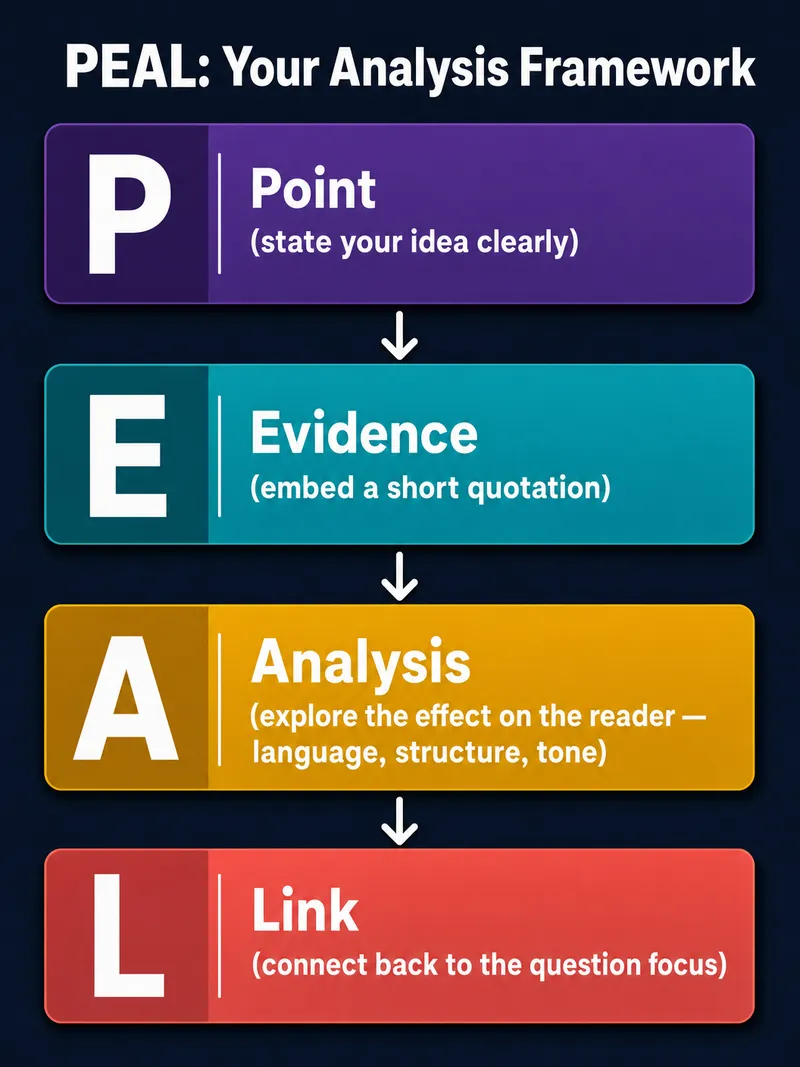
Interactive Diagrams
1 interactive diagram to visualise key concepts
Conceptual Flow Outline
English Language exam approach flowchart
Your focus
- Read texts from a range of genres, periods and purposes and identify each one's purpose and audience.
- Read aloud or silently with fluency, adjusting pace and re-reading where meaning is unclear.
- Explain how a writer's language and structural choices create effects that support understanding.
Show all 18 objectives
- Evaluate how a writer's language and structure create effects on the reader.
- Identify bias or selective evidence in a text and explain its impact.
- Apply a technique noticed in reading to improve a piece of own writing.
- Plan and produce a whole text whose structure clearly serves its purpose and audience.
- Link sentences and paragraphs so a reader can follow the argument or narrative without confusion.
- Sustain Standard English and an appropriate register throughout a sustained piece of writing.
- Construct grammatically complete sentences with accurate agreement and consistent tense.
- Apply punctuation accurately to mark boundaries and clarify meaning.
- Spell common and ambitious vocabulary correctly and proofread to eliminate repeated errors.
- Select and use a wide, precise vocabulary appropriately in reading, writing and spoken language.
- Identify and explain grammatical features using accurate terminology.
- Apply linguistic conventions accurately to communicate clearly for different purposes and audiences.
- Listen to spoken language and identify main points, detail and the speaker's emphasis.
- Speak using accurate Standard English grammar and vocabulary appropriate to audience and purpose.
- Adapt register and delivery between formal and informal spoken contexts.
Introduction - Aims and objectives flashcards
Card 1 of 12
Critical reading
Introduction - Aims and objectives exam tips
Marking Points
- Evaluates a writer's methods, commenting on language, structure and form and their effects on the reader.
- Identifies bias, assumption and selective evidence, and explains how these shape a reader's response.
- Draws on models from wide reading to choose vocabulary, sentence structures and organisational features in own writing.
- Adapts register, tone and form to suit a specified purpose and audience.
- Uses evidence from texts to support an interpretation, distinguishing what is stated from what is implied.
- Reflects on and edits own writing, applying techniques noticed in reading.
- Content is selected and shaped to suit the stated purpose, audience and form, with ideas developed rather than listed.
- Whole-text structure is deliberate: an engaging opening, logically sequenced paragraphs and a conclusion that satisfies the task.
- Cohesion is managed within and across paragraphs using discourse markers, topic sentences and clear pronoun reference.
- Standard English grammar, vocabulary and spelling are sustained, with register adapted appropriately to the reader and form.
- Sentence structures are varied for effect, and punctuation is used to control pace and clarify meaning.
- Sentences are grammatically complete, with subject-verb agreement and consistent tense and viewpoint.
- Punctuation is used accurately and purposefully, including commas, apostrophes, colons and semicolons where they aid clarity.
- Spelling of common and ambitious vocabulary is accurate, including homophones and words with irregular patterns.
- Errors, where they occur, do not obscure meaning, and ambitious vocabulary and varied sentences are attempted.
- Proofreading is evident: repeated slips in tense, agreement or punctuation are avoided across the whole response.
- Selects vocabulary that is precise, varied and matched to purpose, audience and form, avoiding vague or repeated word choices.
- Uses grammatical terminology accurately when identifying and explaining how sentences, clauses, phrases and words create meaning.
- Applies linguistic conventions such as punctuation, paragraphing, tense consistency and Standard English appropriately in writing.
- Adapts vocabulary and grammatical choices in spoken language to suit formal and informal contexts.
- Explains the effect of a writer's or speaker's language choices using terminology, rather than only naming features.
- Shows control of a range of sentence structures and word classes to achieve clarity, emphasis or cohesion.
Examiner Tips
- 💡Keep a short reading log recording genre, purpose, audience and one technique per text so you can draw on a genuinely wide range under timed conditions.
- 💡Practise skimming for gist in about a minute, then re-read closely to annotate, so fluency and close understanding work together.
- 💡When analysing, always link a quoted word or phrase to its effect on the reader rather than listing features.
- 💡Use a short quotation as a springboard, then spend most of your answer explaining the effect of the writer's choice.
- 💡Plan writing with a quick purpose-audience-form note at the top so every paragraph can be checked against it.
- 💡Re-read your own draft as a critical reader would, asking whether each sentence earns its place.
- 💡Keep a mental bank of two or three techniques from your reading that you can deploy confidently under time pressure.
- 💡Spend a few minutes planning purpose, audience, form and paragraph order before writing.
- 💡Re-read as a reader: check each paragraph has one clear job and links to the last.
- 💡Leave time to proofread for coherence slips such as missing connectives or ambiguous pronouns.
- 💡Read each sentence aloud in your head to test whether it is complete and correctly bounded.
- 💡Check apostrophes and homophones deliberately during proofreading rather than relying on chance.
- 💡Use a short final proofread to fix agreement and tense slips before the time ends.
- 💡Build a personal vocabulary bank organised by topic and register, and practise dropping precise words into sentences rather than listing them.
- 💡When analysing language, use a three-step habit: identify the choice, name the terminology accurately, then explain the effect on the reader or listener.
- 💡Remember that as an untiered exam, the texts and tasks will range in difficulty, so applying precise grammatical terminology is key to accessing higher marks.
- 💡When listening to a talk, jot the main claim and two supporting details, then note one way the speaker signalled emphasis.
- 💡Record a short spoken response and review it for grammatical accuracy, clarity and register before delivering it live.
- 💡Adapt your register explicitly: identify your audience and purpose first, then choose vocabulary and tone to match.
Common Mistakes
- Treating 'wide range' as reading only one genre such as novels; correction: deliberately read non-fiction, journalism, speeches and poetry too, and note the different conventions each uses.
- Confusing fluency with speed; correction: fluency is accurate, expressive reading that preserves meaning, so slow down and re-read when a sentence is dense rather than racing through.
- Summarising plot instead of showing understanding of purpose and effect; correction: for each text, state what the writer is trying to do and identify the language or structural choice that achieves it.
- Describing what a text says without judging how or why; correct this by adding a comment on method and effect for each point.
- Copying a writer's style wholesale so the writing loses its own voice; correct this by adapting a technique to fit your purpose rather than imitating surface features.
- Treating all texts as equally trustworthy; correct this by checking the source, date and evidence behind claims.
- Using impressive vocabulary without accuracy; correct this by choosing words whose meaning and register you can control.
- Writing in a chatty spoken register for a formal task; correct by matching vocabulary and tone to the named audience and form.
- Starting a new paragraph for every sentence so ideas fragment; correct by grouping linked points under one clear topic sentence.
- Using a pronoun whose referent is unclear; correct by naming the person or thing again or restructuring the sentence.
- Comma splicing two independent clauses; correct by using a full stop, semicolon or conjunction.
- Confusing possessive and plural apostrophes; correct by checking whether the word shows ownership or omission.
- Shifting tense mid-narrative; correct by choosing a tense and maintaining it unless the timeline genuinely changes.
- Naming a feature without explaining its effect, such as writing 'the writer uses a metaphor' and stopping there; the correction is to add what the metaphor suggests and how it shapes the reader's response.
- Using complicated vocabulary inaccurately or out of register, such as inserting 'ubiquitous' where 'common' is meant; the correction is to check meaning and formality before using a word.
- Confusing grammatical terms, for example calling a clause a phrase; the correction is to learn that a clause contains a subject and a verb, while a phrase does not.
- Ignoring conventions such as inconsistent tense or missing punctuation; the correction is to proofread for agreement, tense and sentence boundaries.
- Assuming Standard English means always speaking formally; correction: it is about grammatical accuracy and appropriateness, so register shifts with audience and purpose.
- Listening passively without noting structure; correction: track the speaker's main points and the signposting words that reveal emphasis and sequence.
- Ignoring non-verbal and prosodic cues such as stress and pace; correction: notice how these change meaning and use them deliberately in your own speech.