Eduqas · GCSE · English Language
Course version: C700QS · Version from Mar 2026
Use grammar correctly, punctuate and spell accurately
Full specification wording
Introduction - Aims and objectives: use grammar correctly, punctuate and spell accurately
Technical accuracy means controlling grammar, punctuation and spelling so meaning is unambiguous.
Checked against the Eduqas C700QS specification (opens in a new tab) on .
- Point 4 of 6
- 4 key terms
Study notes
From the checked teaching notes for this specification point.
The idea
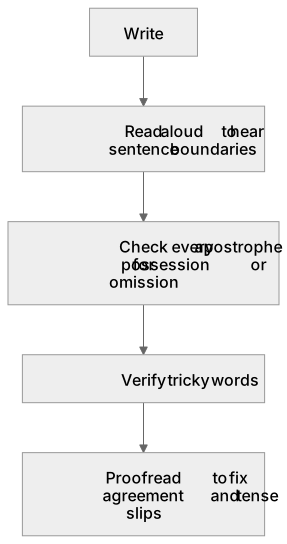
Technical accuracy means controlling grammar, punctuation and spelling so meaning is unambiguous. Grammar covers agreement, tense consistency, complete sentences and correct word classes; punctuation marks boundaries and clarifies meaning, including commas, apostrophes, colons and semicolons; spelling draws on patterns, roots and proofreading. Accuracy is assessed through how far it supports communication, not by counting errors alone. A practical method: write, then read aloud to hear sentence boundaries, check every apostrophe for possession or omission, and verify tricky words such as 'necessary' or 'separate'. In an Eduqas paper this skill underpins every writing task, so secure the basics and apply them consistently under time pressure.
What earns the marks
- Sentences are grammatically complete, with subject-verb agreement and consistent tense and viewpoint.
- Punctuation is used accurately and purposefully, including commas, apostrophes, colons and semicolons where they aid clarity.
- Spelling of common and ambitious vocabulary is accurate, including homophones and words with irregular patterns.
- Errors, where they occur, do not obscure meaning, and ambitious vocabulary and varied sentences are attempted.
- Proofreading is evident: repeated slips in tense, agreement or punctuation are avoided across the whole response.
Common mistakes and how to put them right
Comma splicing two independent clauses.
Put it right by using a full stop, semicolon or conjunction.
Confusing possessive and plural apostrophes.
Put it right by checking whether the word shows ownership or omission.
Shifting tense mid-narrative; correct by choosing a tense and maintaining it unless the timeline genuinely changes.
Exam tips
- Read each sentence aloud in your head to test whether it is complete and correctly bounded.
- Check apostrophes and homophones deliberately during proofreading rather than relying on chance.
- Use a short final proofread to fix agreement and tense slips before the time ends.
Try the lesson
The start of the Introduction - Aims and objectives: use grammar correctly, punctuate and spell accurately lesson, made from checked teaching notes for this specification point.
Have a go first
Which sentence uses punctuation correctly?
Listen
Technical accuracy means controlling grammar, punctuation and spelling so meaning is unambiguous. Grammar covers agreement, tense consistency, complete sentences and correct word classes; punctuation marks boundaries and clarifies meaning, including commas, apostrophes, colons and semicolons; spelling draws on patterns, roots and proofreading. Accuracy is assessed through how far it supports communication, not by counting errors alone. A practical method: write, then read aloud to hear sentence boundaries, check every apostrophe for possession or omission, and verify tricky words such as 'necessary' or 'separate'. In an Eduqas paper this skill underpins every writing task, so secure the basics and apply them consistently under time pressure. A strong answer earns marks for these points. Sentences are grammatically complete, with subject-verb agreement and consistent tense and viewpoint. Punctuation is used accurately and purposefully, including commas, apostrophes, colons and semicolons where they aid clarity. Spelling of common and ambitious vocabulary is accurate, including homophones and words with irregular patterns. Errors, where they occur, do not obscure meaning, and ambitious vocabulary and varied sentences are attempted. A common slip: Comma splicing two independent clauses. Instead, using a full stop, semicolon or conjunction. Exam tip: Read each sentence aloud in your head to test whether it is complete and correctly bounded.
See it
Put it in order
Put these steps in the order they happen.
- 1. Read aloud to hear sentence boundaries
- 2. Check every apostrophe for possession or omission
- 3. Write
- 4. Proofread to fix agreement and tense slips
- 5. Verify tricky words
Key words
Say what each word means before you turn the card.
Grammatical accuracy
Try answering aloud or in your head before turning the card.
Punctuation for clarity
Try answering aloud or in your head before turning the card.
Spelling and vocabulary
Try answering aloud or in your head before turning the card.
Proofreading and editing
Try answering aloud or in your head before turning the card.
See every definition
- Grammatical accuracy
- Sentences are grammatically complete, with subject-verb agreement and consistent tense and viewpoint.
- Punctuation for clarity
- Punctuation is used accurately and purposefully, including commas, apostrophes, colons and semicolons where they aid clarity.
- Spelling and vocabulary
- Spelling of common and ambitious vocabulary is accurate, including homophones and words with irregular patterns.
- Proofreading and editing
- Repeated slips in tense, agreement or punctuation are avoided across the whole response, so proofreading is evident.
Label the diagram
Some boxes have lost their names. Pick the right name for each number.
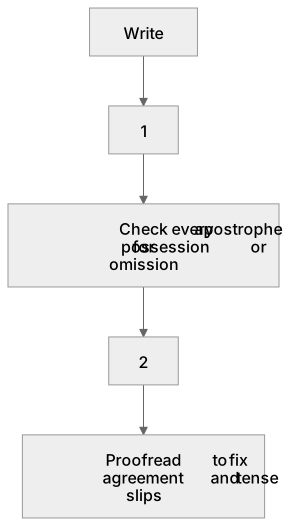
1Box 1
2Box 2
There is more to this lesson
The full lesson goes on to check your understanding and help you earn the marks. Create a free account to carry on, with your progress saved.
A week of Premium from your first lesson · Then the free plan continues · No card, no charge
Test your understanding of Introduction - Aims and objectives: use grammar correctly, punctuate and spell accurately
Active recall beats re-reading. Take an instant quiz now to test what you’ve learned and lock it into long-term memory.
A week of Premium from your first lesson · Then the free plan continues · No card, no charge