Eduqas · GCSE · English Language
Course version: C700QS · Version from Mar 2026
Write effectively and coherently using Standard English appropriately
Full specification wording
Introduction - Aims and objectives: write effectively and coherently using Standard English appropriately
Effective writing means shaping content, structure and style so a reader follows your meaning without effort.
Checked against the Eduqas C700QS specification (opens in a new tab) on .
- Point 3 of 6
- 4 key terms
Study notes
From the checked teaching notes for this specification point.
The idea
Effective writing means shaping content, structure and style so a reader follows your meaning without effort. Coherence is the logical glue: paragraphs grouped by idea, discourse markers such as 'however', and pronouns that clearly refer back. Standard English is the agreed grammar, vocabulary and spelling used in formal published writing; it is a dialect or variety of English, not a judgement about regional speech. In an Eduqas response you might plan a letter: opening states purpose, body paragraphs develop arguments, close returns to the purpose. Adapt register to audience and form, keeping tense and viewpoint consistent. Accuracy supports coherence because errors force readers to re-read.
What earns the marks
- Content is selected and shaped to suit the stated purpose, audience and form, with ideas developed rather than listed.
- Whole-text structure is deliberate: an engaging opening, logically sequenced paragraphs and a conclusion that satisfies the task.
- Cohesion is managed within and across paragraphs using discourse markers, topic sentences and clear pronoun reference.
- Standard English grammar, vocabulary and spelling are sustained, with register adapted appropriately to the reader and form.
- Sentence structures are varied for effect, and punctuation is used to control pace and clarify meaning.
Common mistakes and how to put them right
Writing in a chatty spoken register for a formal task.
Put it right by matching vocabulary and tone to the named audience and form.
Starting a new paragraph for every sentence so ideas fragment.
Put it right by grouping linked points under one clear topic sentence.
Using a pronoun whose referent is unclear.
Put it right by naming the person or thing again or restructuring the sentence.
Exam tips
- Spend a few minutes planning purpose, audience, form and paragraph order before writing.
- Re-read as a reader: check each paragraph has one clear job and links to the last.
- Leave time to proofread for coherence slips such as missing connectives or ambiguous pronouns.
Try the lesson
The start of the Introduction - Aims and objectives: write effectively and coherently using Standard English appropriately lesson, made from checked teaching notes for this specification point.
Have a go first
Which sentence is written in Standard English?
Listen
Effective writing means shaping content, structure and style so a reader follows your meaning without effort. Coherence is the logical glue: paragraphs grouped by idea, discourse markers such as 'however', and pronouns that clearly refer back. Standard English is the agreed grammar, vocabulary and spelling used in formal published writing; it is a dialect or variety of English, not a judgement about regional speech. In an Eduqas response you might plan a letter: opening states purpose, body paragraphs develop arguments, close returns to the purpose. Adapt register to audience and form, keeping tense and viewpoint consistent. Accuracy supports coherence because errors force readers to re-read. A strong answer earns marks for these points. Content is selected and shaped to suit the stated purpose, audience and form, with ideas developed rather than listed. Whole-text structure is deliberate: an engaging opening, logically sequenced paragraphs and a conclusion that satisfies the task. Cohesion is managed within and across paragraphs using discourse markers, topic sentences and clear pronoun reference. Standard English grammar, vocabulary and spelling are sustained, with register adapted appropriately to the reader and form. A common slip: Writing in a chatty spoken register for a formal task. Instead, matching vocabulary and tone to the named audience and form. Exam tip: Spend a few minutes planning purpose, audience, form and paragraph order before writing.
See it
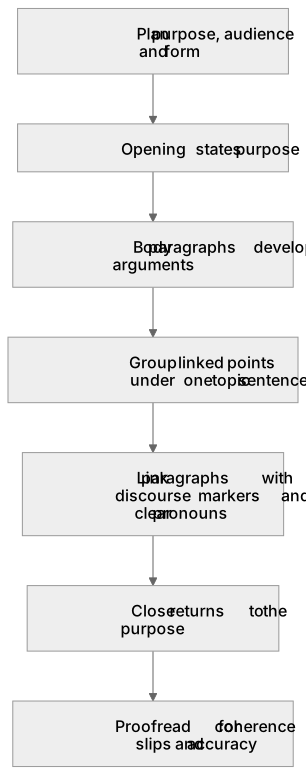
Put it in order
Put these steps in the order they happen.
- 1. Proofread for coherence slips and accuracy
- 2. Close returns to the purpose
- 3. Body paragraphs develop arguments
- 4. Link paragraphs with discourse markers and clear pronouns
- 5. Plan purpose, audience and form
- 6. Opening states purpose
- 7. Group linked points under one topic sentence
Key words
Say what each word means before you turn the card.
Purpose, audience and form
Try answering aloud or in your head before turning the card.
Coherence and cohesion
Try answering aloud or in your head before turning the card.
Paragraphing and whole-text structure
Try answering aloud or in your head before turning the card.
Standard English and register
Try answering aloud or in your head before turning the card.
See every definition
- Purpose, audience and form
- Content is selected and shaped to suit these, with ideas developed rather than listed.
- Coherence and cohesion
- The logical glue of a text, managed within and across paragraphs using discourse markers, topic sentences and clear pronoun reference.
- Paragraphing and whole-text structure
- A deliberate arrangement with an engaging opening, logically sequenced paragraphs and a conclusion that satisfies the task.
- Standard English and register
- The agreed grammar, vocabulary and spelling used in formal published writing, sustained with register adapted appropriately to the reader and form.
Label the diagram
Some boxes have lost their names. Pick the right name for each number.
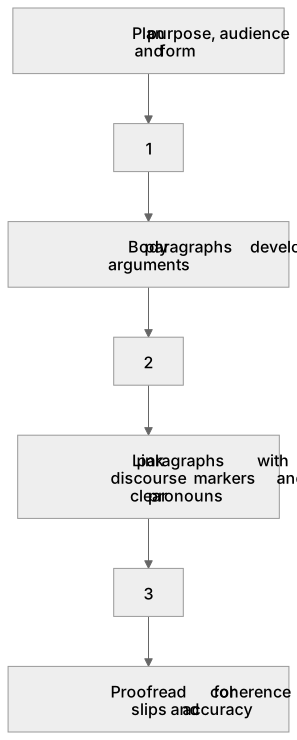
1Box 1
2Box 2
3Box 3
There is more to this lesson
The full lesson goes on to check your understanding and help you earn the marks. Create a free account to carry on, with your progress saved.
A week of Premium from your first lesson · Then the free plan continues · No card, no charge
Test your understanding of Introduction - Aims and objectives: write effectively and coherently using Standard English appropriately
Active recall beats re-reading. Take an instant quiz now to test what you’ve learned and lock it into long-term memory.
A week of Premium from your first lesson · Then the free plan continues · No card, no charge