OCR · GCSE · English Language
Analysing Structure
Analysing structure is a core skill in OCR GCSE English Language, assessed under AO2 and worth 20% of your marks. This guide teaches you to move beyond feature-spotting to analyse how writers deliberately organise texts to shape meaning, control pace, and influence readers—skills that will elevate your responses from mid-level to top-band.
- 9 min read
- 3 worked examples
- 5 practice questions
- 10 key terms
Study Notes
Overview
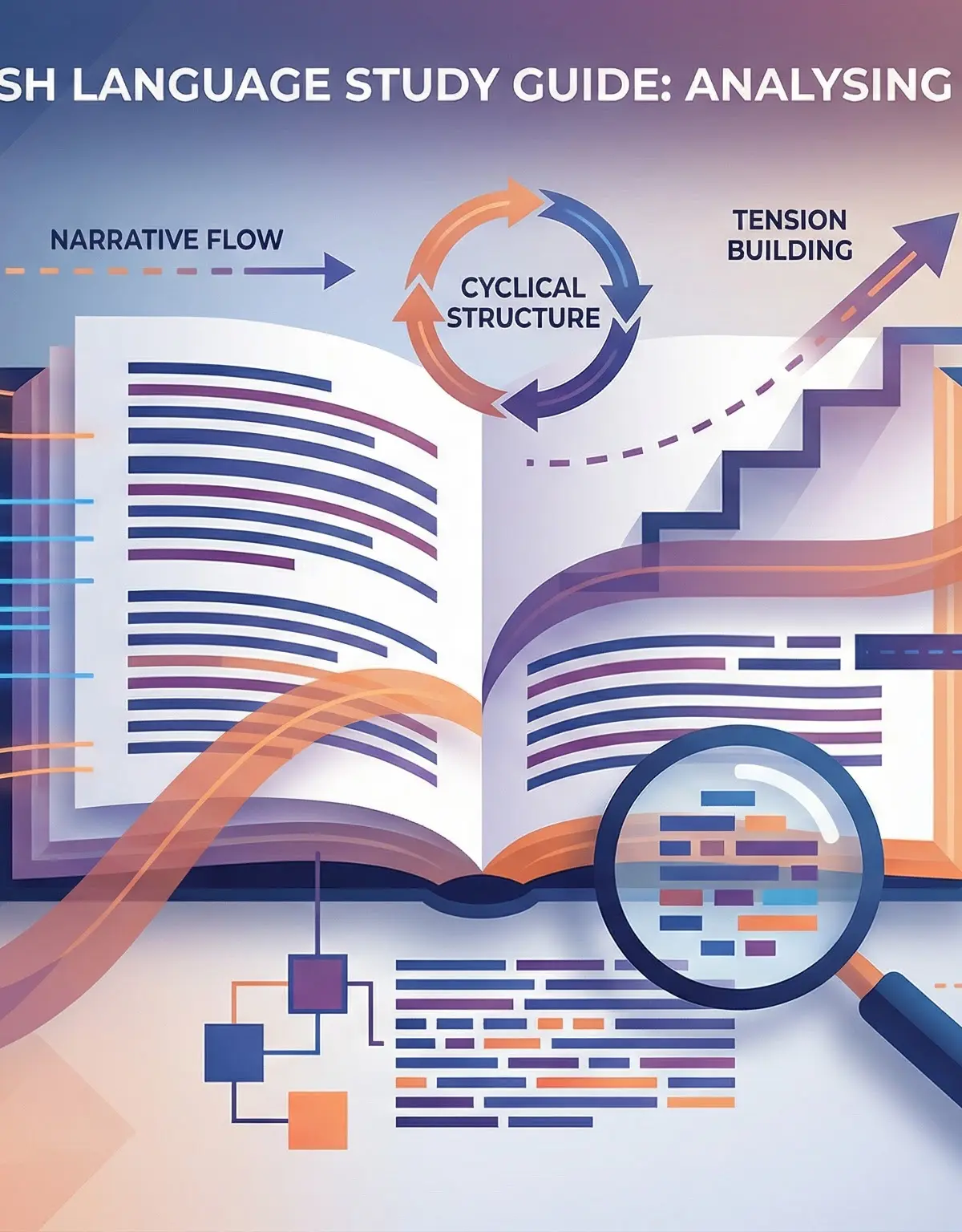
In your OCR GCSE English Language exam, analysing structure is a critical skill assessed under Assessment Objective 2 (AO2). It requires you to move beyond simply identifying features and instead analyse how a writer has deliberately organised a text to shape meaning and influence you, the reader. This guide will equip you with the skills to deconstruct a text's architecture, from the whole-text level down to individual sentences, and explain its effects with the precision of a top-band candidate.
Reading Skills
Identifying Information & Ideas
This is the foundation of all reading skills. Before you can analyse, you must understand. In the exam, you will be presented with unseen 19th, 20th, and 21st-century texts. Your first job is to extract both explicit information (what is directly stated) and implicit information (what is suggested or implied). For instance, a writer might explicitly state "the room was cold," but implicitly suggest a character's emotional state of isolation or fear through that description.
Analysing Language
While our focus is structure, it's impossible to separate it entirely from language. The two work together. Examiners expect you to understand how word choices create effects. Credit is given for analysing how specific language features contribute to the overall tone and meaning.
Key Language Features to Identify
| Feature | Definition | Effect on Reader | Example |
|---|---|---|---|
| Metaphor | A figure of speech where a word or phrase is applied to an object or action to which it is not literally applicable. | Creates a powerful image, making an abstract concept more concrete or drawing a striking comparison. | "The classroom was a zoo." |
| Simile | A comparison of one thing with another thing of a different kind, using 'like' or 'as'. | Makes a description more vivid and relatable by linking it to a familiar image. | "He was as brave as a lion." |
| Pathetic Fallacy | The attribution of human feelings and responses to inanimate things or animals, especially the weather. | Creates atmosphere and can reflect a character's internal emotional state. | "The miserable rain echoed his despair." |
| Personification | Giving human qualities or abilities to something that is not human. | Brings an object or concept to life, making it more engaging or threatening. | "The wind whispered through the trees." |
| Alliteration | The occurrence of the same letter or sound at the beginning of adjacent or closely connected words. | Can create a specific mood (e.g., soft sounds for calm, hard sounds for aggression) and makes phrases more memorable. | "The sweet smell of success." |
| Sibilance | A specific type of alliteration using soft consonant sounds like 's', creating a hissing effect. | Often used to create a sense of slyness, secrecy, or menace. | "The snake slithered silently." |
| Juxtaposition | Placing two contrasting ideas, characters, or descriptions close together. | Highlights the differences between them, often to create a dramatic or ironic effect. | "The calm of the library was shattered by a sudden scream." |
Analysing Structure
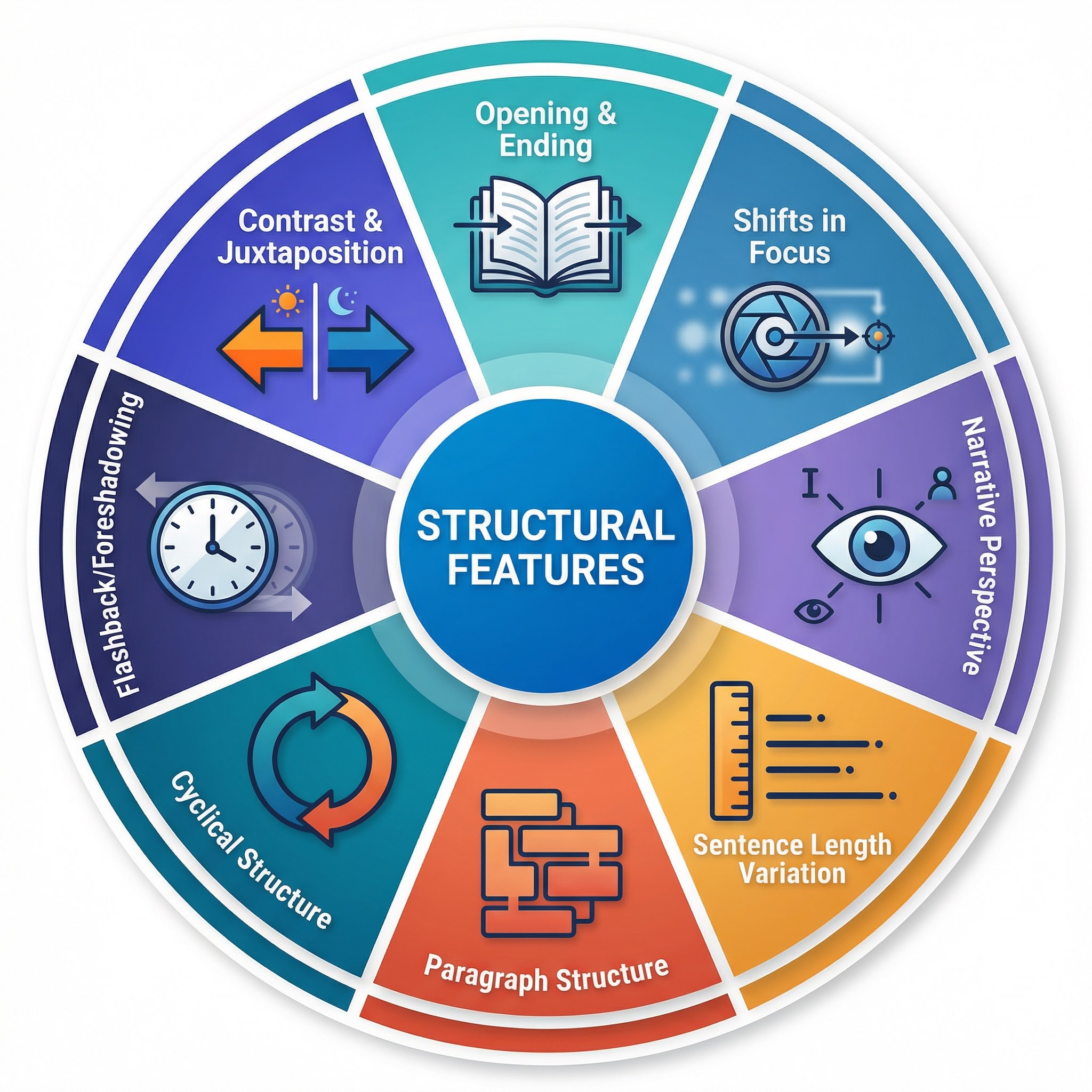
This is the core of AO2. Structure is the writer's blueprint. It's about the order and arrangement of the text as a whole. Examiners want to see you analyse the sequence of events, the shifts in focus, and the patterns that build meaning.
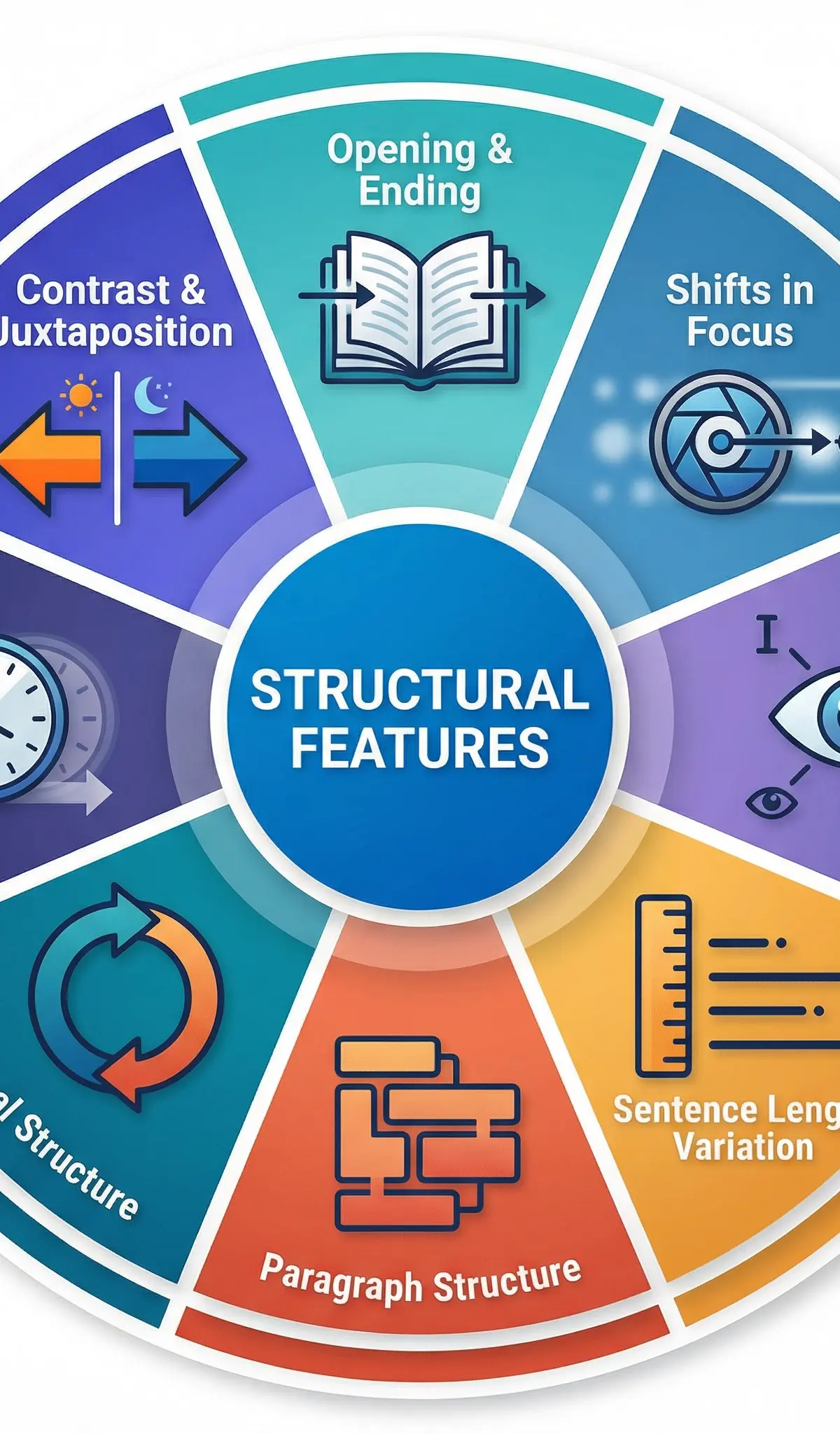
Key Structural Features to Analyse:
- Openings and Endings: How does the writer begin? In the middle of the action (in medias res)? With a description? How does the ending relate to the opening? A cyclical structure, where the end echoes the beginning, can create a sense of inevitability or closure.
- Shifts in Focus: Where does the writer direct your attention? Notice shifts between characters, from wide views to close-ups, from internal thoughts to external action, or from past to present. These shifts are always deliberate.
- Narrative Perspective: Who is telling the story? A first-person narrator provides a personal, subjective view. A third-person narrator can be omniscient (all-knowing) or limited, affecting how much information the reader receives.
- Sentence Length Variation: This is a powerful tool for controlling pace. Long, complex sentences can slow down the reader, building tension or reflecting a complex thought process. A short, simple sentence can create a sudden impact, shock, or moment of clarity.
- Paragraph Structure: Look at the length and focus of paragraphs. A single-sentence paragraph isolates a key idea for emphasis. A series of long, dense paragraphs might create a feeling of being overwhelmed.
- Flashback and Foreshadowing: These devices manipulate time. A flashback provides crucial backstory, while foreshadowing hints at future events, building suspense and anticipation.
- Contrast and Juxtaposition: When a writer places opposing ideas or images side by side, the contrast heightens the effect of each. This can be used to create irony, emphasise change, or highlight conflict.
**The What-How-Why Method:**When analysing structure, always follow this framework:
- What is the structural feature? (e.g., shift from past to present tense)
- How does it work in this context? (e.g., the sudden shift jolts the reader into the immediacy of the moment)
- Why did the writer use it? (e.g., to emphasise the urgency and danger the character now faces)
Evaluating Critically
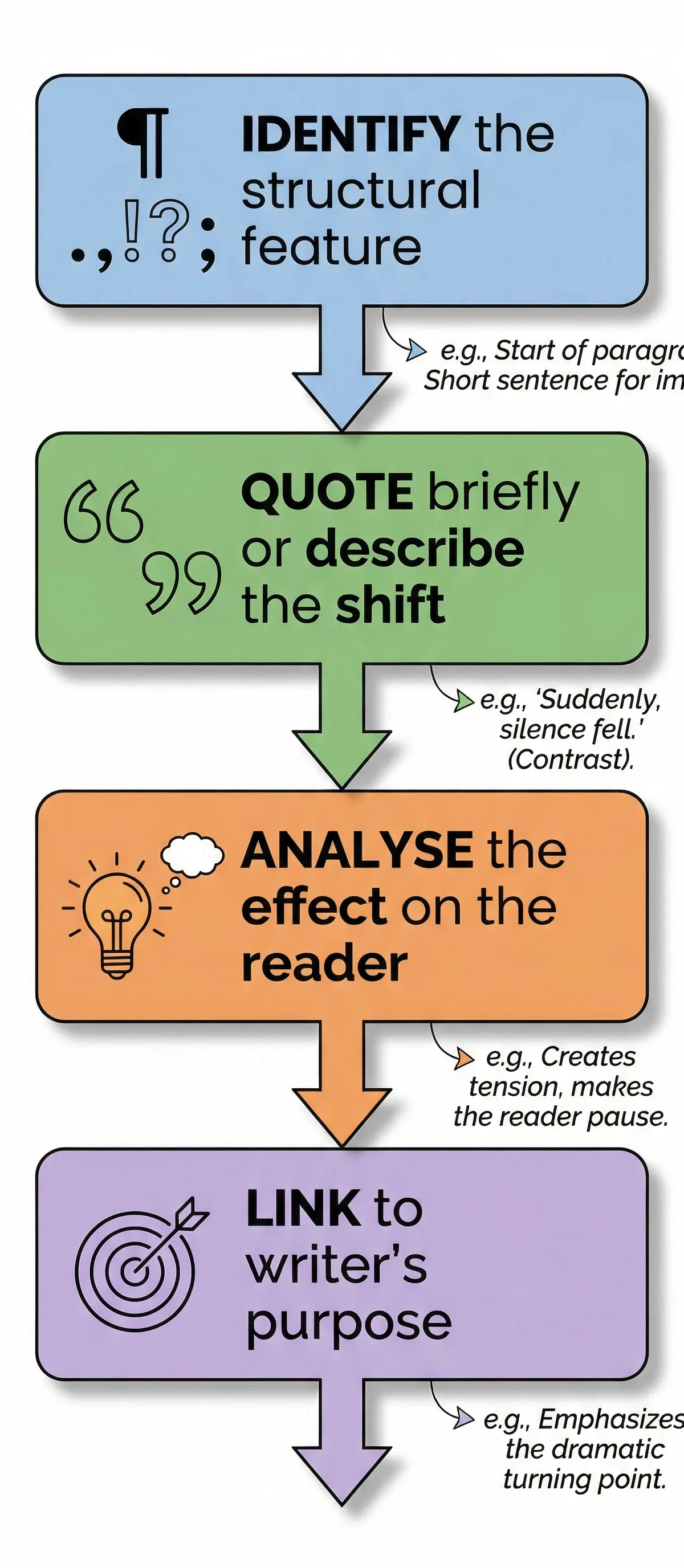
For higher marks, you need to evaluate how successfully the writer has used language and structure. This involves forming a judgement and supporting it with evidence. Use phrases like "The writer effectively creates a sense of panic by..." or "To some extent, the ending feels unresolved because...". A good structure for this is:
- Statement: Make a clear point about the writer's methods.
- Evidence: Select a short, embedded quotation.
- Analysis: Explain the effect of the chosen feature.
- Link: Connect your analysis back to the writer's overall purpose or the question's focus.
Comparing Writers' Viewpoints
In Paper 2, you will be asked to compare how two writers present a similar topic. The key is to compare their methods (language and structure) and the resulting viewpoints and perspectives. Avoid simply discussing what each text says. Instead, focus on how they say it differently. Use comparative discourse markers like "whereas," "in contrast," "similarly," and "on the other hand."
Writing Skills
Creative Writing
Your writing needs to be as crafted as the texts you analyse. Whether writing a narrative or a description, focus on:
- Show, Don't Tell: Instead of telling the reader "he was angry," show it: "He clenched his fists, his jaw tight, and a muscle pulsed in his cheek."
- Sensory Description: Engage all five senses—sight, sound, smell, touch, and taste—to create a vivid and immersive world for the reader.
- Varied Sentence Structures: Use a mix of simple, compound, and complex sentences to create rhythm and pace. Start sentences in different ways (e.g., with an adverb, a subordinate clause, or a prepositional phrase).
- Engaging Openings: Hook your reader immediately. Start with dialogue, action, a striking image, or a question.
- Satisfying Endings: Avoid clichés like "it was all a dream." Instead, aim for an ending that resolves the narrative or leaves the reader with a powerful final image.
- The One-Scene Rule: For timed exam writing, focus on developing one scene in depth rather than rushing through multiple events.
Transactional/Non-Fiction Writing
For tasks like writing a letter, article, speech, or leaflet, you must consider Purpose, Audience, and Form (PAF). Your tone, vocabulary, and structure must be appropriate for the task. Use persuasive techniques to engage your reader.
AFOREST Persuasive Techniques:
- Alliteration: Memorable phrases that stick in the reader's mind.
- Facts: Concrete information that supports your argument.
- Opinions: Your viewpoint, clearly stated.
- Rhetorical questions: Questions that make the reader think and engage.
- Emotive language: Words that appeal to the reader's emotions.
- Statistics: Numerical data that adds weight to your argument.
- Three (Rule of): Listing things in threes for emphasis and rhythm.
Technical Accuracy (SPaG)
Spelling, Punctuation, and Grammar (SPaG) are crucial. They account for a significant portion of the marks in the writing sections. Aim for flawless spelling and use a range of punctuation for effect. Ambitious punctuation like semicolons, colons, and dashes, when used correctly, will be rewarded by examiners.
Ambitious Punctuation:
- Semicolons (;): Link two closely related independent clauses without a conjunction.
- Colons (:): Introduce a list, explanation, or quotation.
- Dashes (—): Create emphasis, add an aside, or show an interruption.
- Parenthetical commas: Set off additional information within a sentence.
Visual Resources
2 diagrams and illustrations
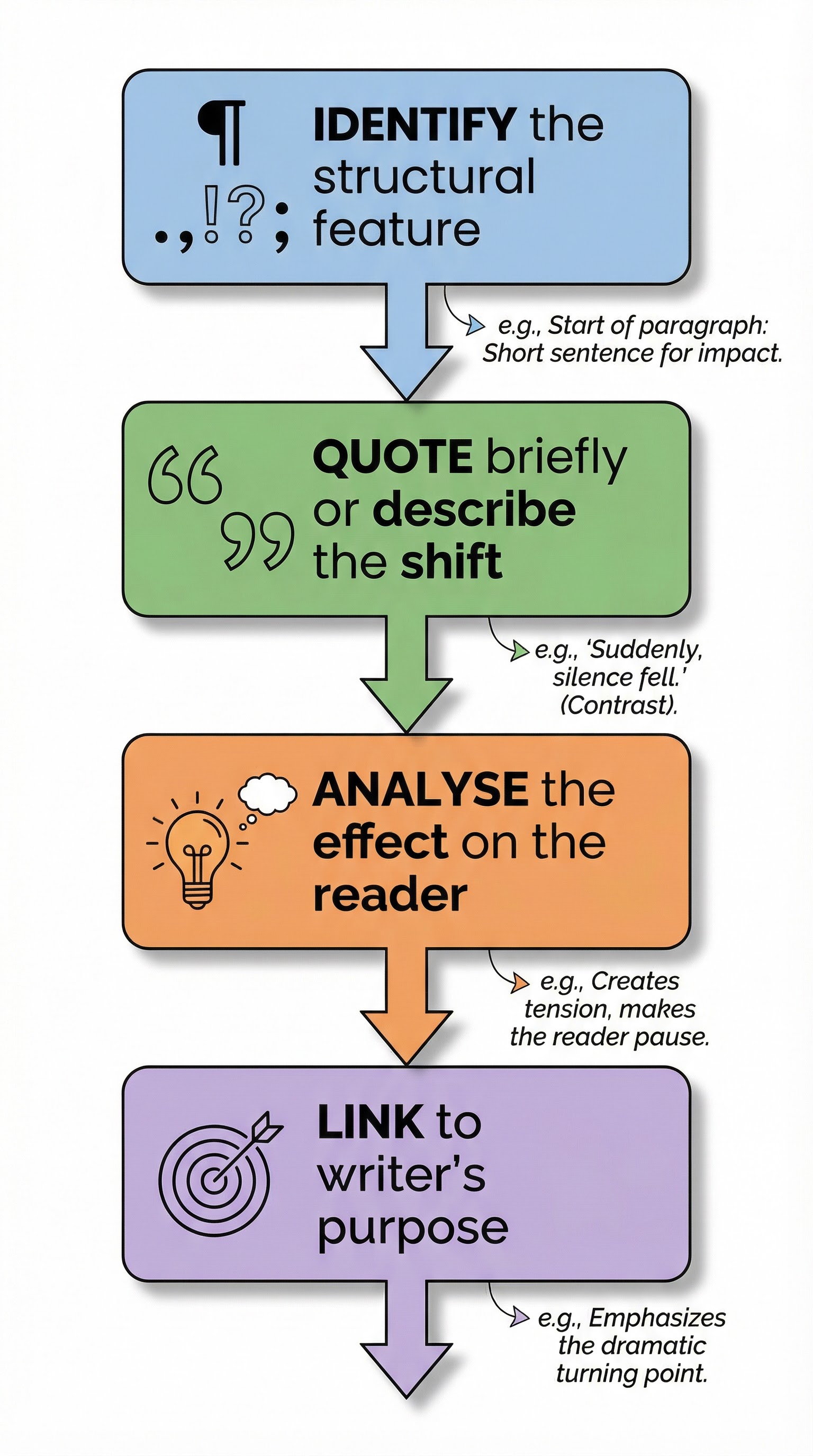
Interactive Diagrams
2 interactive diagrams to visualise key concepts
Conceptual Flow Outline
OCR GCSE English Language exam approach flowchart
Conceptual Flow Outline
Structural features to analyse at whole-text and sentence level
Worked Examples
3 worked examples — open one to explore the question and available guidance.
Practice Questions
Test your understanding — click to reveal model answers
Read the opening of a 20th-century fiction extract. The writer describes a character walking through an empty city at dawn. Identify two things you learn about the character's feelings.
Hint: This is an AO1 question. You only need to identify explicit or implicit information. No analysis required—just state what you learn.
Read lines 5-15 of the extract. How does the writer use language to create a sense of danger?
Hint: This is an AO2 language question. Identify specific language features (e.g., word choices, imagery) and explain their effects. Use the PEAL structure.
Read the whole extract. How does the writer use structure to build tension from the beginning to the end?
Hint: This is an AO2 structure question. Focus on whole-text features (openings, endings, shifts) and sentence-level features (sentence length, paragraph structure). Use the What-How-Why method.
To what extent do you agree that the writer successfully conveys the character's sense of isolation in this extract? You should write about: your own impressions of the extract; how the writer conveys isolation through language and structure.
Hint: This is an AO4 evaluation question. You need to give your opinion and support it with analysis of both language and structure. Use phrases like 'The writer effectively...' or 'To some extent...'
Write an article for a school magazine in which you argue that students should have more say in how their school is run. [24 marks for content and organisation; 16 marks for technical accuracy]
Hint: This is a transactional writing task. Plan your structure, use AFOREST techniques, and write in a formal but engaging tone. Remember to proofread for SPaG.
Test your understanding of Analysing Structure
Active recall beats re-reading. Take an instant quiz now to test what you’ve learned and lock it into long-term memory.
7 days Premium · Then free forever · No card, no charge