OCR · GCSE · English Language
Comparing Writers' Ideas and Perspectives
This study guide focuses on mastering OCR GCSE English Language Paper 2, Question 4. It provides a detailed framework for comparing writers' ideas and perspectives in non-fiction texts, helping you to analyse language and structure to secure top marks."
- 6 min read
- 3 worked examples
- 5 practice questions
Study Notes
Overview
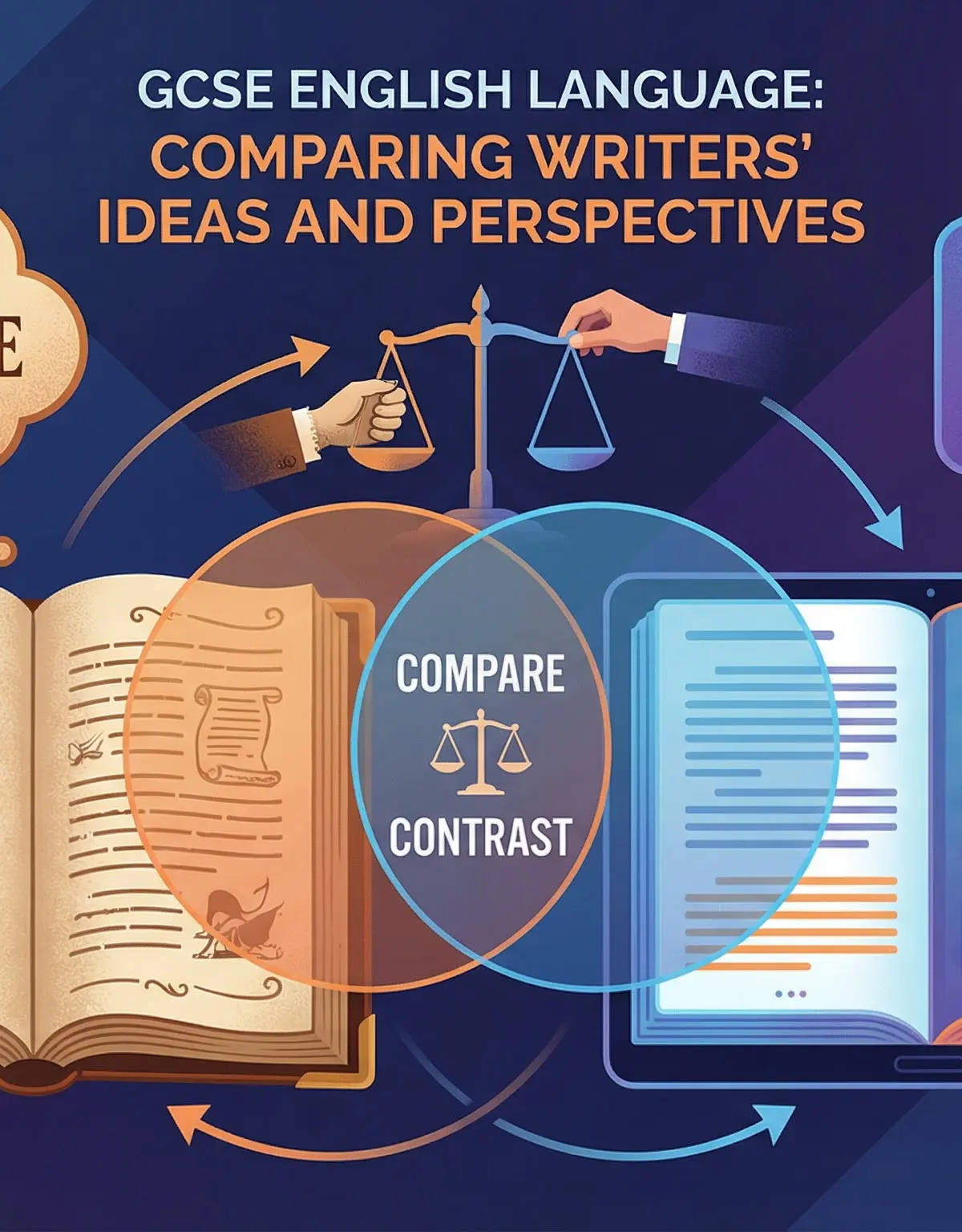
This guide focuses on a crucial skill for your OCR GCSE English Language Paper 2: Comparing Writers' Ideas and Perspectives. This is assessed in Question 4 and is worth 12 marks. You will be given two non-fiction texts from different time periods and asked to compare how the writers convey their different viewpoints. This isn't just about what they say, but how they say it and the attitudes they reveal.
Reading Skills
Identifying Information & Ideas
To compare perspectives, you first need to be a skilled reader who can unpick both explicit and implicit meanings. Explicit information is stated directly, while implicit information is suggested or hinted at. For example, a writer might explicitly state "the journey was long," but implicitly suggest their boredom through descriptions of a monotonous landscape.
Analysing Language
Examiners are looking for your ability to analyse how writers use language to shape meaning and convey their perspective. This means going beyond simply identifying features.
Key Language Features to Identify
| Feature | Definition | Effect on Reader | Example |
|---|---|---|---|
| Metaphor | A figure of speech in which a word or phrase is applied to an object or action to which it is not literally applicable. | Creates a powerful image, making an abstract concept more concrete and relatable. | "The city was a jungle." |
| Simile | A figure of speech involving the comparison of one thing with another thing of a different kind, used to make a description more emphatic or vivid. | Makes a description more vivid and easier for the reader to visualise. | "He was as brave as a lion." |
| Pathetic Fallacy | The attribution of human feelings and responses to inanimate things or animals, especially in art and literature. | Creates a specific mood or atmosphere that reflects the emotions of a character or the tone of the piece. | "The miserable weather reflected his mood." |
| Personification | The attribution of a personal nature or human characteristics to something non-human, or the representation of an abstract quality in human form. | Helps the reader to understand, sympathise with, or react emotionally to non-human characters. | "The wind whispered through the trees." |
| Alliteration | The occurrence of the same letter or sound at the beginning of adjacent or closely connected words. | Can create a particular mood (e.g., soft sounds for a calm mood) or draw attention to a key phrase. | "The sweet smell of success." |
| Sibilance | A figure of speech in which a hissing sound is created within a group of words through the repetition of 's' sounds. | Can create a sinister or soothing effect, depending on the context. | "The snake slithered silently." |
| Juxtaposition | The fact of two things being seen or placed close together with contrasting effect. | Highlights the differences between two things and can create a sense of shock or surprise. | "The poverty of the slums was juxtaposed with the wealth of the city." |
Analysing Structure
Structure refers to how a text is organised. Writers use structure to guide the reader through their ideas and to emphasise their perspective.
- Openings: How does the writer begin? Do they grab the reader's attention with a dramatic statement or a gentle introduction?
- Shifts in focus: Where does the writer change the topic or the tone? What does this reveal about their priorities?
- Narrative perspective: Is the text written in the first person (I) or third person (he/she/they)? How does this affect our connection to the writer's viewpoint?
- Sentence length variation: A mix of long and short sentences can create a dynamic pace. Short sentences can create tension, while long sentences can be more descriptive.
- Paragraph structure: How are the paragraphs organised? Do they build on each other to develop an argument?
- Cyclical structure: Does the text end where it began? This can suggest that nothing has changed or that an idea has been reinforced.
- Flashback/Foreshadowing: Does the writer move back and forth in time? This can be used to build suspense or to provide context.
Evaluating Critically
This is the highest-level skill. It means forming your own opinion on how effectively the writer has conveyed their message. A good way to structure this is:
- Statement: Make a clear point about the writer's methods.
- Evidence: Support your point with a short, embedded quotation.
- Analysis: Explain the effect of the language or structure you have identified.
- Link: Connect your analysis back to the writer's overall perspective.
Comparing Writers' Viewpoints
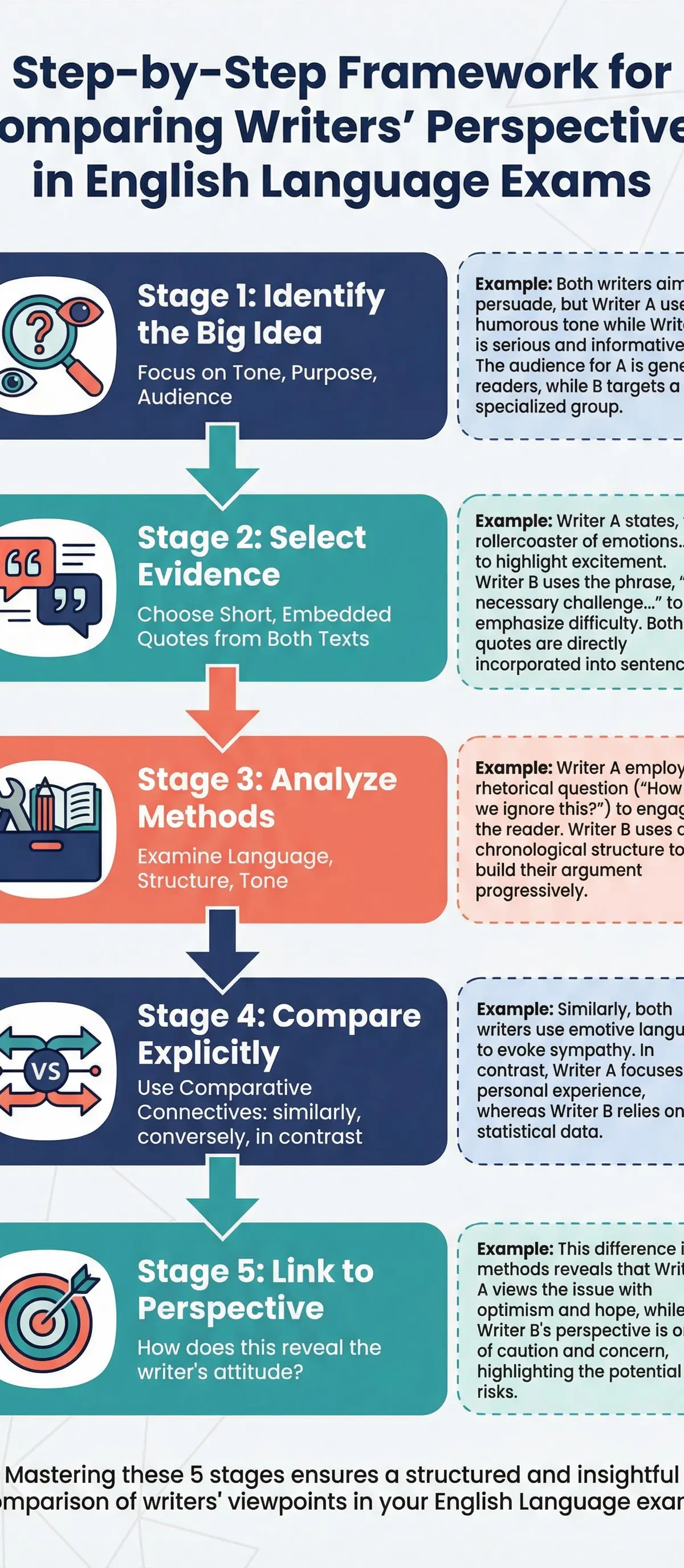
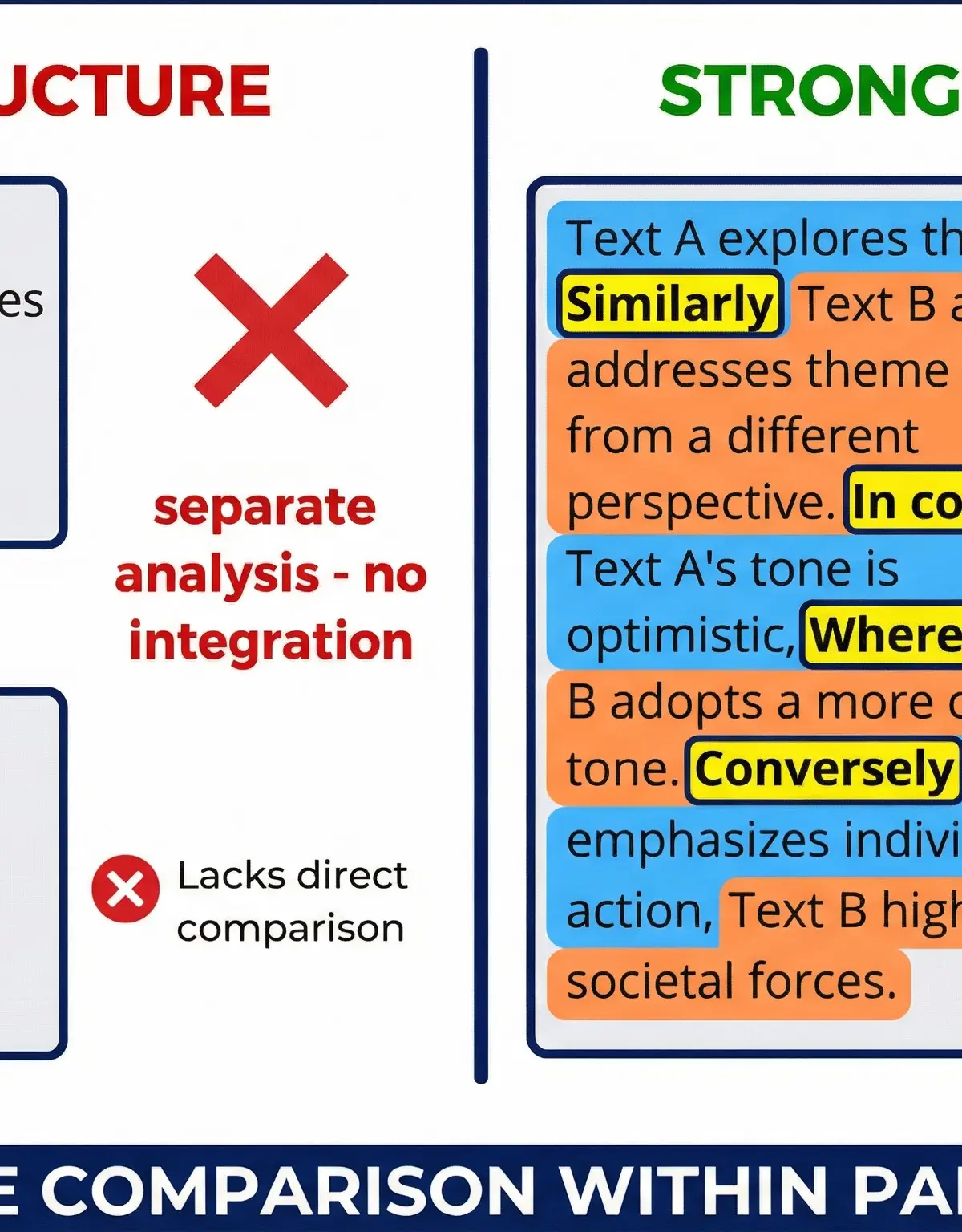
This is the core of the question. You need to compare the writers' attitudes and the methods they use to convey them. A good framework is:
- Identify viewpoints: What is each writer's overall perspective on the topic?
- Compare methods: How do they use language and structure differently or similarly to convey these viewpoints?
- Evaluate effectiveness: Which writer do you think is more successful in conveying their perspective and why?
Writing Skills
Creative Writing
- Show, don't tell: Instead of telling the reader that a character is angry, show it through their actions and dialogue.
- Sensory description: Appeal to the five senses to create a vivid and immersive world for the reader.
- Varied sentence structures: Use a mix of simple, compound, and complex sentences to create a more engaging rhythm.
- Engaging openings: Hook the reader from the very first sentence.
- Satisfying endings: Leave the reader with a lasting impression.
- One-scene rule: For short stories, it's often best to focus on a single, significant event.
Transactional/Non-Fiction Writing
- Structure: Use the correct conventions for letters, articles, speeches, and leaflets.
- AFOREST: Use this acronym to remember persuasive techniques: Alliteration, Facts, Opinions, Rhetorical questions, Emotive language, Statistics, Three (rule of).
- Purpose-form-audience: Always consider why you are writing, what form it should take, and who you are writing for.
Technical Accuracy (SPaG)
Spelling, punctuation, and grammar are crucial. Ambitious punctuation like semicolons, colons, dashes, and parenthetical commas can help you to express complex ideas and will be rewarded by examiners."
Worked Examples
3 worked examples — open one to explore the question and available guidance.
Practice Questions
Test your understanding — click to reveal model answers
Identify two phrases, one from each text, that show the writers have different attitudes to the weather.
Hint: Look for descriptive words that have positive or negative connotations.
Explain how the writer of Text A uses language to convey their excitement.
Hint: Find a powerful word or phrase and explain its connotations. Use the PEEL structure.
Compare how the writers of Text A and Text B use structure to present their different viewpoints.
Hint: Think about the overall shape of each text. Does one build to a climax? Does the other have a more fragmented structure? How does this reflect their perspective?
Write a diary entry about a time you felt disappointed.
Hint: Use the first person and an informal register. Focus on your thoughts and feelings, using sensory details to bring the experience to life.
Evaluate how successfully the writer of Text B persuades the reader to agree with their negative view of modern technology.
Hint: This is an evaluation question, so you need to give your own opinion, but back it up with evidence. Consider both the strengths and weaknesses of the writer's argument.
Test your understanding of Comparing Writers' Ideas and Perspectives
Active recall beats re-reading. Take an instant quiz now to test what you’ve learned and lock it into long-term memory.
7 days Premium · Then free forever · No card, no charge