OCR · GCSE · English Language
Engaging the Audience
This guide focuses on mastering audience engagement for OCR GCSE English Language, a skill vital for over half the exam marks. It covers adapting tone, style, and register for specific audiences (AO5) and critically evaluating how writers manipulate readers (AO4)."
- 6 min read
- 3 worked examples
- 5 practice questions
Study Notes
Overview
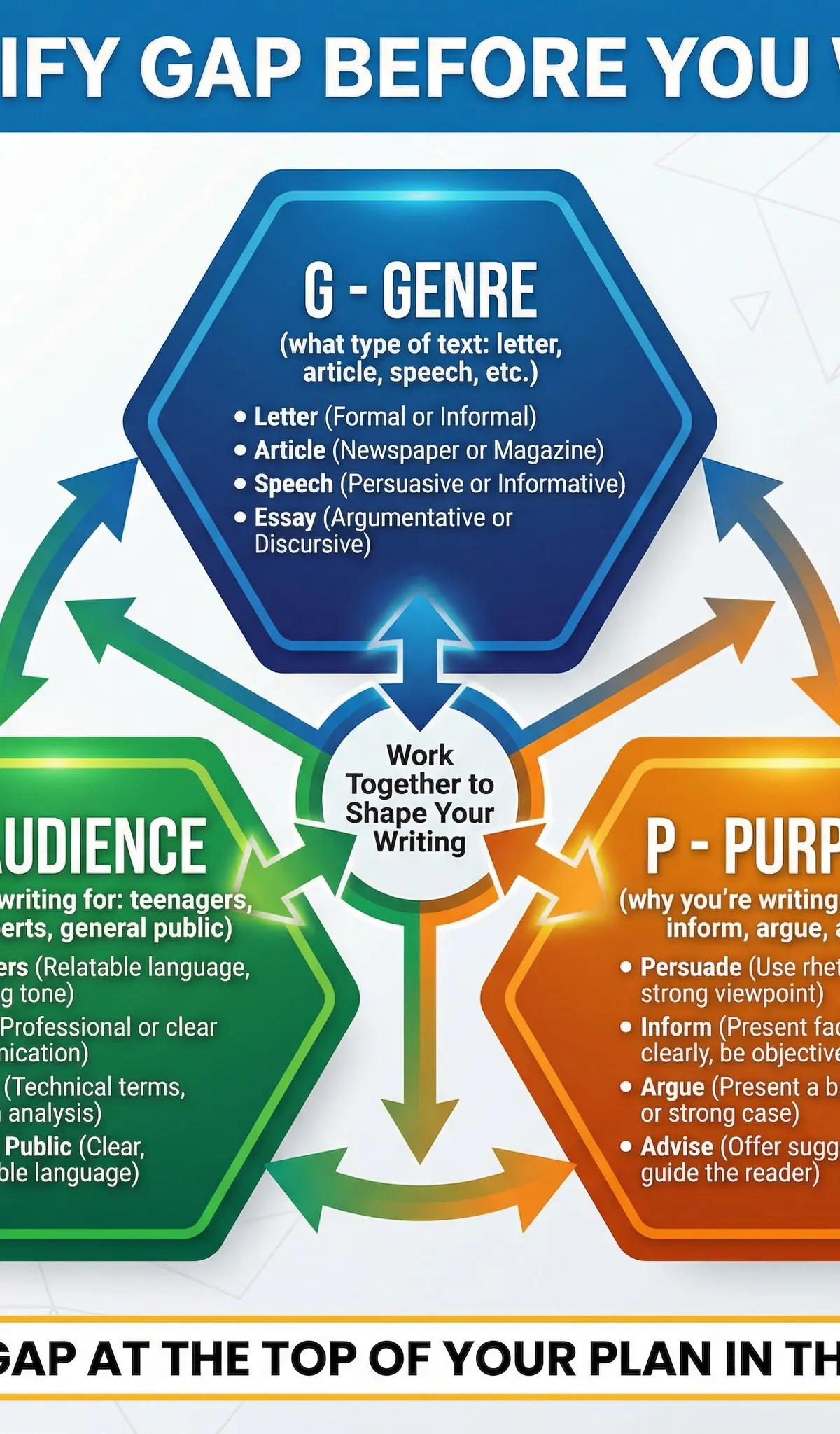
Engaging the audience is the cornerstone of effective communication in English Language. For your OCR GCSE, this isn't just a vague concept; it's a specific, high-stakes skill set. Examiners are trained to look for your ability to consciously shape your writing to suit a specific Genre, Audience, and Purpose (GAP), and to deconstruct how other writers do the same. This guide will equip you with the analytical and creative frameworks needed to excel in both reading (Paper 1 & 2) and writing (Paper 2) tasks, turning this challenging area into a major source of marks.
Reading Skills
Identifying Information & Ideas
This is the foundation (AO1). Before you can analyse, you must understand. In unseen texts, you'll need to quickly distinguish between explicit information (what the text directly states) and implicit information (what the text suggests or implies). For example, a writer might explicitly state "the room was cold," but implicitly suggest a character's emotional isolation or a sense of foreboding.
Analysing Language
This is where you dissect the writer's craft (AO2). It's not enough to just spot features; you must explain their precise effect on the reader. Credit is given for analysing how specific word choices, sentence forms, and figurative language shape meaning and influence the audience.
Key Language Features to Identify
| Feature | Definition | Effect on Reader | Example |
|---|---|---|---|
| Metaphor | A figure of speech stating one thing is another to create a powerful image. | Makes abstract ideas tangible and can create a strong emotional connection. | "The city was a jungle, its streets tangled vines." |
| Simile | A comparison using "like" or "as". | Clarifies a description by linking it to a familiar image, making it more relatable. | "He was as quiet as a mouse." |
| Pathetic Fallacy | Attributing human emotions to the weather or inanimate objects. | Creates atmosphere and can mirror a character's internal state, influencing the reader's mood. | "The angry clouds gathered overhead." |
| Personification | Giving human qualities or abilities to inanimate objects or abstract ideas. | Brings concepts to life, making them more engaging or threatening. | "Fear gripped his heart." |
| Alliteration | Repetition of the same consonant sound at the beginning of words. | Can create a specific mood (e.g., harsh sounds for anger) or make a phrase more memorable. | "The deep, dark dread descended." |
| Sibilance | Repetition of "s" or "sh" sounds. | Often creates a sinister, soft, or sly tone, making the reader feel uneasy or soothed. | "The snake slithered silently through the grass." |
| Juxtaposition | Placing two contrasting ideas, characters, or descriptions close together. | Highlights the differences between them, often to create a dramatic or ironic effect. | "The pristine white snow was stained with drops of blood." |
| Direct Address | The writer or narrator speaks directly to the reader using pronouns like "you". | Creates an immediate, personal connection, making the reader feel involved and implicated. | "You must ask yourself: what would you have done? |
Analysing Structure
Structure (AO2) is the writer's blueprint. It's about how the text is organised and why it's organised that way to guide the reader's journey. Examiners reward candidates who can comment on the whole text, from the opening to the ending.
- Openings: How does the writer hook the reader from the first sentence?
- Shifts in Focus: Where does the perspective or topic change, and why?
- Narrative Perspective: Is it first-person (I), third-person limited (he/she, one character's view), or third-person omniscient (he/she, all-knowing)? How does this choice affect engagement?
- Sentence Length Variation: The deliberate use of long, complex sentences for detail, and short, simple sentences for impact.
- Paragraph Structure: How are paragraphs used to build an argument or pace a narrative? Look for single-sentence paragraphs used for emphasis.
- Cyclical Structure: Does the text end where it began? This can suggest a lack of change or a sense of inevitability.
- Flashback/Foreshadowing: How does the writer manipulate time to control the information the reader receives?
Evaluating Critically
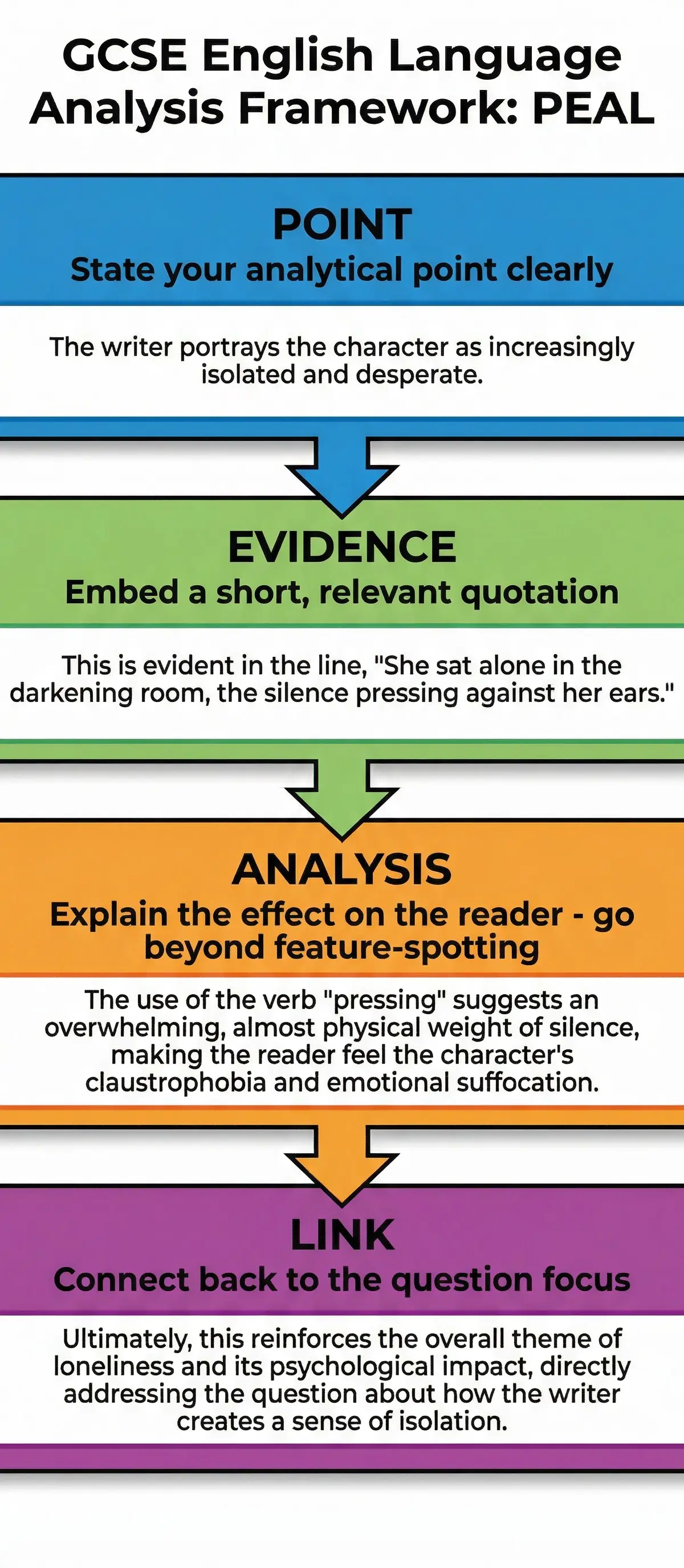
This is the top-level reading skill (AO4). It requires you to make a judgement on how successfully the writer has achieved their purpose. You need to form an opinion and defend it with evidence. Use the PEAL framework, but add a layer of judgement.
Comparing Writers' Viewpoints
For comparison questions (AO3), you must synthesise information from two texts. The key is to compare the writers' methods and ideas directly, point by point. Avoid discussing one text and then the other. A good structure is: identify a shared idea, then compare how each writer uses language and structure to present that idea, and finally, evaluate which is more effective.
Writing Skills
Creative Writing
This is your chance to show, not tell (AO5 & AO6). Whether describing a scene or narrating an event, focus on sensory details (sight, sound, smell, touch, taste) to immerse the reader. Use varied sentence structures to control pace and create tension. A strong opening is vital, but a satisfying, resonant ending is what secures the highest marks.
Transactional/Non-Fiction Writing
This is all about adapting to the GAP framework. Your tone, style, and register must be perfectly matched to the task. A formal letter to an MP requires a different voice from an informal article for your school magazine. The AFOREST mnemonic is your best friend here for persuasive tasks.
Technical Accuracy (SPaG)
Spelling, Punctuation, and Grammar (AO6) are worth 20% of the marks on writing tasks. This is not just about avoiding errors; it's about using punctuation ambitiously to create sophisticated effects. A well-placed semicolon, colon, or dash demonstrates a high level of control and will be rewarded by examiners. Ensure your paragraphs are cohesive and linked with appropriate discourse markers (e.g., "Furthermore," "In contrast," "Consequently")."
Worked Examples
3 worked examples — open one to explore the question and available guidance.
Practice Questions
Test your understanding — click to reveal model answers
Identify three emotive words used in the following sentence: "The heartbreaking images of the abandoned puppies left us all feeling devastated and angry."
Hint: Look for words that describe strong feelings.
How does the writer use sentence structure to create tension in the line: "He waited. The clock ticked. Silence."?
Hint: Think about the length of the sentences and the effect of the punctuation.
Write the opening paragraph of a formal letter to your headteacher persuading them to provide more funding for the school library. (approx. 80-100 words)",
"marks": 6
Analyse how the writer uses language and structure to present the narrator's changing feelings about the city.
Hint: Track the narrator\'s feelings from the beginning to the end of the text. Look for a key turning point or shift in focus. How do the word choices and sentence structures reflect this change?
'Homework is an outdated and ineffective tool. It should be abolished.' Write an article for a broadsheet newspaper arguing for or against this statement.",
"marks": 24
Test your understanding of Engaging the Audience
Active recall beats re-reading. Take an instant quiz now to test what you’ve learned and lock it into long-term memory.
7 days Premium · Then free forever · No card, no charge