Identifying Bias and Context

    This guide focuses on identifying bias and context in non-fiction texts for OCR GCSE English Language. You will learn the critical reading skills needed to deconstruct how writers use language and structure to present subjective viewpoints, a key area for earning marks in AO3 (comparison) and AO4 (evaluation)."

    6
    Min Read
    3
    Examples
    5
    Questions
    0
    Key Terms
    🎙 Podcast Episode
    Identifying Bias and Context
    0:00-0:00

    Study Notes

    header_image.png

    Overview

    Welcome to your deep dive into one of the most crucial skills for OCR GCSE English Language: Identifying Bias and Context. This skill is central to your success in Component 01 (Communicating information and ideas) and Component 02 (Exploring effects and impact), where you will encounter a range of non-fiction texts. Examiners are looking for candidates who can move beyond surface-level comprehension and critically evaluate how a writer's choices shape meaning and influence the reader. Mastering this will directly boost your marks for AO4 (Evaluate texts critically and support this with appropriate textual references) and AO3 (Compare writers’ ideas and perspectives, as well as how these are conveyed, across two or more texts).

    This guide will equip you with the analytical tools to deconstruct persuasive texts, understand the subtle art of manipulation, and articulate your findings with the precision of a senior examiner.

    Reading Skills

    Identifying Information & Ideas

    In the exam, you'll be asked to retrieve information from unseen texts. This isn't just about finding facts; it's about understanding both what is explicitly stated and what is implied. To secure marks, you must be able to pinpoint specific details and infer meaning from the writer's language and tone. For instance, a writer might not state they dislike a politician, but they might describe their actions as 'reckless' or 'short-sighted', implying a negative viewpoint.

    Analysing Language

    Language analysis is the engine room of your English Language GCSE. It's where you prove you understand how a writer creates effects. Simply spotting a feature is not enough; you must analyse its impact on the reader. Credit is given for detailed, specific analysis that connects the technique to the writer's overall purpose.

    Key Language Features to Identify

    FeatureDefinitionEffect on ReaderExample
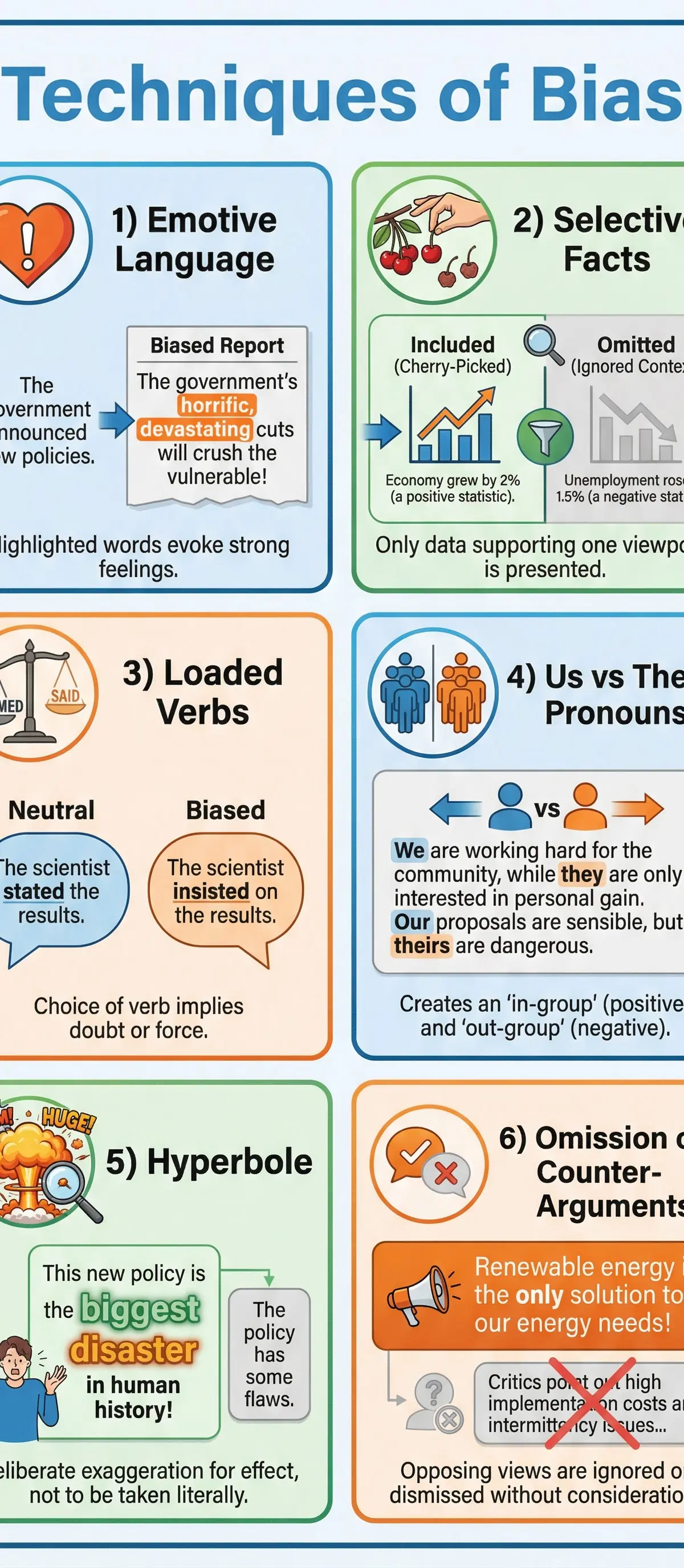
    Emotive LanguageWords or phrases chosen to evoke a strong emotional response.Creates sympathy, anger, or excitement, positioning the reader to agree with the writer's viewpoint.'Helpless animals are suffering in appalling conditions.'
    Rhetorical QuestionA question asked for effect, not requiring an answer.Encourages the reader to agree with an assumed answer, making them feel their view is the only logical one.'Can we really stand by and do nothing?'
    HyperboleDeliberate exaggeration for emphasis or comic effect.Creates a sense of urgency or drama, making a situation seem more significant than it is.'This is the worst decision in the history of humanity.'
    Pejorative AdjectivesAdjectives with negative connotations used to create a hostile tone.Discredits the subject by associating it with negative qualities, making it easy for the reader to dislike.'The politician offered a weak and cowardly response.'
    Modal Verbs of NecessityVerbs like 'must', 'should', 'have to', which imply obligation.Creates a sense of moral certainty and urgency, suggesting the writer's proposed action is the only option.'We must act now before it is too late.'
    JuxtapositionPlacing two contrasting ideas or images side-by-side.Highlights the differences between them, often to make one seem better than the other.'While the rich enjoy lavish parties, the poor struggle to eat.'
    Synthetic PersonalisationUsing inclusive pronouns like 'we' and 'us' to create a fake relationship with the reader.Fosters a sense of shared identity and values, making the reader feel they are on the writer's side.'We all know that our community deserves better.'

    bias_techniques.png

    Analysing Structure

    Structure is the writer's blueprint. It's how they organise and sequence information to guide the reader's journey through the text. Structural choices are deliberate and are a key method of embedding bias.

    • Openings: How does the text begin? Does it use an anecdote to create an emotional connection, or a shocking statistic to create alarm? The opening sets the tone.
    • Shifts in Focus: Where does the writer change topic or perspective? These shifts can reveal what the writer wants to emphasise or de-emphasise.
    • Sequencing: The order of information is crucial. A writer might present their strongest point first (primacy effect) or last (recency effect) for maximum impact. They might deliberately place a weak counter-argument in the middle, surrounded by stronger points of their own.
    • Omission: What is left out? A biased text will often ignore or briefly dismiss counter-arguments, creating a one-sided narrative. This is a powerful structural device.
    • Cyclical Structure: Does the text end where it began? This can reinforce a central idea, leaving it fixed in the reader's mind.

    Evaluating Critically

    Evaluation (AO4) is about judging the success of the writer's methods. It requires you to step back and assess how well the writer has achieved their purpose. Is the bias effective, or is it so heavy-handed that it alienates the reader? Use phrases like 'to a large extent', 'highly effective', or 'partially successful' to signal your judgement.

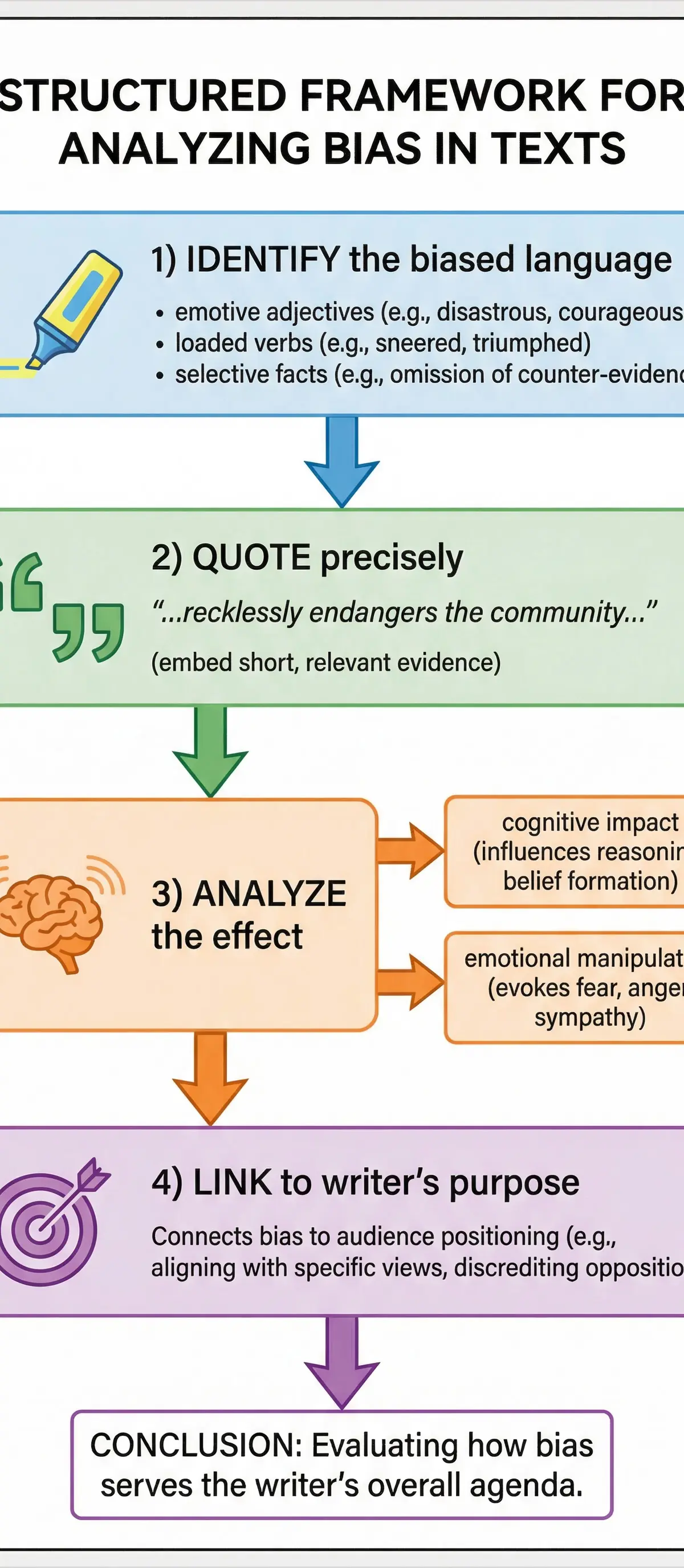
    Your evaluation must be built on a foundation of analysis. Use the Statement → Evidence → Analysis → Evaluation framework.
    analysis_framework.png

    Comparing Writers' Viewpoints

    For comparison questions (AO3), you need to synthesise your understanding of two texts. The key is to compare the methods of conveying viewpoints, not just the viewpoints themselves.

    • Identify Viewpoints: What is each writer's core argument or perspective?
    • Compare Methods: How do they convey these views? Does Text A use emotive language while Text B uses statistics? Does one use a formal tone while the other is informal and anecdotal?
    • Evaluate Effectiveness: Which writer is more persuasive and why? Link your evaluation to the specific techniques they have used."

    Worked Examples

    3 detailed examples with solutions and examiner commentary

    Practice Questions

    Test your understanding — click to reveal model answers

    Q1

    Identify three words or phrases from the following sentence that show the writer's negative bias: 'The council's shambolic and ill-conceived plan will inevitably devastate our tranquil park.'

    3 marks
    foundation

    Hint: Look for adjectives and adverbs that carry strong negative feelings.

    Q2

    Explain how the writer uses language in the sentence above to influence the reader.

    4 marks
    standard

    Hint: Choose one of the biased words you identified and explain its specific effect.

    Q3

    A writer states: 'While a handful of so-called 'experts' whine about the costs, we all know that this project is essential for our future.' Analyse how the writer uses bias to persuade the reader.

    8 marks
    standard

    Hint: Look for techniques like 'Us vs. Them' pronouns and words that discredit the opposition.

    Q4

    Evaluate how successfully the writer in the question above uses bias to present a convincing argument.

    8 marks
    challenging

    Hint: Make a judgement. Is the bias clever and persuasive, or is it too obvious and aggressive?

    Q5

    Write the opening to a speech arguing that the voting age should be lowered to 16. (Approx. 150 words)

    10 marks
    challenging

    Hint: Start with a hook. Use rhetorical questions and the rule of three to engage your audience.

    More English Language Study Guides

    View all

    Using Vocabulary and Sentence Structures

    OCR
    GCSE

    This guide focuses on mastering vocabulary and sentence structures for the OCR GCSE English Language exam. It covers how to analyse their effects in reading (AO2) and use them skilfully in writing (AO6) to maximise marks."

    Communicating Clearly and Effectively

    OCR
    GCSE

    This guide focuses on mastering OCR GCSE English Language Topic 2.4: Communicating Clearly and Effectively. It provides a comprehensive breakdown of the reading and writing skills required to excel in your exams, moving beyond simple feature-spotting to sophisticated analysis and production of language.

    Responding to Questions

    OCR
    GCSE

    This guide focuses on the core reading and writing skills for OCR GCSE English Language (J351). It breaks down how to analyse unseen texts for language and structure, evaluate writers' methods, compare perspectives, and produce high-impact creative and transactional writing under exam conditions.", "podcast_script": "OCR GCSE English Language: Responding to Questions - Educational Podcast Script Duration: Approximately 10 minutes Speaker: Female educator (warm, conversational, enthusiastic tone) [INTRO - 1 minute] Hello and welcome! I'm so glad you're here. Today we're diving into one of the most crucial skills for your OCR GCSE English Language exam: responding to questions effectively. Whether you're tackling Paper 1 or Paper 2, this skill is absolutely fundamental to your success. Now, I know what you might be thinking: "It's just answering questions, right? How hard can it be?" But here's the thing: the difference between a grade 5 and a grade 8 often comes down to how precisely you respond to what the examiner is actually asking. And that's exactly what we're going to master today. By the end of this session, you'll understand the key reading and writing skills tested in OCR English Language, you'll know exactly how to deconstruct different question types, and you'll have practical strategies to maximise your marks. So let's get started! [CORE CONCEPTS - 5 minutes] Let's begin with the foundation. OCR GCSE English Language is all about demonstrating your skills in reading and writing. Unlike English Literature, you're not analysing set texts or memorising quotes. Instead, you're showing examiners that you can read unseen texts critically and write with purpose and technical accuracy. The assessment objectives are your roadmap. AO1 is about identifying and synthesising information from texts. AO2 focuses on analysing how writers use language and structure. AO3 is all about comparing writers' viewpoints and perspectives. AO4 asks you to evaluate texts critically. And then we have AO5 and AO6 for your writing: AO5 rewards ambitious content and organisation, while AO6 assesses your technical accuracy—that's your spelling, punctuation, and grammar. Now, here's where candidates often go wrong: they treat every question the same way. But each question type demands a specific approach. Let me break this down for you. For reading questions, you need to master the "What-How-Why" framework. When a question asks you to analyse how a writer uses language, you can't just spot a metaphor and move on. That's what we call feature-spotting, and it won't get you beyond a Level 2. Instead, you need to identify WHAT technique the writer uses, quote it precisely and embed it in your sentence—that's the HOW—and then explain WHY it's effective, what impact it has on the reader. This is the difference between saying "the writer uses a metaphor" and saying "by describing the fog as a 'thick grey blanket, suffocating the city,' the writer creates a sense of oppression and claustrophobia, suggesting the city is being choked." Structure questions are another area where marks are lost. When you're asked about structure, the examiner wants you to discuss things like shifts in focus, changes in narrative perspective, sentence length variation, how the opening hooks the reader, or how the ending creates closure. Don't just retell the story—analyse the writer's structural choices and their effects. For comparison questions—and these are worth 10 marks on AO3—you must integrate your discussion. Don't write about Text A for three paragraphs and then Text B for three paragraphs. That's not comparison; that's two separate analyses. Instead, make conceptual links: both writers use emotive language, but Writer A employs it to evoke sympathy while Writer B uses it to provoke outrage. See the difference? Evaluation questions ask "to what extent do you agree" or "how far do you think the writer is successful." This is your chance to show critical thinking. Don't just agree with everything. A Level 4 response will offer a balanced view: "To some extent, the writer successfully creates tension through short, fragmented sentences. However, the reliance on clichéd imagery in the final paragraph undermines the overall impact." You're showing you can critique, not just summarise. Now let's talk about writing. Whether it's creative or transactional writing, the process is the same: plan, draft, and proofread. And I cannot stress this enough—planning is not optional. Five minutes spent planning will save you from rambling, repetitive writing. Identify your purpose, audience, and form. If you're writing a letter to your headteacher arguing for longer lunch breaks, your tone and vocabulary will be very different from a magazine article for teenagers on the same topic. For creative writing, remember the golden rule: show, don't tell. Don't write "she was angry." Write "her fists clenched, knuckles white, as she bit down on the words she wanted to scream." Use sensory details, vary your sentence structures, and create a compelling voice. For transactional writing, structure is king. Articles need headlines and subheadings. Speeches need direct address and rhetorical devices. Letters need formal openings and closings. And across all forms, use AFOREST: Alliteration, Facts, Opinions, Rhetorical questions, Emotive language, Statistics, and the rule of Three. These persuasive techniques will elevate your writing. [EXAM TIPS & COMMON MISTAKES - 2 minutes] Right, let's talk about the mistakes I see all the time—and how to avoid them. Mistake number one: not reading the question carefully. If the question says "analyse how the writer uses language in lines 10 to 20," don't analyse the whole text. You'll waste time and won't get extra marks. Be precise. Mistake number two: writing without a plan. I know you're under time pressure, but trust me, five minutes planning will result in a much stronger, more coherent response than 45 minutes of unplanned rambling. Mistake number three: feature-spotting. Saying "the writer uses alliteration" is not analysis. You need to explain the effect: "the sibilant sounds in 'slithering, silent serpent' create a sinister, threatening atmosphere." Mistake number four: not embedding quotations. Don't dump a long quote and then try to analyse it. Weave short, precise quotations into your own sentences. This shows you're in control of the evidence. Mistake number five: forgetting to proofread. Reserve five minutes at the end of the writing section to check for spelling errors, especially homophones like "their," "there," and "they're," and to fix any comma splices or run-on sentences. AO6 is worth 20% of your marks—don't throw those away. And here's a top tip for timing: you get roughly one mark per minute in English Language. A 4-mark question should take about 5 minutes. An 8-mark question, around 10 minutes. A 24-mark writing task, about 45 minutes including planning and proofreading. Stick to these timings and you won't run out of time. [QUICK-FIRE RECALL QUIZ - 1 minute] Alright, let's test your recall. I'll ask a question, and I want you to pause and answer it before I give you the answer. Ready? Question one: What does the acronym AFOREST stand for? [Pause] Answer: Alliteration, Facts, Opinions, Rhetorical questions, Emotive language, Statistics, and the rule of Three. Question two: What are the three steps in the What-How-Why analysis framework? [Pause] Answer: WHAT technique is used, HOW it's used—quote and embed it—and WHY it's effective, explaining the impact on the reader. Question three: How much time should you spend on a 24-mark writing question? [Pause] Answer: About 45 minutes, including 5 minutes for planning and 5 minutes for proofreading. Question four: Name two structural features you could analyse in a text. [Pause] Answer: Any two from: shifts in focus, changes in narrative perspective, sentence length variation, opening techniques, cyclical structure, use of flashback or foreshadowing, paragraph structure. Excellent! If you got those right, you're already on your way to exam success. [SUMMARY & SIGN-OFF - 1 minute] Let's recap what we've covered today. OCR GCSE English Language is all about demonstrating your reading and writing skills. For reading, use the What-How-Why framework, integrate your comparisons, and evaluate critically rather than just summarising. For writing, plan your response, match your tone to your audience and purpose, use persuasive techniques, and always proofread for technical accuracy. Remember: examiners reward precision, analysis, and technical control. Avoid feature-spotting, always embed your quotations, and manage your time carefully. You've got this. With practice and the right approach, you can absolutely achieve the grade you're aiming for. Keep practising, keep refining your skills, and remember—every mark counts. Thank you so much for listening, and best of luck with your revision. Now go and show those examiners what you're capable of! [END]"

    Writing for Audience, Purpose and Form

    OCR
    GCSE

    Writing for Audience, Purpose and Form is a core skill assessed in OCR GCSE English Language Component 02, Section B (Transactional Writing). Candidates must demonstrate sophisticated control of tone, register, and style (AO5) tailored precisely to the specified recipient, whether formal or informal, while maintaining technical accuracy (AO6). Mastering this skill is essential for earning top marks in the writing section.

    Organising Information and Ideas

    OCR
    GCSE

    This guide focuses on mastering AO5, the crucial skill of organising information and ideas for the OCR GCSE English Language exam. Candidates will learn to consciously structure their writing for sophistication and coherence, moving beyond simple sequencing to earn top marks."

    Evaluating Texts Critically

    OCR
    GCSE

    Evaluating Texts Critically is the cornerstone of Assessment Objective 4 (AO4) in OCR GCSE English Language, worth 20% of your overall grade. This skill requires you to form a critical judgement on how effectively a writer achieves specific effects through their choices of language, structure, and tone. Primarily assessed in Paper 2, Question 4, candidates must respond to a statement about a text and argue 'how far' they agree, using judicious evidence and evaluative language to demonstrate sophisticated literary judgement.