Identifying Bias and Context

    This guide focuses on the crucial OCR GCSE English Language skill of identifying bias and context in non-fiction texts. Mastering this allows candidates to deconstruct how writers use language to persuade, manipulate, and position their audience, unlocking top-level marks in AO1, AO3, and AO4.
    7
    Min Read
    3
    Examples
    5
    Questions
    8
    Key Terms
    🎙 Podcast Episode
    Identifying Bias and Context
    11:13
    0:00-11:13

    Study Notes

    Header image for OCR GCSE English Language: Identifying Bias and Context.

    Overview

    In your OCR GCSE English Language exam, particularly in Component 01, you will be presented with unseen non-fiction texts. These are not neutral, objective pieces of writing; they are crafted arguments designed to influence you. The ability to distinguish between verifiable fact and subjective opinion, and to understand the context in which a text is produced, is fundamental. Examiners are looking for candidates who can act as critical readers, deconstructing a writer's methods rather than simply accepting their words at face value. This skill is not just about spotting features; it is about evaluating why a writer has made specific linguistic and structural choices to create a biased or persuasive effect. Credit is awarded for moving beyond simple identification to a sophisticated analysis of a writer's craft.

    Podcast: Mastering Bias & Context for your GCSE English Exam.

    Reading Skills: Deconstructing Bias and Context

    Identifying Fact vs. Opinion

    The core of this skill lies in rigorously separating statements that can be proven from those that are based on belief or judgement. This is the foundation for all further analysis.

    • Fact: A statement that can be independently verified or disproven with evidence. It is objective and measurable. For example, "The report found that 55% of participants agreed with the proposal."
    • Opinion: A statement that reflects a belief, feeling, or judgement. It cannot be proven true or false. For example, "The proposal is a shockingly misguided attempt to solve the problem."

    Candidates often lose marks by confusing the two. A statement is not a fact simply because it contains a number. The language surrounding the statistic is what reveals the bias. Use the Verifiability Test: could this statement be proven true or false by a neutral third party? If not, it is an opinion.
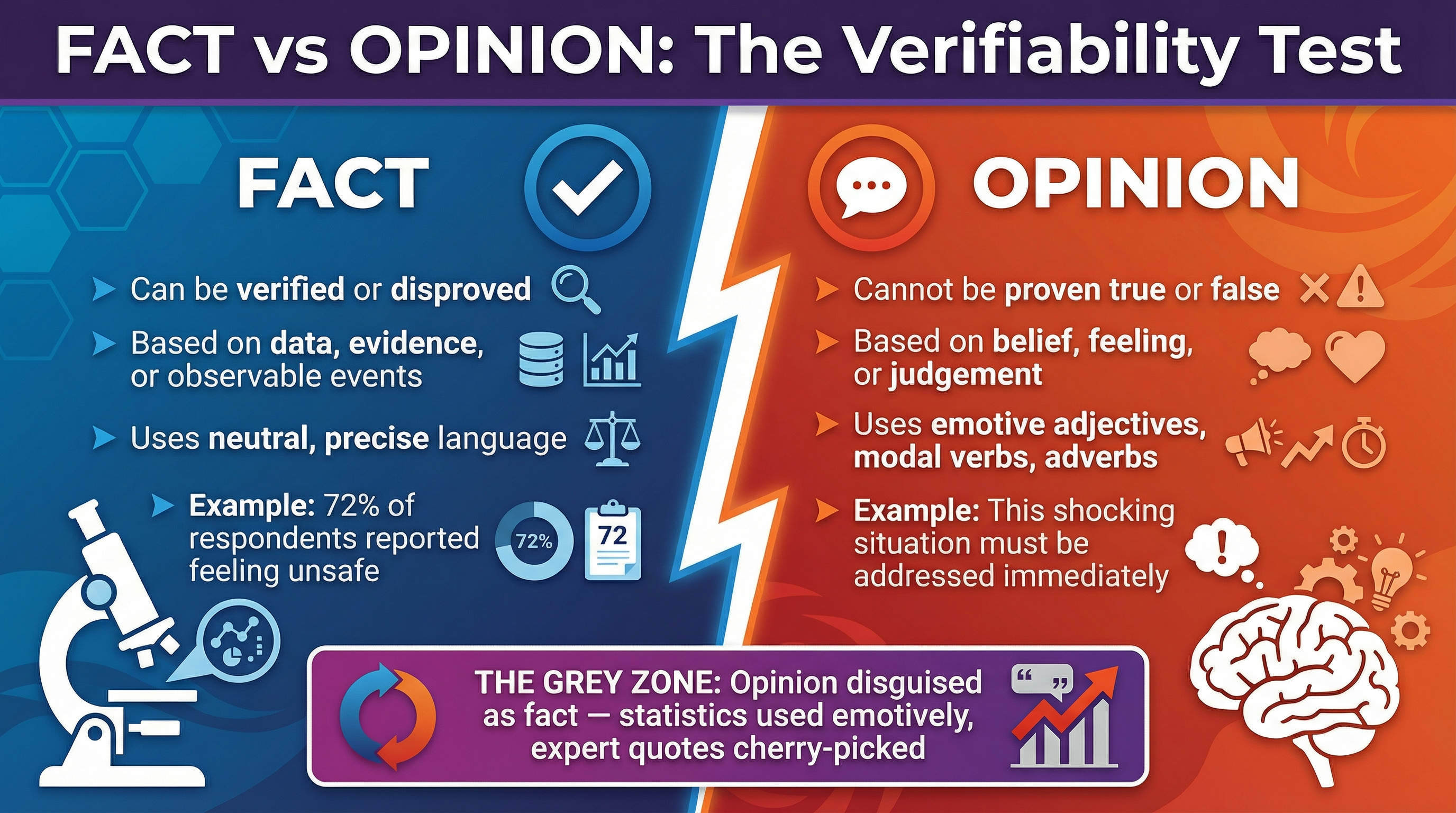
    The Verifiability Test: A visual guide to distinguishing fact from opinion.

    Analysing Linguistic Markers of Bias

    Examiners expect you to identify the specific words and phrases a writer uses to inject their viewpoint. Credit is given for using precise terminology to analyse these features.
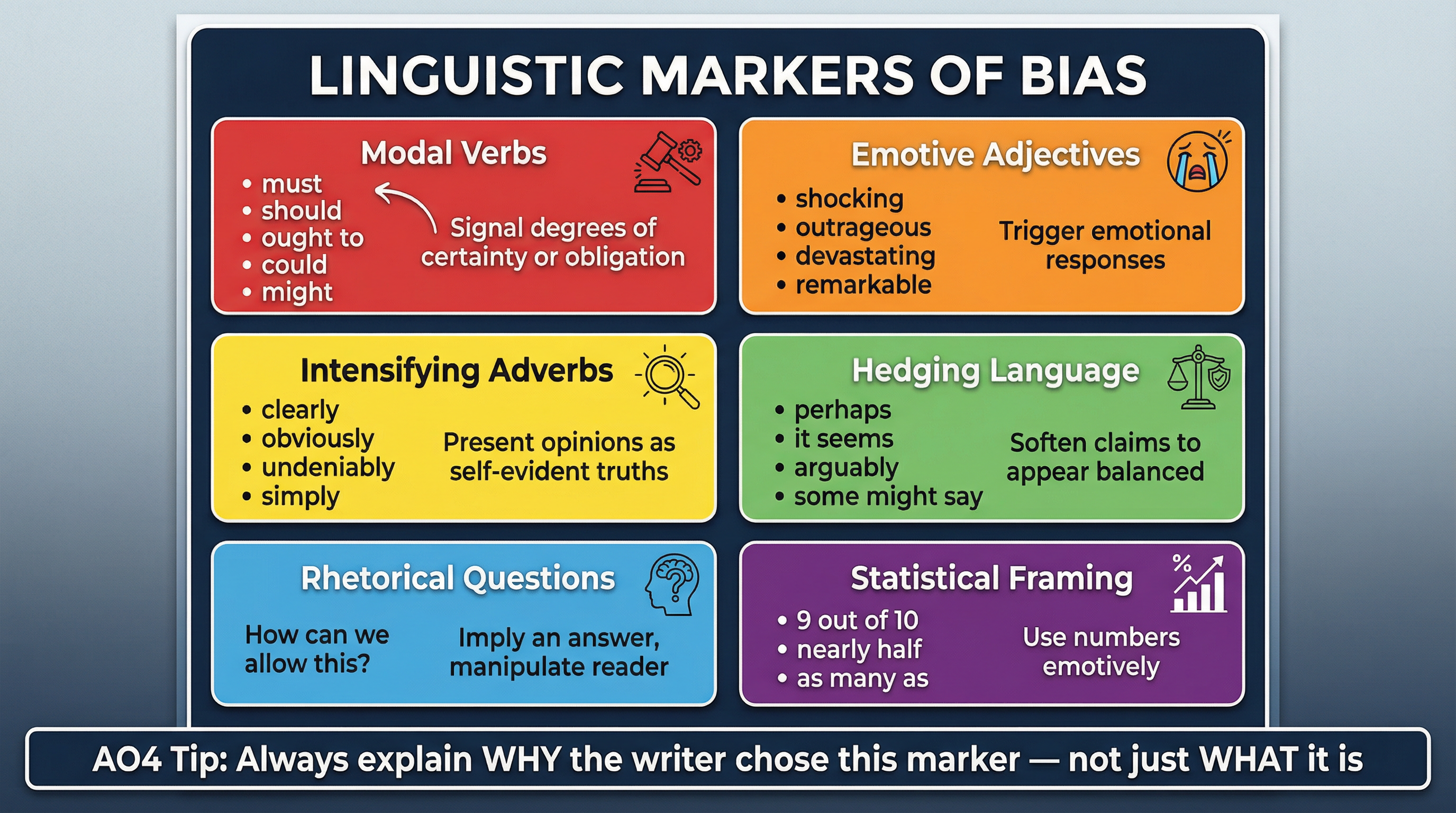
    A toolkit for identifying the linguistic markers of bias.

    FeatureDefinitionEffect on ReaderExaminer-Level Example
    Modal VerbsVerbs that indicate certainty, possibility, or obligation.Creates a sense of urgency or moral authority, making the writer's opinion seem like a necessary truth."The writer uses the modal verb 'must' to insist on a course of action, presenting their opinion as non-negotiable and creating a sense of urgency."
    Emotive AdjectivesWords that are deliberately chosen to provoke an emotional reaction.Steers the reader towards a specific emotional response (e.g., anger, pity, fear) before they can rationally assess the argument."The adjective 'devastating' frames the consequences in a highly negative light, encouraging the reader to feel outrage rather than consider the issue objectively."
    Intensifying AdverbsAdverbs that add force or certainty to a statement.Presents the writer's opinion as a self-evident fact, making it harder for the reader to disagree without appearing unreasonable."By using the adverb 'clearly', the writer attempts to close down debate, positioning their interpretation as the only logical one."
    Rhetorical QuestionsQuestions asked for effect rather than to elicit an answer.Manipulates the reader into agreeing with the implied answer, creating a sense of shared understanding or outrage."The rhetorical question positions the reader to agree with the writer's implied condemnation, making any alternative viewpoint seem untenable."
    Statistical FramingPresenting numerical data in a way that supports a particular viewpoint.Can make an issue seem more or less significant, depending on the writer's agenda. It lends an air of authority while being highly manipulative."The writer frames the statistic as 'a staggering 90%', using the adjective to create alarm, whereas another writer might frame the same data as 'a 10% minority'."

    Analysing Structural Bias

    Bias is also created through the deliberate structuring of a text.

    • Juxtaposition: Placing two opposing ideas or images side-by-side to create a stark contrast and imply that one is superior.
    • Selective Quoting: Cherry-picking quotes from experts or witnesses that support the writer's argument while ignoring those that don't.
    • Opening/Closing Positions: Placing the most powerful point at the beginning (primacy effect) or end (recency effect) to make it more memorable and impactful.
    • Paragraphing and Focus: Devoting significant space to one side of an argument while briefly dismissing the other.

    Evaluating Critically with the PEAL Framework

    To achieve the highest marks in AO4 (evaluation), you must move beyond identification and analyse why the writer has made these choices and how successful they are. The PEAL framework is essential for this.
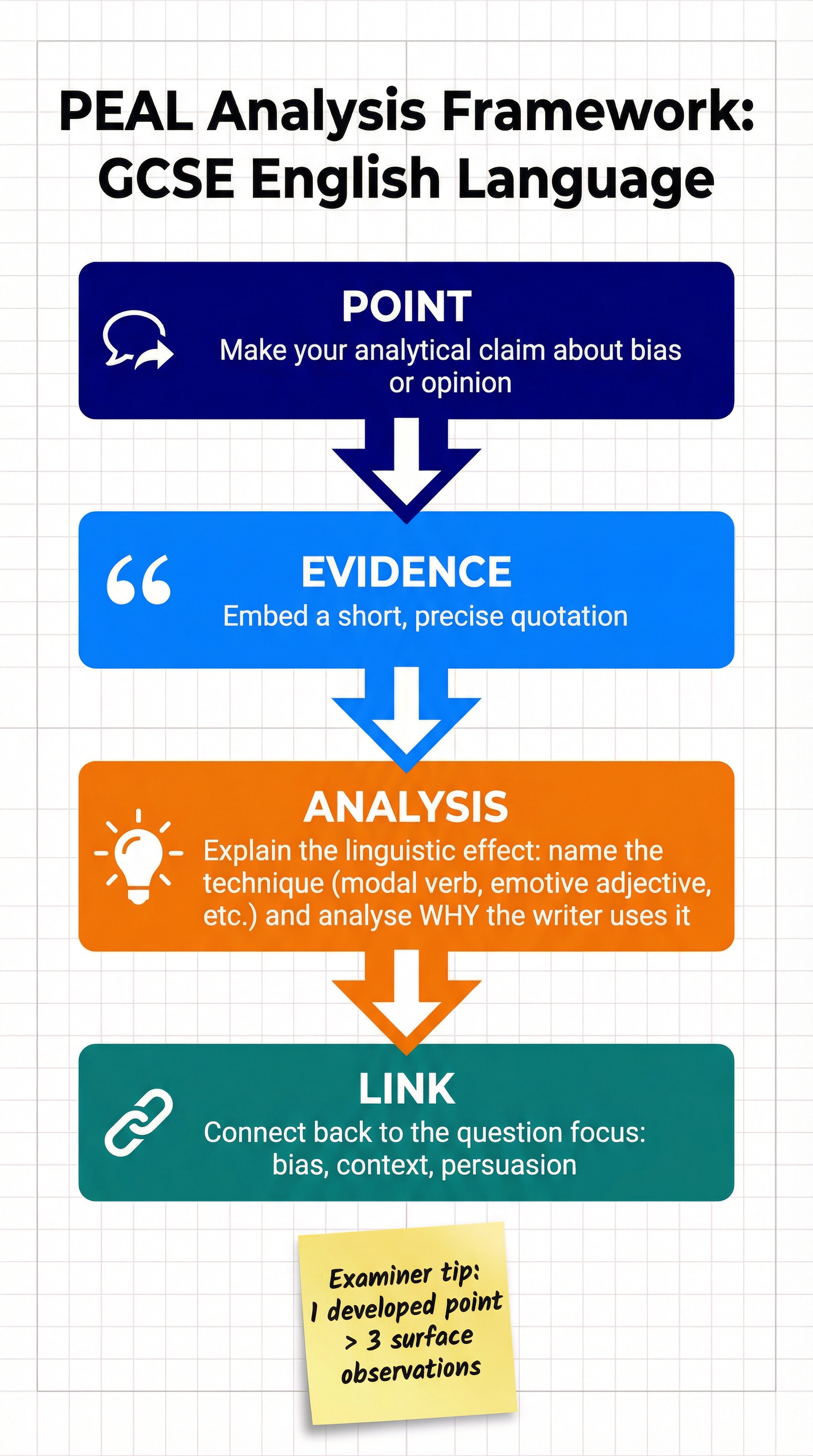
    The PEAL framework for high-level analysis.

    • Point: Make a clear, analytical statement about the writer's use of bias.
    • Evidence: Embed a short, relevant quotation to support your point.
    • Analysis: Explain the effect of the specific linguistic or structural feature you have identified. Use subject terminology. Crucially, analyse why the writer made this choice.
    • Link: Connect your analysis back to the overall argument and the question focus.

    Writing Skills: Using Bias and Context Persuasively

    Understanding how to analyse bias directly improves your own persuasive and transactional writing (AO5). You can consciously adopt a persona and manipulate language to create a specific effect on your audience.

    Crafting a Persona

    When you write a letter, article, or speech, you are adopting a voice. Is it an angry resident, a concerned expert, a passionate campaigner? Your choice of persona will determine your tone and register. To gain marks, you must sustain this persona consistently throughout your writing.

    Using AFOREST for Persuasion

    The AFOREST acronym is a powerful toolkit for building a persuasive argument in your own writing.

    • Alliteration & Anecdotes
    • Facts & Figures (even if you have to invent plausible ones for the exam)
    • Opinions (presented as facts)
    • Rhetorical Questions & Repetition
    • Emotive Language & Expert Quotes
    • Statistics & Superlatives
    • Three (Rule of)

    Technical Accuracy (SPaG)

    Technical accuracy (AO6) is not just about avoiding errors; it is about using punctuation and sentence structures for effect. Ambitious punctuation—such as semicolons to link related independent clauses, colons to introduce a list or explanation, and parenthetical dashes to add dramatic asides—signals to the examiner that you are a sophisticated writer. Varied sentence structures, moving between simple, compound, and complex forms, create a more engaging rhythm for the reader.

    Visual Resources

    3 diagrams and illustrations

    The Verifiability Test: A visual guide to distinguishing fact from opinion.
    The Verifiability Test: A visual guide to distinguishing fact from opinion.
    A toolkit for identifying the linguistic markers of bias.
    A toolkit for identifying the linguistic markers of bias.
    The PEAL framework for high-level analysis.
    The PEAL framework for high-level analysis.

    Interactive Diagrams

    2 interactive diagrams to visualise key concepts

    YesNoYesNoStart: Read TextIs the statement verifiable?It is a FACTDoes it contain judgement words?It is an OPINIONIt is OPINION disguised as FACTUse for evidenceAnalyse the linguistic markersAnalyse the manipulative intent

    Flowchart for distinguishing fact from opinion.

    Diagram could not be rendered

    Framework for comparing how two writers present their biased viewpoints.

    Worked Examples

    3 detailed examples with solutions and examiner commentary

    Practice Questions

    Test your understanding — click to reveal model answers

    Q1

    Identify one fact and one opinion from the following sentence: 'A recent poll showed that 78% of people support the new library, a truly wonderful result for our community.'

    2 marks
    foundation

    Hint: A fact can be proven. An opinion is a judgement.

    Q2

    How does the writer use language in the phrase 'This outrageous decision must be challenged' to show their bias?

    4 marks
    standard

    Hint: Identify the emotive adjective and the modal verb. Explain their effect.

    Q3

    Write a short speech to be given in a school assembly persuading students to volunteer for a local charity event. (10 marks)

    10 marks
    standard

    Hint: Use at least three AFOREST techniques. Adopt a passionate and inspiring tone.

    Q4

    Analyse how the writer uses structural features to build their argument that the internet is a force for good.

    8 marks
    challenging

    Hint: Look at the opening, the ending, and how the paragraphs are organised. Is there any juxtaposition?

    Q5

    A writer states: 'While some may argue for its benefits, the undeniable truth is that this new policy is a catastrophic failure that will harm us all.' Evaluate how successfully the writer blends fact and opinion to create a persuasive effect.

    12 marks
    challenging

    Hint: Consider how the writer acknowledges an opposing view only to dismiss it. Analyse the powerful, biased language used.

    Key Terms

    Essential vocabulary to know

    More English Language Study Guides

    View all

    Using Vocabulary and Sentence Structures

    OCR
    GCSE

    This guide focuses on mastering vocabulary and sentence structures for the OCR GCSE English Language exam. It covers how to analyse their effects in reading (AO2) and use them skilfully in writing (AO6) to maximise marks."

    Communicating Clearly and Effectively

    OCR
    GCSE

    This guide focuses on mastering OCR GCSE English Language Topic 2.4: Communicating Clearly and Effectively. It provides a comprehensive breakdown of the reading and writing skills required to excel in your exams, moving beyond simple feature-spotting to sophisticated analysis and production of language.

    Responding to Questions

    OCR
    GCSE

    This guide focuses on the core reading and writing skills for OCR GCSE English Language (J351). It breaks down how to analyse unseen texts for language and structure, evaluate writers' methods, compare perspectives, and produce high-impact creative and transactional writing under exam conditions.", "podcast_script": "OCR GCSE English Language: Responding to Questions - Educational Podcast Script Duration: Approximately 10 minutes Speaker: Female educator (warm, conversational, enthusiastic tone) [INTRO - 1 minute] Hello and welcome! I'm so glad you're here. Today we're diving into one of the most crucial skills for your OCR GCSE English Language exam: responding to questions effectively. Whether you're tackling Paper 1 or Paper 2, this skill is absolutely fundamental to your success. Now, I know what you might be thinking: "It's just answering questions, right? How hard can it be?" But here's the thing: the difference between a grade 5 and a grade 8 often comes down to how precisely you respond to what the examiner is actually asking. And that's exactly what we're going to master today. By the end of this session, you'll understand the key reading and writing skills tested in OCR English Language, you'll know exactly how to deconstruct different question types, and you'll have practical strategies to maximise your marks. So let's get started! [CORE CONCEPTS - 5 minutes] Let's begin with the foundation. OCR GCSE English Language is all about demonstrating your skills in reading and writing. Unlike English Literature, you're not analysing set texts or memorising quotes. Instead, you're showing examiners that you can read unseen texts critically and write with purpose and technical accuracy. The assessment objectives are your roadmap. AO1 is about identifying and synthesising information from texts. AO2 focuses on analysing how writers use language and structure. AO3 is all about comparing writers' viewpoints and perspectives. AO4 asks you to evaluate texts critically. And then we have AO5 and AO6 for your writing: AO5 rewards ambitious content and organisation, while AO6 assesses your technical accuracy—that's your spelling, punctuation, and grammar. Now, here's where candidates often go wrong: they treat every question the same way. But each question type demands a specific approach. Let me break this down for you. For reading questions, you need to master the "What-How-Why" framework. When a question asks you to analyse how a writer uses language, you can't just spot a metaphor and move on. That's what we call feature-spotting, and it won't get you beyond a Level 2. Instead, you need to identify WHAT technique the writer uses, quote it precisely and embed it in your sentence—that's the HOW—and then explain WHY it's effective, what impact it has on the reader. This is the difference between saying "the writer uses a metaphor" and saying "by describing the fog as a 'thick grey blanket, suffocating the city,' the writer creates a sense of oppression and claustrophobia, suggesting the city is being choked." Structure questions are another area where marks are lost. When you're asked about structure, the examiner wants you to discuss things like shifts in focus, changes in narrative perspective, sentence length variation, how the opening hooks the reader, or how the ending creates closure. Don't just retell the story—analyse the writer's structural choices and their effects. For comparison questions—and these are worth 10 marks on AO3—you must integrate your discussion. Don't write about Text A for three paragraphs and then Text B for three paragraphs. That's not comparison; that's two separate analyses. Instead, make conceptual links: both writers use emotive language, but Writer A employs it to evoke sympathy while Writer B uses it to provoke outrage. See the difference? Evaluation questions ask "to what extent do you agree" or "how far do you think the writer is successful." This is your chance to show critical thinking. Don't just agree with everything. A Level 4 response will offer a balanced view: "To some extent, the writer successfully creates tension through short, fragmented sentences. However, the reliance on clichéd imagery in the final paragraph undermines the overall impact." You're showing you can critique, not just summarise. Now let's talk about writing. Whether it's creative or transactional writing, the process is the same: plan, draft, and proofread. And I cannot stress this enough—planning is not optional. Five minutes spent planning will save you from rambling, repetitive writing. Identify your purpose, audience, and form. If you're writing a letter to your headteacher arguing for longer lunch breaks, your tone and vocabulary will be very different from a magazine article for teenagers on the same topic. For creative writing, remember the golden rule: show, don't tell. Don't write "she was angry." Write "her fists clenched, knuckles white, as she bit down on the words she wanted to scream." Use sensory details, vary your sentence structures, and create a compelling voice. For transactional writing, structure is king. Articles need headlines and subheadings. Speeches need direct address and rhetorical devices. Letters need formal openings and closings. And across all forms, use AFOREST: Alliteration, Facts, Opinions, Rhetorical questions, Emotive language, Statistics, and the rule of Three. These persuasive techniques will elevate your writing. [EXAM TIPS & COMMON MISTAKES - 2 minutes] Right, let's talk about the mistakes I see all the time—and how to avoid them. Mistake number one: not reading the question carefully. If the question says "analyse how the writer uses language in lines 10 to 20," don't analyse the whole text. You'll waste time and won't get extra marks. Be precise. Mistake number two: writing without a plan. I know you're under time pressure, but trust me, five minutes planning will result in a much stronger, more coherent response than 45 minutes of unplanned rambling. Mistake number three: feature-spotting. Saying "the writer uses alliteration" is not analysis. You need to explain the effect: "the sibilant sounds in 'slithering, silent serpent' create a sinister, threatening atmosphere." Mistake number four: not embedding quotations. Don't dump a long quote and then try to analyse it. Weave short, precise quotations into your own sentences. This shows you're in control of the evidence. Mistake number five: forgetting to proofread. Reserve five minutes at the end of the writing section to check for spelling errors, especially homophones like "their," "there," and "they're," and to fix any comma splices or run-on sentences. AO6 is worth 20% of your marks—don't throw those away. And here's a top tip for timing: you get roughly one mark per minute in English Language. A 4-mark question should take about 5 minutes. An 8-mark question, around 10 minutes. A 24-mark writing task, about 45 minutes including planning and proofreading. Stick to these timings and you won't run out of time. [QUICK-FIRE RECALL QUIZ - 1 minute] Alright, let's test your recall. I'll ask a question, and I want you to pause and answer it before I give you the answer. Ready? Question one: What does the acronym AFOREST stand for? [Pause] Answer: Alliteration, Facts, Opinions, Rhetorical questions, Emotive language, Statistics, and the rule of Three. Question two: What are the three steps in the What-How-Why analysis framework? [Pause] Answer: WHAT technique is used, HOW it's used—quote and embed it—and WHY it's effective, explaining the impact on the reader. Question three: How much time should you spend on a 24-mark writing question? [Pause] Answer: About 45 minutes, including 5 minutes for planning and 5 minutes for proofreading. Question four: Name two structural features you could analyse in a text. [Pause] Answer: Any two from: shifts in focus, changes in narrative perspective, sentence length variation, opening techniques, cyclical structure, use of flashback or foreshadowing, paragraph structure. Excellent! If you got those right, you're already on your way to exam success. [SUMMARY & SIGN-OFF - 1 minute] Let's recap what we've covered today. OCR GCSE English Language is all about demonstrating your reading and writing skills. For reading, use the What-How-Why framework, integrate your comparisons, and evaluate critically rather than just summarising. For writing, plan your response, match your tone to your audience and purpose, use persuasive techniques, and always proofread for technical accuracy. Remember: examiners reward precision, analysis, and technical control. Avoid feature-spotting, always embed your quotations, and manage your time carefully. You've got this. With practice and the right approach, you can absolutely achieve the grade you're aiming for. Keep practising, keep refining your skills, and remember—every mark counts. Thank you so much for listening, and best of luck with your revision. Now go and show those examiners what you're capable of! [END]"

    Writing for Audience, Purpose and Form

    OCR
    GCSE

    Writing for Audience, Purpose and Form is a core skill assessed in OCR GCSE English Language Component 02, Section B (Transactional Writing). Candidates must demonstrate sophisticated control of tone, register, and style (AO5) tailored precisely to the specified recipient, whether formal or informal, while maintaining technical accuracy (AO6). Mastering this skill is essential for earning top marks in the writing section.

    Organising Information and Ideas

    OCR
    GCSE

    This guide focuses on mastering AO5, the crucial skill of organising information and ideas for the OCR GCSE English Language exam. Candidates will learn to consciously structure their writing for sophistication and coherence, moving beyond simple sequencing to earn top marks."

    Evaluating Texts Critically

    OCR
    GCSE

    Evaluating Texts Critically is the cornerstone of Assessment Objective 4 (AO4) in OCR GCSE English Language, worth 20% of your overall grade. This skill requires you to form a critical judgement on how effectively a writer achieves specific effects through their choices of language, structure, and tone. Primarily assessed in Paper 2, Question 4, candidates must respond to a statement about a text and argue 'how far' they agree, using judicious evidence and evaluative language to demonstrate sophisticated literary judgement.