OCR · GCSE · English Language
Presenting Information Clearly
This guide focuses on mastering OCR GCSE English Language Component 02, Section B: Transactional Writing. It provides the essential skills for adapting tone, style, and register to produce clear, effective non-fiction texts like speeches, letters, and articles, securing high marks in AO5 (Content & Organisation) and AO6 (Technical Accuracy).
- 7 min read
- 3 worked examples
- 5 practice questions
- 8 key terms
Study Notes
Overview
Welcome to your definitive guide for OCR GCSE English Language, focusing on the crucial skill of Presenting Information Clearly. This skill is the cornerstone of Component 02, Section B (Transactional Writing), a task that requires you to write for a specific purpose, audience, and form. Worth a substantial 40 marks, this section assesses your ability to craft a piece of non-fiction writing that is not only engaging and persuasive but also technically precise. Candidates are expected to demonstrate confident control over language and structure, adapting their style to fit the context provided in the exam question. Success here is not about having the 'right' opinion, but about communicating your ideas with clarity, conviction, and control.
Writing Skills for Component 02, Section B
Unlike the creative writing task in Component 01, this section is about real-world communication. You will be asked to write a text, such as a formal letter, a speech, a leaflet, or an article, for a clearly defined reason. The key to earning top marks is to move beyond simply writing what you know and to focus on how you are writing it. Examiners are looking for a sophisticated understanding of how form, audience, and purpose dictate your linguistic and structural choices.
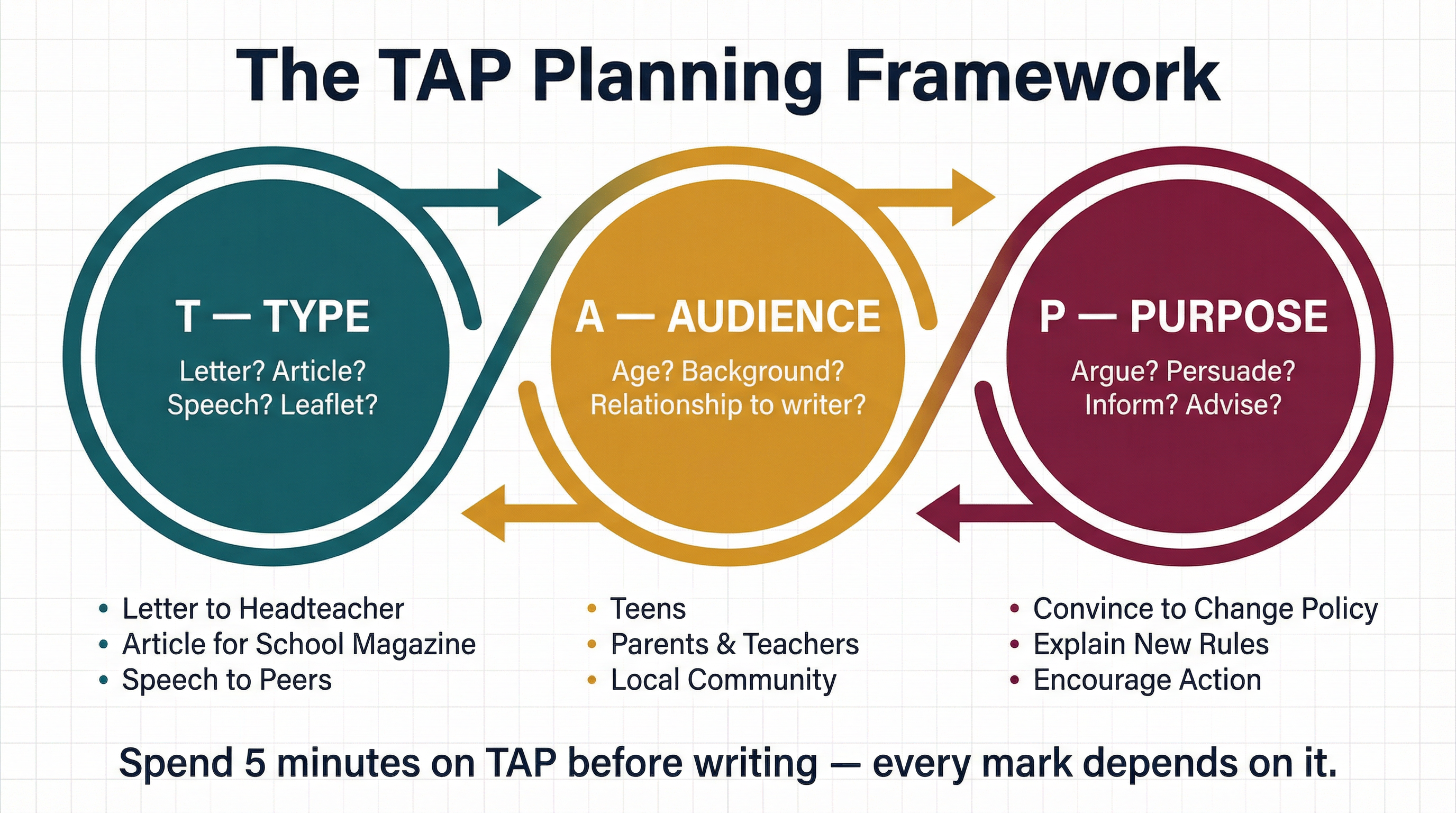
The Core Framework: Type, Audience, Purpose (TAP)
Before you write a single sentence, you must dedicate at least five minutes to planning using the TAP framework. This is non-negotiable for achieving a high-level response. Credit is explicitly awarded for responses that show a clear and sustained adaptation to the task's requirements.
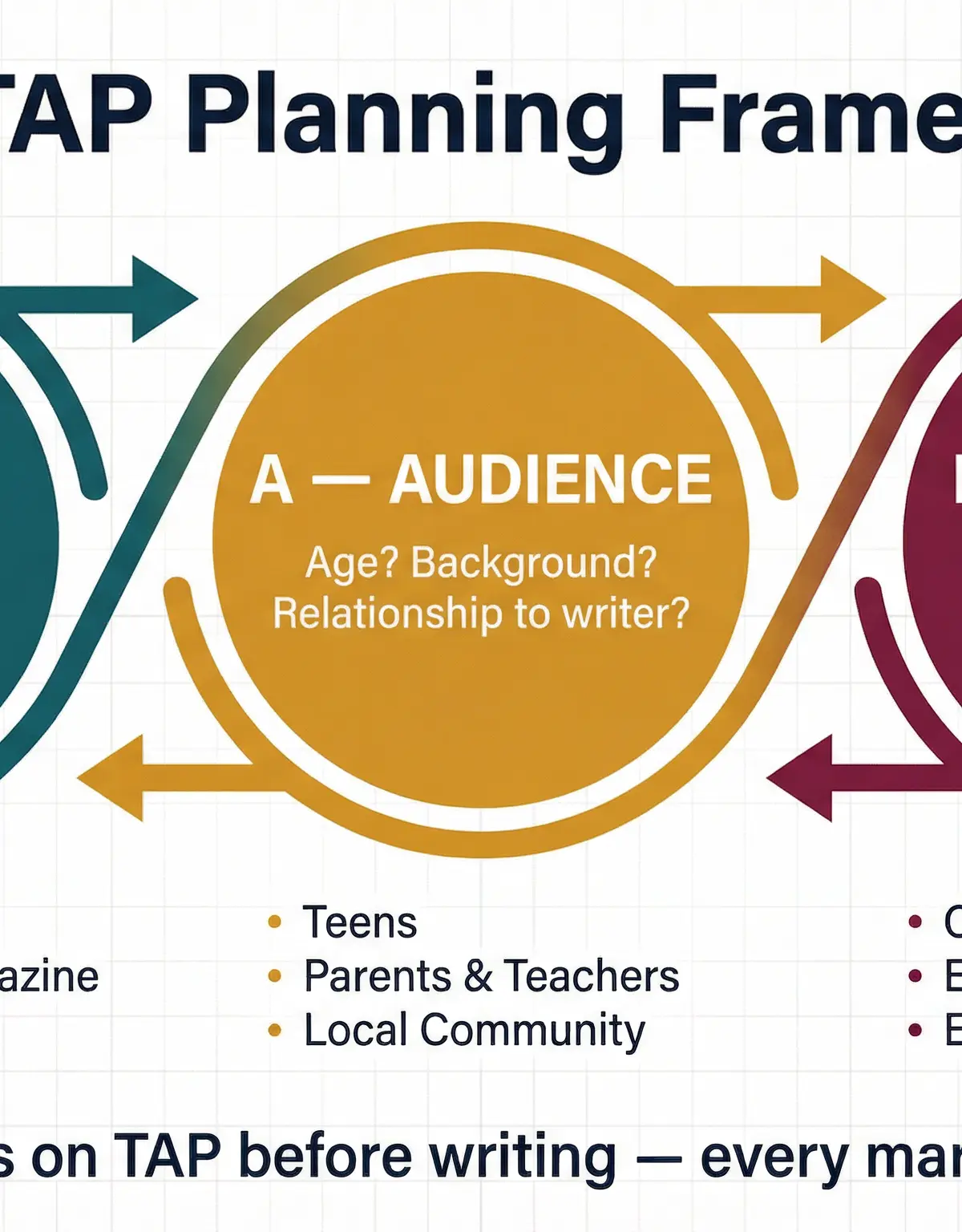
- Type: What is the form of the text? A formal letter has different conventions (address, salutation, sign-off) to a speech (direct address, rhetorical devices) or a magazine article (headline, subheadings, engaging tone). Failing to adhere to these conventions is a common reason for losing marks.
- Audience: Who are you writing for? A headteacher? Your peers? Readers of a broadsheet newspaper? Your choice of vocabulary, sentence structure, and overall tone (your register) must be perfectly calibrated to this audience. For example, writing to a headteacher would require formal language and a respectful tone, whereas an article for fellow students could use more colloquial language and direct address.
- Purpose: What is the goal of your writing? Are you arguing, persuading, informing, or advising? This purpose should drive every word you choose. A persuasive piece will lean heavily on rhetorical techniques, while an informative piece will prioritise clarity, facts, and a logical structure.
Structuring Your Response for Maximum Impact
Structural control is a key discriminator for AO5. A well-structured response guides the reader effortlessly through your argument. Avoid simply listing points; instead, craft a cohesive and compelling journey for your reader.
| Structural Element | Function & Examiner Advice | Example |
|---|---|---|
| Engaging Opening | Hook the reader immediately. Use a provocative question, a surprising statistic, or a bold statement. | 'Can we honestly say that a society that discards 91% of its plastic is a civilised one?' |
| Clear Paragraphing | Each paragraph should explore a single, distinct idea. Use topic sentences to signal the focus of the paragraph. | A paragraph on the environmental impact of plastic, followed by a separate paragraph on the economic costs. |
| Discourse Markers | Use sophisticated linking words and phrases to create cohesion and show the relationship between ideas. | 'Furthermore...', 'Conversely...', 'Notwithstanding this point...', 'Consequently...'. These force you into more complex sentence structures. |
| Cyclical Structure | Create a satisfying sense of closure by referencing an idea or image from your introduction in your conclusion. | If you start with a question about plastic, end by answering it or reflecting on its implications. |
Persuasive Techniques: The AFOREST Toolkit
For tasks that require you to argue or persuade, the AFOREST toolkit is your best friend. However, do not just 'feature-spot' or use these mechanically. The best candidates weave them seamlessly into their writing to create a powerful effect.
| Technique | Definition | Effect on Reader | Example |
|---|---|---|---|
| Alliteration | Repetition of the same consonant sound at the beginning of words. | Creates emphasis and makes phrases more memorable and impactful. | 'The persistent, pervasive problem of plastic pollution...' |
| Facts | Verifiable information used to lend authority and credibility to an argument. | Builds trust and makes the writer's position seem more logical and well-founded. | 'Over eight million tonnes of plastic enter our oceans every year.' |
| Opinions | The writer's personal viewpoint, often stated as if it were a fact. | Positions the reader to agree with the writer's perspective. | 'It is simply unacceptable that we continue to ignore this crisis.' |
| Rhetorical Questions | A question asked for effect, not requiring an answer. | Engages the reader directly, making them think and positioning them to agree. | 'How many more species must we lose before we act?' |
| Emotive Language | Words chosen to evoke a strong emotional response. | Creates a powerful connection with the reader, making the argument more compelling. | 'Innocent marine creatures are suffering a slow, agonising death.' |
| Statistics | Numerical data used to provide concrete, scientific-sounding evidence. | Adds weight and credibility to an argument, making it harder to refute. | 'A staggering 91% of all plastic is never recycled.' |
| Three (Rule of) | Listing three related ideas or words in a row. | Creates a rhythmic, memorable, and emphatic effect. | 'We must act now, act decisively, and act together.' |
Technical Accuracy (SPaG) for AO6
Technical accuracy is worth 20% of the marks for this section. Control over spelling, punctuation, and grammar is not just about avoiding errors; it's about using them with ambition and precision to enhance your meaning.
- Sentence Demarcation: This is the most critical skill. You MUST use full stops and capital letters correctly. Avoid comma splices at all costs (using a comma to join two independent clauses). Responses with persistent comma splicing cannot achieve the higher levels for AO6.
- Ambitious Punctuation: To access the top bands, you should demonstrate confident use of a range of punctuation. This includes:
- Semicolons (;): To link two closely related independent clauses. Example: The evidence is overwhelming; we must change our behaviour.
- Colons (:): To introduce a list, an explanation, or a quotation. Example: The problem can be summarised in one word: plastic.
- Dashes (-): To add dramatic emphasis or a piece of additional information. Example: The solution is simple - but it requires collective will.
- Parenthetical Commas: A pair of commas used to embed extra information in a sentence. Example: The council, despite its promises, has failed to act.
- Vocabulary: Use precise and sophisticated vocabulary that enhances your tone. Instead of 'bad', consider 'detrimental', 'damaging', or 'counterproductive'. Instead of 'good', try 'beneficial', 'invaluable', or 'constructive'.
Visual Resources
2 diagrams and illustrations
Interactive Diagrams
2 interactive diagrams to visualise key concepts
Conceptual Flow Outline
Flowchart for a high-level transactional writing response.
Conceptual Flow Outline
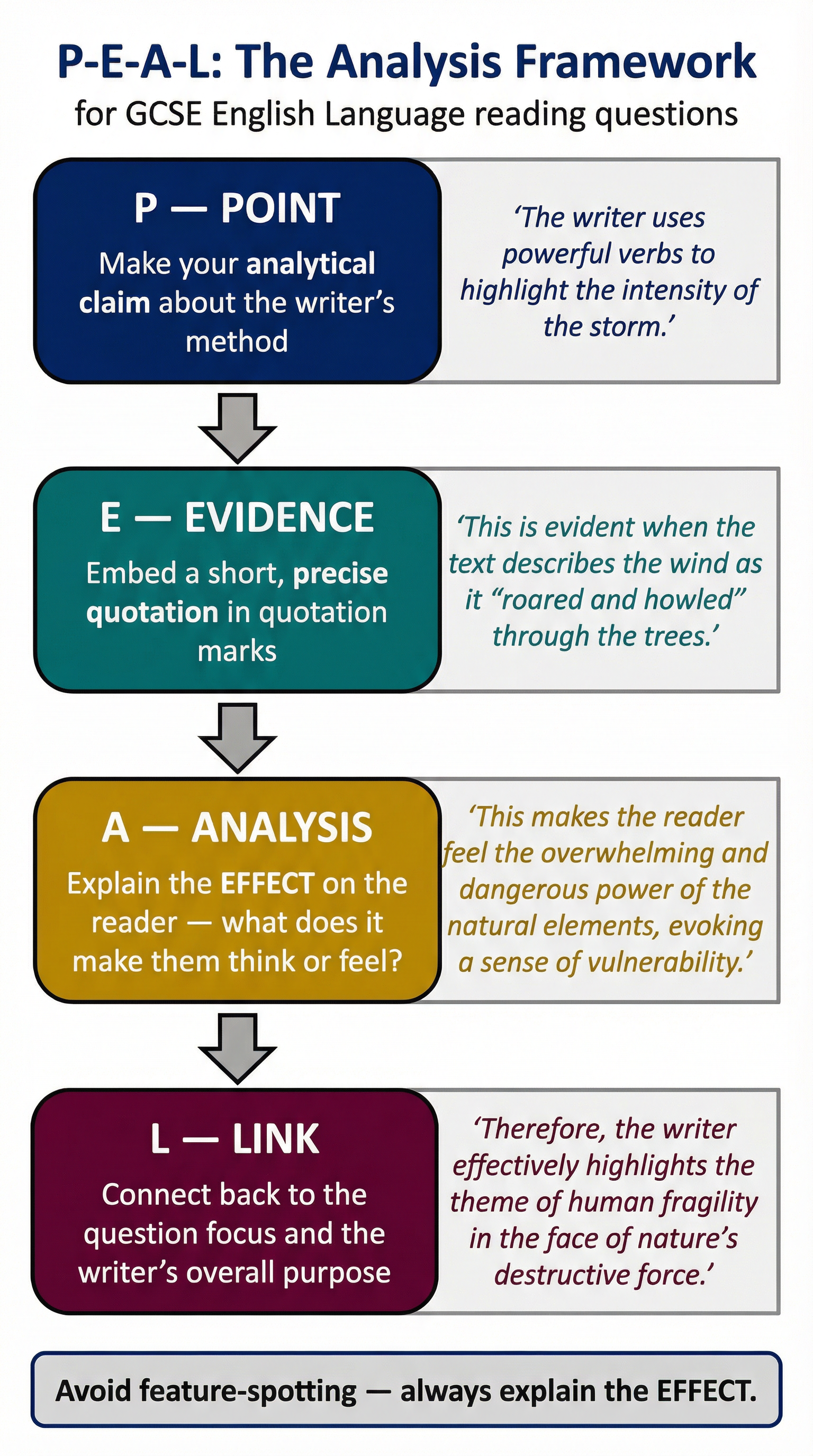
Diagram showing the relationship between reading analysis skills and effective writing techniques.
Worked Examples
3 worked examples — open one to explore the question and available guidance.
Practice Questions
Test your understanding — click to reveal model answers
Identify three persuasive techniques used in the following sentence: 'This catastrophic situation, a direct result of our carelessness, demands an immediate, intelligent, and integrated response.'
Hint: Look for emotive words, lists, and sophisticated vocabulary.
Rewrite the following sentence to correct the comma splice: 'The school needs a new recycling policy, the current one is ineffective.'
Hint: You can use a full stop, a semicolon, or a conjunction.
Write the opening paragraph of an article for a travel magazine about a holiday destination you dislike. (AO5)
Hint: Think about your audience (travel enthusiasts) and purpose (to inform/entertain with a negative slant). Use an engaging hook and establish a clear, cynical tone.
Write a single paragraph arguing that social media has a detrimental effect on young people's mental health. Use at least one semicolon and one example of the rule of three. (AO5 & AO6)
Hint: Structure your paragraph with a clear topic sentence. Your semicolon should link two closely related independent clauses.
You are a former student who has become a successful entrepreneur. Write the text for a speech to be given to current Year 11 students, advising them on how to be successful. (Full Task)
Hint: Use the full TAP and AFOREST frameworks. Your audience is young, so your tone should be inspiring and relatable, not arrogant. Structure your speech with a hook, clear points, and a memorable conclusion.
Test your understanding of Presenting Information Clearly
Active recall beats re-reading. Take an instant quiz now to test what you’ve learned and lock it into long-term memory.
7 days Premium · Then free forever · No card, no charge