OCR · GCSE · English Language
Selecting and Synthesising Evidence
This guide focuses on the crucial skill of Selecting and Synthesising Evidence for OCR GCSE English Language Paper 2, Question 2. You will learn how to combine information from two non-fiction texts to earn high marks for AO1, avoiding common pitfalls like confusing synthesis with comparison."
- 6 min read
- 3 worked examples
- 5 practice questions
Study Notes
Overview
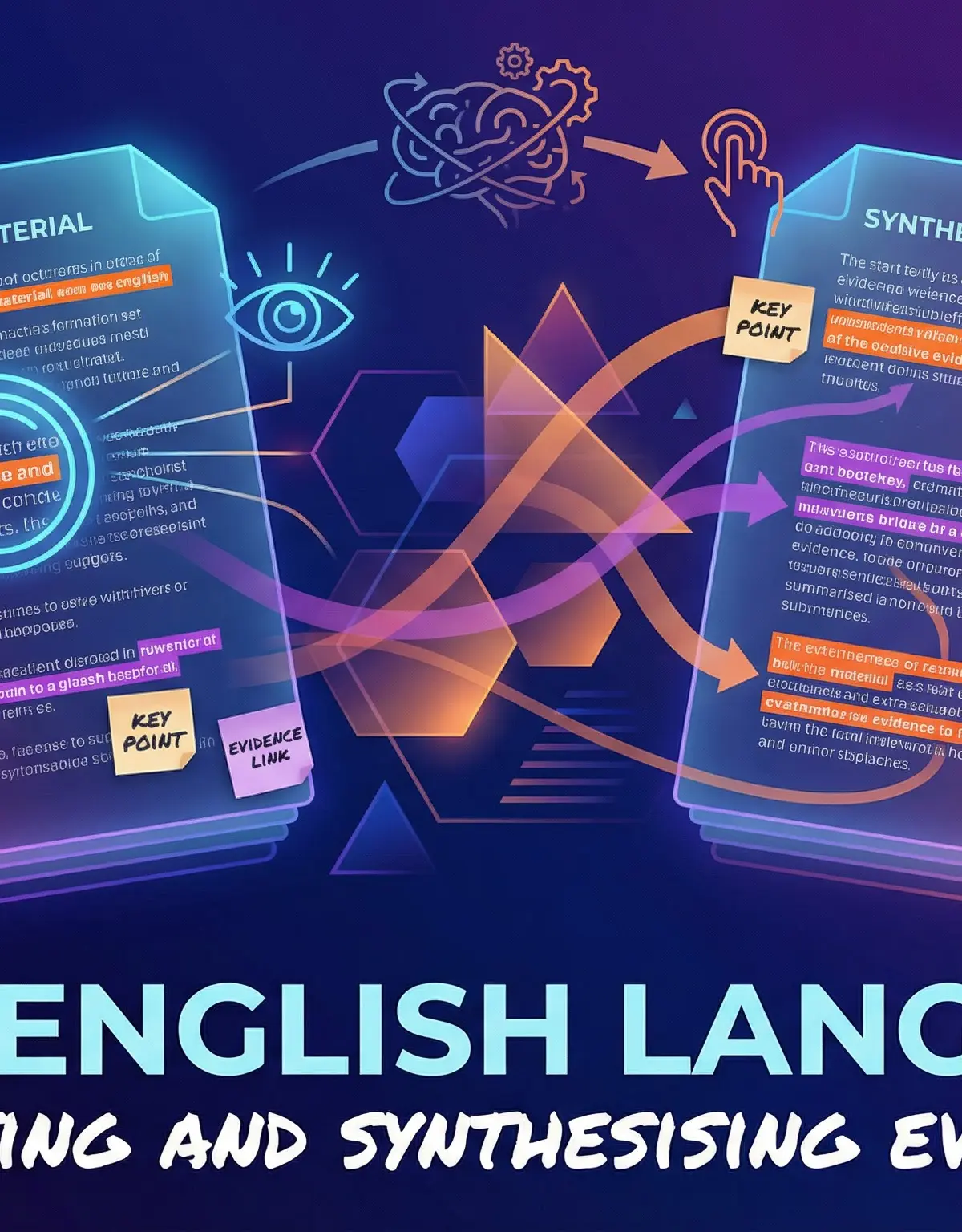
Welcome to your deep-dive into Selecting and Synthesising Evidence, a key reading skill for your OCR GCSE English Language exam. This skill is exclusively tested in Paper 2, Question 2, and is worth a significant 15 marks. The assessment objective is **AO1: Identify and interpret explicit and implicit information and ideas; select and synthesise evidence from different texts.**In simple terms, you are required to read two non-fiction texts and combine information from both to answer a specific question. You are not being asked to compare the texts, analyse the writers' language, or evaluate their viewpoints. Think of yourself as a detective, gathering clues from two different witness statements to build a single, coherent picture of an event.
Mastering this skill is essential for a high grade. It requires you to read carefully, select precisely, and write fluently. This guide will equip you with the techniques and knowledge to do just that.
The Core Skill: Synthesis Explained
Synthesis is the process of combining elements to form a coherent whole. In this exam question, it means blending information and ideas from two separate texts into a single, focused answer. The key is to reshape the material in your own words, demonstrating that you have understood and processed it, rather than just copying it out.
Synthesis vs. Comparison
A common error is to confuse synthesis with comparison. Examiners are very clear on this distinction.
| Aspect | Synthesis (Question 2) | Comparison (Question 4) |
|---|---|---|
| Focus | Combining factual content and ideas from two texts. | Analysing how writers present their different viewpoints and perspectives. |
| What you write about | What you learn about the topic in the question (e.g., challenges, experiences). | The writers' methods (language, structure, tone) and how they shape meaning. |
| Connectives | Similarly, In addition, Furthermore, Likewise. | In contrast, However, Whereas, On the other hand. |
| Assessment Objective | AO1 | AO3 |
Getting this wrong is a major pitfall. If you start comparing in Question 2, you will not be rewarded with marks.
The 'Concept-Evidence-Evidence' Framework
To structure your response effectively and ensure you are synthesising rather than just listing points, use the Concept-Evidence-Evidence (CEE) framework. This is a highly effective way to build your paragraphs and impress the examiner.
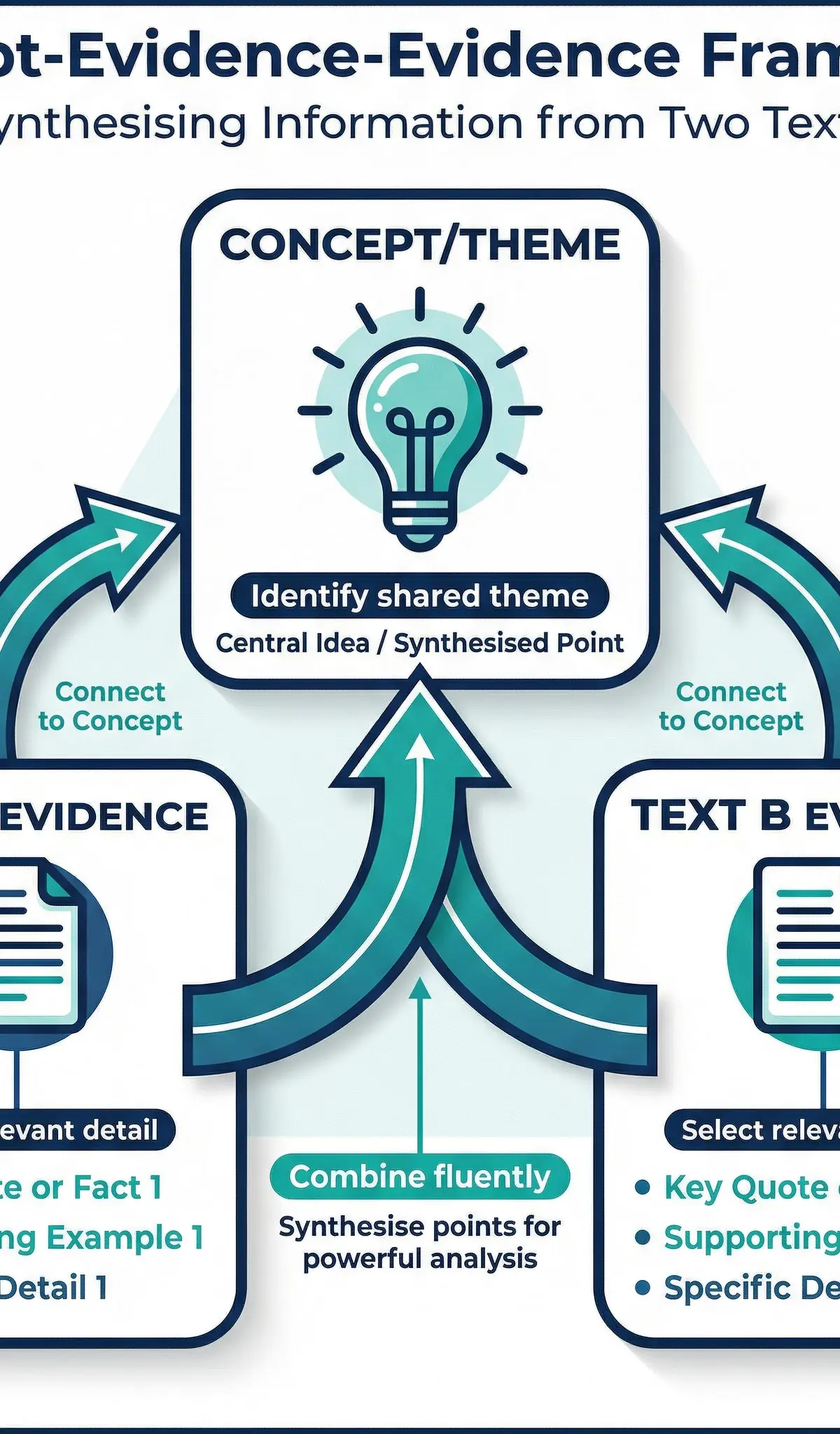
- Concept: Start your paragraph with a clear topic sentence that identifies a shared idea or theme from both texts that relates to the question's focus.
- Evidence (Text A): Provide a specific detail, fact, or example from the first text to support your concept. You should embed a short quotation or paraphrase the information.
- Evidence (Text B): Provide a specific detail, fact, or example from the second text that also supports the same concept. Use a connective to link it smoothly to the previous point.
By following this structure, you are naturally synthesising evidence to support a single, overarching point.
Step-by-Step Guide to Answering Question 2
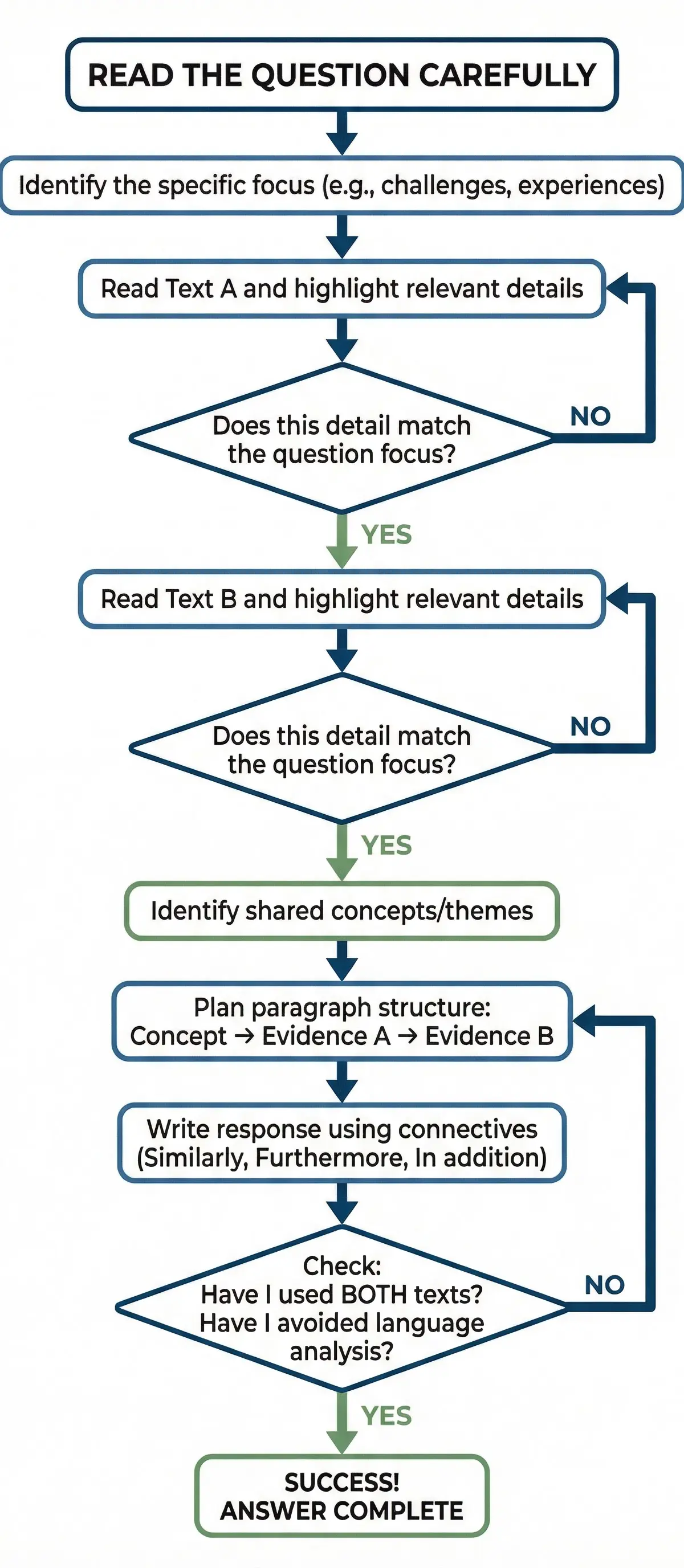
Follow this process to approach the question methodically and efficiently.
-
Deconstruct the Question (2 minutes): Read the question very carefully. Underline the specific focus. Are you being asked about challenges, benefits, experiences, or something else? All your points must relate directly to this focus.
-
Read and Annotate Text A (3 minutes): Read the first text with the question focus in mind. Using a highlighter or pen, select and label any details, facts, or ideas that are relevant. Don't highlight whole paragraphs; be precise.
-
Read and Annotate Text B (3 minutes): Do the same for the second text. As you read, you might start to see connections or shared themes with Text A. You could use a different colour or symbol to group similar ideas together.
-
Plan Your Concepts (2 minutes): Look at your annotations. Group the points you have highlighted into 3-4 shared concepts or themes. For example, you might group points about 'physical dangers' together, and points about 'emotional strain' together. These will become the 'Concepts' for your CEE paragraphs.
-
Write Your Response (10 minutes): Write your answer, dedicating one paragraph to each concept you planned. Use the CEE structure for each paragraph. Focus on writing fluently and using your own words as much as possible. Remember to use connectives to link your evidence from Text A and Text B.
-
Review (1-2 minutes): Quickly re-read your answer. Have you used both texts? Have you stuck to the question's focus? Have you avoided analysing language? This final check can save you from losing easy marks.
Advanced Skills: Reading Between the Lines
To achieve the highest marks (Level 4), you need to go beyond surface-level information and interpret implicit meanings. This is what the mark scheme means by a 'detailed, perceptive synthesis'.
- Explicit information is stated directly in the text. For example, 'The temperature dropped to minus forty degrees.'
- Implicit information is suggested or implied. For example, if a text describes a character staring out of a window with a single tear rolling down their cheek, it implies they are sad or upset, even if the text doesn't say so explicitly.
When you are selecting evidence, look for these subtle clues. When you write your answer, you can use phrases like 'This suggests...', 'This implies...', or 'From this, we can infer...' to show the examiner you are thinking perceptively."
Worked Examples
3 worked examples — open one to explore the question and available guidance.
Practice Questions
Test your understanding — click to reveal model answers
Based on two imaginary texts about volunteering, 'Summarise the benefits of volunteering for young people.'
Hint: Look for shared concepts in the texts, such as the development of new skills, or the positive impact on mental health. Structure your answer using the CEE framework.
Based on two imaginary texts about life in space, 'Summarise the psychological challenges of long-duration spaceflight.'
Hint: Focus on the mental and emotional difficulties. Look for implicit details. For example, if an astronaut mentions missing the smell of rain, what does that imply about their psychological state?
Based on two imaginary texts about Victorian prisons, 'Summarise what you learn about the conditions inside these prisons.'
Hint: Look for details about the physical environment, the food, the work prisoners had to do, and the rules they had to follow. Group these into concepts.
Based on two imaginary texts about the rise of social media, 'Summarise the effects of social media on modern society.'
Hint: The question is broad, so you can focus on a few key effects. Look for both positive and negative effects mentioned in the texts. For example, does it bring people together or push them apart?
Based on two imaginary texts about ancient Roman entertainment, 'Summarise what you learn about the gladiatorial games.'
Hint: Focus on what the games were like, who was involved, and why they were held. Look for details about the gladiators, the crowd, and the role of the Emperor.
Test your understanding of Selecting and Synthesising Evidence
Active recall beats re-reading. Take an instant quiz now to test what you’ve learned and lock it into long-term memory.
7 days Premium · Then free forever · No card, no charge