Understanding Writer's Purpose, Audience and Perspective — OCR GCSE Study Guide
Exam Board: OCR | Level: GCSE
Understanding a writer's purpose, audience, and perspective is a foundational skill for OCR GCSE English Language, tested across both reading (AO2, AO4) and writing (AO5, AO6) tasks. Candidates must deconstruct how writers manipulate language and structure to target specific demographics, and conversely, adopt convincing personas and registers in their own transactional writing to maximise marks.

## Overview
In OCR J351 English Language, the ability to identify and analyse a writer's **purpose**, **audience**, and **perspective** is not just a single skill—it is the lens through which you approach every reading and writing task. In the reading sections (Component 01 and 02), you are required to evaluate how successfully a writer has used language and structural choices to achieve their intended effect on a specific readership. In the writing sections, you must demonstrate your own mastery by adopting an appropriate tone, register, and style to communicate effectively with a given audience. This skill is weighted heavily: AO4 (evaluation) accounts for 10% of your total marks, while AO5 (content and organisation in writing) and AO6 (technical accuracy) together account for 40%. Understanding these three elements—purpose, audience, and perspective—unlocks success across the entire specification.
**Purpose** refers to the writer's reason for creating the text. Is the writer aiming to **persuade** you to adopt a viewpoint, **inform** you about a topic, **entertain** you with a narrative, **argue** a controversial position, or **advise** you on a course of action? The OCR mark scheme explicitly rewards candidates who can identify the purpose and link it to the writer's methods. For example, a persuasive text will employ rhetorical devices such as direct address, emotive language, and the rule of three, whereas an informative text will prioritise clarity, factual accuracy, and a logical structure.
**Audience** is the specific demographic or group the writer is targeting. Examiners penalise vague statements such as 'the general public' or 'everyone'. Instead, you must define the audience with precision. Are they teenagers familiar with social media culture? Parents concerned about their children's education? Experts in a scientific field? The writer's **lexical choices**—their selection of vocabulary—provide crucial clues. A text using colloquialisms like 'sick' or 'fire' is clearly not aimed at a formal, older demographic. Similarly, a text laden with technical jargon is targeting an expert audience, not a general readership. The register (formal or informal) and the complexity of syntax also signal the intended audience.
**Perspective** is the writer's viewpoint or attitude towards the subject. Is the writer biased, objective, sarcastic, enthusiastic, or critical? Their perspective colours every choice they make, from the adjectives they select to the examples they include. Your task is to identify this perspective and evaluate how it shapes the text's meaning and impact. For instance, a writer with a passionate, urgent perspective on climate change will use emotive language and short, dramatic sentences to create a sense of crisis, whereas a writer with an objective, detached perspective will use measured, impersonal language and complex sentence structures to convey authority.
These three elements are inextricably linked. The writer's **purpose** determines the **audience** they target, and their **perspective** influences the tone and style they adopt. In the exam, you must demonstrate your understanding of this interplay. For example, if a writer's purpose is to persuade teenagers to protest against climate change, and their perspective is passionate and urgent, you would expect to see informal, direct language ('You need to act now!'), emotive vocabulary ('devastating', 'catastrophic'), and short, punchy sentences for impact. Contrast this with a formal report for policymakers on the same topic: the purpose is to inform, the audience is expert, and the perspective is objective, so the language will be complex, impersonal, and full of statistics.
## Reading Skills: Analysing Purpose, Audience, and Perspective
### Identifying the Audience
The first step in any reading task is to define the audience. Look for **contextual clues** in the text itself. Where was it published? A broadsheet newspaper like *The Guardian* targets an educated, politically engaged readership, whereas a tabloid like *The Sun* targets a mass-market audience with simpler language and sensationalist headlines. What is the subject matter? A text about pension reform is unlikely to target teenagers, whereas a text about social media influencers is unlikely to target retirees.
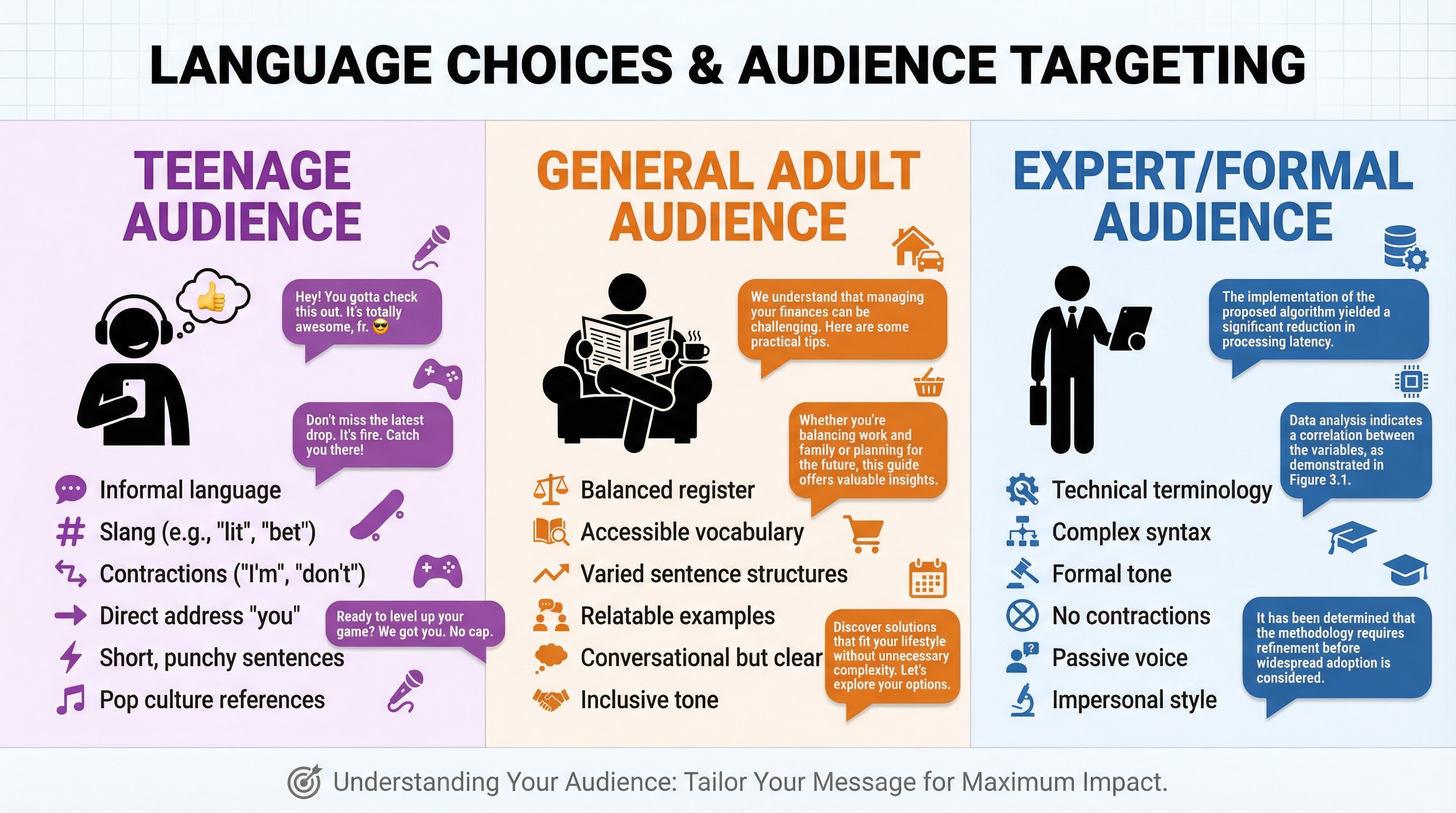
Next, examine the **lexical choices**. Formal vocabulary and technical terminology signal an expert or educated audience. Colloquialisms, slang, and contractions signal a younger, informal audience. For example, a text using phrases like 'let's be real' or 'no cap' is clearly targeting a teenage demographic. Conversely, a text using phrases like 'it has been determined that' or 'the implementation of the proposed algorithm' is targeting a formal, professional audience.
Finally, consider the **sentence structures**. Short, simple sentences are accessible to a general audience, whereas long, complex sentences with multiple subordinate clauses are aimed at a more sophisticated readership. The use of direct address ('you', 'we') creates an immediate, personal connection with the reader, whereas the passive voice and third-person pronouns create distance and formality.
### Analysing Language for Purpose and Perspective
Once you have identified the audience, you can analyse how the writer's **language choices** serve their purpose and reveal their perspective. The OCR mark scheme (AO2) awards credit for detailed analysis of how specific words and phrases create meaning and effect. You must go beyond **feature-spotting**—simply naming a technique earns zero marks. Instead, you must explain the **effect** on the reader.
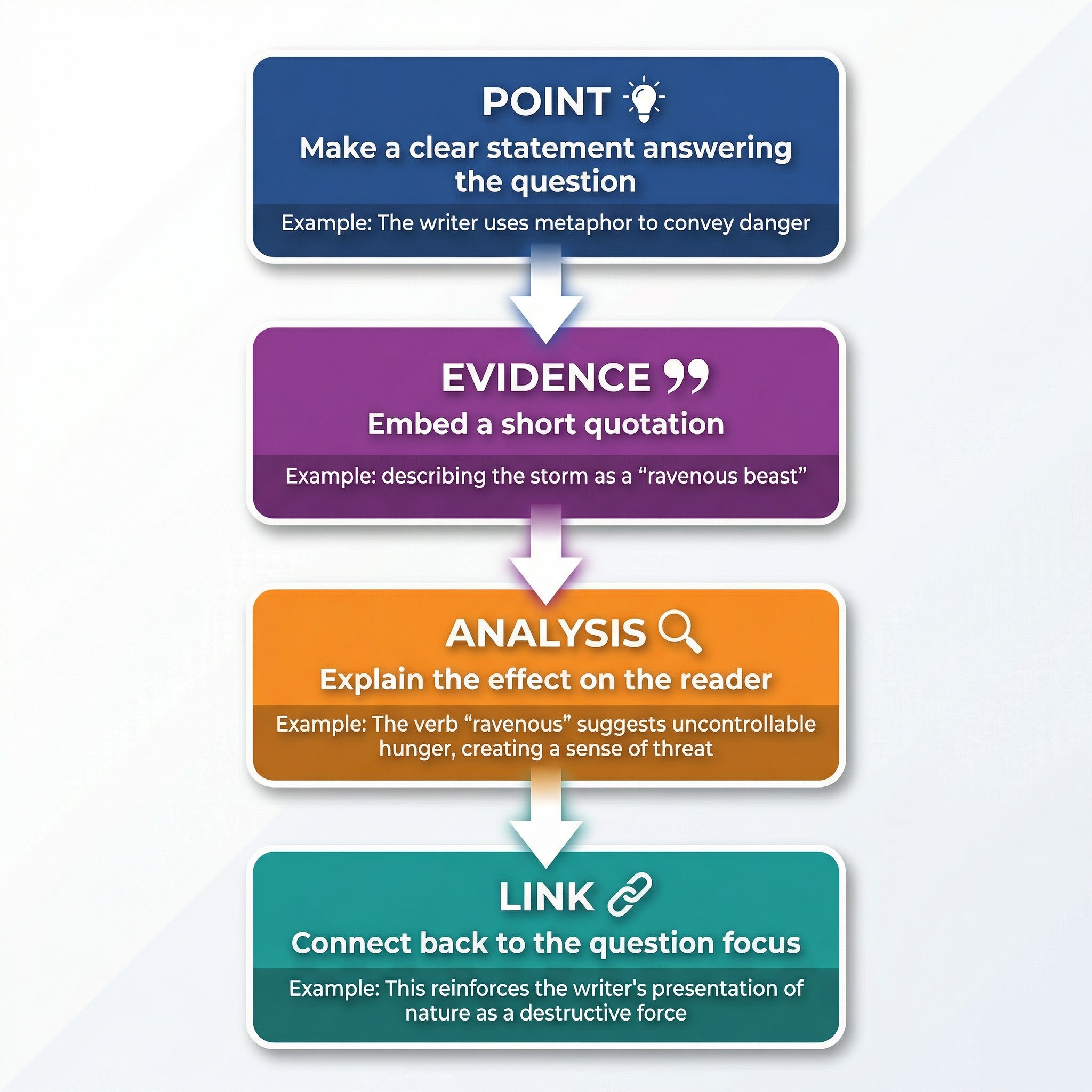
Consider the following example: 'The writer uses a metaphor, describing the storm as a "ravenous beast".' This is feature-spotting. To earn marks, you must analyse the effect: 'The metaphor "ravenous beast" personifies the storm, attributing it with animalistic hunger and aggression. The adjective "ravenous" connotes uncontrollable, insatiable appetite, which creates a sense of imminent danger and positions nature as a destructive, uncontrollable force. This aligns with the writer's purpose to warn the reader about the power of natural disasters.'
#### Key Language Features to Identify and Analyse
| Feature | Definition | Effect on Reader | Example |
|---|---|---|---|
| **Metaphor** | A direct comparison stating one thing *is* another | Creates vivid imagery; encourages the reader to see the subject in a new light | 'The city is a jungle' suggests danger, competition, survival |
| **Simile** | A comparison using 'like' or 'as' | Creates vivid imagery; makes abstract concepts more relatable | 'Her smile was like sunshine' suggests warmth, happiness, positivity |
| **Personification** | Giving human qualities to non-human things | Makes abstract or inanimate subjects more relatable and emotionally engaging | 'The wind whispered secrets' creates a mysterious, intimate atmosphere |
| **Emotive Language** | Words chosen to provoke an emotional response | Manipulates the reader's feelings to align with the writer's perspective | 'Innocent children are suffering' evokes sympathy and guilt |
| **Rhetorical Question** | A question asked for effect, not requiring an answer | Challenges the reader; provokes thought; implies the answer is obvious | 'Can we really stand by and do nothing?' implies inaction is unacceptable |
| **Direct Address** | Using 'you' or 'we' to speak directly to the reader | Creates intimacy and involvement; makes the message feel personal | 'You have the power to change this' empowers and motivates the reader |
| **Alliteration** | Repetition of initial consonant sounds | Creates rhythm; makes phrases memorable; emphasises key ideas | 'Brave, bold, brilliant' emphasises positive qualities |
| **Sibilance** | Repetition of 's' sounds | Creates a sinister, hissing effect; can suggest danger or secrecy | 'The snake slithered silently' creates a sense of menace |
| **Hyperbole** | Deliberate exaggeration | Emphasises a point; can create humour or drama | 'I've told you a million times' emphasises frustration |
| **Tricolon (Rule of Three)** | A list of three words, phrases, or clauses | Creates rhythm and completeness; makes the message persuasive and memorable | 'Government of the people, by the people, for the people' |
When analysing language, always link your analysis back to the **question focus**. If the question asks 'How does the writer present the dangers of climate change?', every point you make must connect to the idea of danger. Use discourse markers like 'This reinforces...', 'This further emphasises...', 'This contributes to...' to maintain a clear thread throughout your response.
### Analysing Structure for Purpose and Perspective
Structure refers to how the writer has organised the text to create meaning and effect. The OCR mark scheme rewards candidates who can analyse **structural features** such as openings, shifts in focus, narrative perspective, sentence length variation, and cyclical structure. Structure is not just about paragraphs—it is about the **journey** the writer takes the reader on.
**Openings** are crucial. A writer might begin with a shocking statistic to grab attention, a rhetorical question to provoke thought, or a vivid description to immerse the reader. For example, an article beginning with 'Every two seconds, a child dies from a preventable disease' immediately establishes the urgency and seriousness of the topic, aligning with a persuasive purpose.
**Shifts in focus** guide the reader's attention. A writer might shift from a general statement to a specific example, from past to present, or from the writer's perspective to the reader's. For instance, a text might begin by describing a global issue (climate change) and then shift to a personal anecdote ('I remember the summer when...') to make the issue more relatable and emotionally engaging.
**Narrative perspective** (first person 'I', second person 'you', third person 'he/she/they') affects the reader's relationship with the text. First person creates intimacy and authenticity, second person creates involvement and urgency, and third person creates distance and objectivity.
**Sentence length variation** controls pace and emphasis. Short sentences create tension, urgency, or impact. Long, complex sentences slow the pace and allow for detailed description or explanation. A writer might use a series of long sentences to build tension, then a short, punchy sentence to deliver a dramatic revelation: 'The storm raged for hours, tearing through the town, ripping roofs from houses, uprooting ancient trees. Then, silence.'
**Cyclical structure** involves ending the text with a reference to the opening, creating a sense of completeness or inevitability. This is particularly effective in persuasive writing, as it reinforces the central message.
### Evaluating Critically (AO4)
AO4 is tested in the 'How far do you agree...' or 'Evaluate how successfully...' questions. These are worth significant marks (typically 10-15) and require you to form and express a **critical judgement** about the writer's methods. The key to success is to avoid being entirely positive or entirely negative. Instead, adopt a balanced approach: 'To some extent, the writer is successful, however...'
Your evaluation must be **evidence-based**. Select specific quotations and analyse how they contribute to the writer's purpose. Then, offer a critical perspective. For example: 'The writer's use of emotive language, such as "innocent children are suffering", is highly effective in evoking sympathy and guilt in the reader, which aligns with the persuasive purpose. However, the reliance on emotional manipulation rather than factual evidence may alienate a more sceptical or educated audience, who might view the text as sensationalist rather than credible.'
Always link your evaluation back to the **audience**. A technique that is effective for one audience may be ineffective for another. For instance, colloquial language and humour might engage a teenage audience but would be inappropriate and ineffective for a formal, professional audience.
### Comparing Writers' Viewpoints (AO3)
In Component 02, you will be asked to compare how two writers convey their different perspectives on a similar topic. The mark scheme rewards candidates who can identify the **viewpoints** of both writers and compare the **methods** they use to convey those viewpoints.
Start by defining each writer's perspective in a single sentence. For example: 'Writer A presents social media as a dangerous, addictive force that harms young people's mental health, whereas Writer B presents it as a valuable tool for connection and self-expression.'
Then, compare the methods. Use a **point-by-point structure** rather than discussing each text separately. For example: 'Writer A uses emotive language such as "toxic" and "destructive" to create a sense of danger, whereas Writer B uses positive adjectives such as "empowering" and "liberating" to create a sense of opportunity. This contrast in lexical choices reflects their opposing perspectives.'
Always use comparative discourse markers: 'whereas', 'in contrast', 'similarly', 'on the other hand', 'both writers'. This signals to the examiner that you are actively comparing, not just describing.
## Writing Skills: Adopting Purpose, Audience, and Perspective
### Transactional/Non-Fiction Writing
In the writing section, you will be given a specific **purpose** (e.g., persuade, argue, inform, advise), **audience** (e.g., headteacher, local newspaper readers, teenagers), and **form** (e.g., letter, article, speech, leaflet). Your task is to adopt a convincing **persona** and maintain a consistent **register** throughout your response. This is where AO5 (content and organisation) and AO6 (technical accuracy) come into play.
**Before you start writing**, spend two minutes planning. Underline the specified audience in the question. Write down three adjectives to describe them (e.g., 'formal', 'educated', 'sceptical') and three 'power words' you can use to appeal to them (e.g., 'evidence', 'accountability', 'transparency'). This planning ensures you stay in character.
#### AFOREST: Persuasive Techniques
For persuasive writing, use the **AFOREST** framework to structure your argument:
- **A**lliteration: Creates rhythm and makes phrases memorable ('bold, brave, brilliant')
- **F**acts: Provide credibility and authority ('According to recent research...')
- **O**pinions: Assert your viewpoint confidently ('It is clear that...')
- **R**hetorical questions: Challenge the reader ('Can we afford to ignore this?')
- **E**motive language: Evoke sympathy, anger, or urgency ('innocent victims', 'devastating consequences')
- **S**tatistics: Provide concrete evidence ('75% of students report...')
- **T**hree (Rule of): Create completeness and impact ('for our children, for our future, for our planet')
#### Matching Form Conventions
Each form has specific conventions you must follow:
- **Letter**: Include addresses, date, greeting ('Dear Sir/Madam' for formal; 'Dear [Name]' for informal), sign-off ('Yours faithfully' if you don't know the name; 'Yours sincerely' if you do)
- **Article**: Include a headline, subheading, and byline ('By [Your Name]')
- **Speech**: Include a direct address to the audience ('Good morning, fellow students'), rhetorical devices, and a strong conclusion
- **Leaflet**: Use subheadings, bullet points (sparingly), and a clear structure with sections
#### Sustaining Register
The most common mistake in writing is **slipping out of character**. You might start a formal letter correctly ('I am writing to express my concern regarding...') but by paragraph three, you are using slang ('it's a bit rubbish'). This uneven register loses marks. To avoid this:
- **Formal audiences**: Avoid contractions ('do not' instead of 'don't'), use complex sentences, employ the passive voice ('It has been observed that...'), use formal vocabulary ('utilise' instead of 'use')
- **Informal audiences**: Use contractions, direct address ('you'), shorter sentences, colloquialisms (but avoid slang that might date quickly or be unclear)
### Technical Accuracy (SPaG)
AO6 accounts for 16% of your total marks, so technical accuracy is crucial. The mark scheme rewards **ambitious punctuation** and **varied sentence structures**.
**Ambitious punctuation** includes:
- **Semicolons**: Link two closely related independent clauses ('The government has failed to act; the consequences will be severe')
- **Colons**: Introduce a list, explanation, or quotation ('The solution is simple: invest in renewable energy')
- **Dashes**: Create emphasis or an aside ('The evidence—overwhelming and undeniable—speaks for itself')
- **Parenthetical commas**: Add extra information ('The headteacher, who has been in post for ten years, has announced her resignation')
**Varied sentence structures** include:
- **Simple sentences**: One independent clause ('The storm arrived.')
- **Compound sentences**: Two independent clauses joined by a conjunction ('The storm arrived, and the town was evacuated.')
- **Complex sentences**: An independent clause and one or more subordinate clauses ('When the storm arrived, the town was evacuated because the mayor feared for residents' safety.')
Use a mix of all three to create rhythm and maintain the reader's interest. Start some sentences with subordinate clauses ('Although the evidence is clear, many people remain sceptical.') or adverbs ('Undeniably, the situation is urgent.').
**Paragraph cohesion** is also important. Use discourse markers to link your ideas: 'Furthermore', 'Moreover', 'However', 'In contrast', 'Consequently', 'Therefore'. Each paragraph should begin with a clear topic sentence that signals the focus of that paragraph.
## Exam Technique: Maximising Marks
Time management is critical. The OCR specification provides clear guidance: spend approximately **one minute per mark**. For a 4-mark question, spend 5 minutes (including reading time). For an 8-mark question, spend 10 minutes. For a 24-mark writing task, spend 45 minutes, including 5-10 minutes for planning and 5 minutes for proofreading.
### Deconstructing Question Types
Each question type requires a specific approach:
- **Identify/List** (AO1): Find and write down specific information. Brief answers are sufficient. No need for full sentences.
- **How does the writer use language...** (AO2): Name the technique, embed a short quotation, explain the **effect** on the reader. Use the PEAL structure (Point, Evidence, Analysis, Link).
- **How does the writer use structure...** (AO2): Focus on shifts, patterns, narrative perspective changes. Link to meaning and effect.
- **Evaluate/How far do you agree...** (AO4): Give your opinion with evidence. Adopt a balanced approach ('To some extent... however...'). Justify both sides.
- **Compare** (AO3): Use point-by-point structure. Always link back to the comparison focus. Use comparative discourse markers.
- **Write a [text type]** (AO5/AO6): Match form conventions, sustain register, use ambitious vocabulary and punctuation. Plan before you write. Proofread after.
### Command Word Strategies
| Command Word | What It Means | How to Respond |
|---|---|---|
| **Identify/List** | Find specific information | Write down the information briefly; no need for explanation |
| **Explain** | Make clear how or why | Use 'because' or 'this shows that' to link cause and effect |
| **Analyse** | Examine in detail; break down into parts | Name the technique, quote it, explain the **effect** on the reader |
| **Evaluate** | Judge the success or effectiveness | Give your opinion with evidence; consider both strengths and weaknesses |
| **Compare** | Identify similarities and differences | Use comparative language; discuss both texts in each paragraph |
### Common Pitfalls to Avoid
1. **Feature-spotting without analysing effect**: 'The writer uses a metaphor' earns zero marks. You must explain the effect.
2. **Not embedding quotations**: Quotations should be short (1-3 words) and integrated into your sentence, not presented as separate blocks.
3. **Writing without planning**: Five minutes of planning saves you from a disorganised, rambling response.
4. **Forgetting to proofread**: Five minutes of proofreading can catch errors that lose you marks for AO6.
5. **Retelling the text instead of analysing it**: The examiner has read the text. Your job is to analyse, not summarise.
6. **Defining the audience too broadly**: 'The general public' is too vague. Be specific.
7. **Slipping out of register**: Maintain your persona throughout your writing response.
## Listen to the Podcast

Listen to this 10-minute podcast episode to reinforce your understanding of purpose, audience, and perspective. The podcast includes core concepts, exam tips, common mistakes, a quick-fire recall quiz, and a summary of key points.