Using Vocabulary and Sentence Structures — OCR GCSE Study Guide
Exam Board: OCR | Level: GCSE
This guide focuses on mastering vocabulary and sentence structures for the OCR GCSE English Language exam. It provides strategies to elevate reading analysis (AO2) and achieve sophisticated, accurate writing (AO5/AO6), ensuring candidates can consciously craft their responses for maximum marks.

## Overview
In OCR GCSE English Language, the ability to use vocabulary and sentence structures with precision is not just a desirable skill—it is a core requirement for achieving the higher levels of the mark scheme. This skill is assessed in two key areas: your analysis of unseen texts in the Reading sections (Paper 1 and Paper 2), and the technical accuracy and stylistic flair of your own writing in the Writing sections. Examiners are looking for candidates who can move beyond functional communication and demonstrate a conscious, deliberate control over language to shape meaning and engage the reader. This guide will equip you with the analytical frameworks and creative techniques to do just that.
{{asset:vocabulary_sentence_structures_podcast.mp3}}
## Reading Skills
### Identifying Information & Ideas
Candidates are required to locate and interpret both explicit (clearly stated) and implicit (suggested) information from a range of fiction and non-fiction texts. Credit is given for moving beyond surface-level comprehension. For example, if a writer states, "The sky was a bruised purple," the explicit information is the colour of the sky. The implicit idea, however, is one of menace, injury, or impending doom, which you must infer from the connotations of the word "bruised."
### Analysing Language
This is a high-tariff skill, primarily assessed under AO2. Candidates must analyse how writers use language to create meaning and effects. Simply identifying features ("feature-spotting") will not secure high marks. The key is to explain the *effect* of the chosen language on the reader.
#### Key Language Features to Identify
| Feature | Definition | Effect on Reader | Example |
|---|---|---|---|
| **Metaphor** | A figure of speech where a word or phrase is applied to an object or action to which it is not literally applicable. | Creates a powerful image by drawing a direct comparison, making an abstract concept more concrete or vivid. | "The classroom was a zoo." - Suggests chaos, noise, and lack of control. |
| **Simile** | A figure of speech comparing one thing with another thing of a different kind, using 'like' or 'as'. | Softens the comparison made in a metaphor, making it feel more descriptive and less absolute. | "He was as brave as a lion." - Emphasises courage by linking it to a known symbol of bravery. |
| **Pathetic Fallacy** | The attribution of human feelings and responses to inanimate things or animals, especially the weather. | Creates a specific mood or atmosphere that mirrors the emotional state of a character or the tone of the narrative. | "The rain wept down the windowpane as she said goodbye." - The rain reflects the character's sadness. |
| **Personification** | The attribution of a personal nature or human characteristics to something non-human. | Makes an object or concept more relatable and can create a specific tone (e.g., menacing, friendly). | "The wind whispered through the trees." - Suggests a gentle, secretive, or eerie sound. |
| **Alliteration** | The occurrence of the same letter or sound at the beginning of adjacent or closely connected words. | Can create a specific sound effect (e.g., harsh, soft), draw attention to key words, and make a phrase more memorable. | "The slippery snake slithered silently." - The 's' sound mimics the sound of a snake. |
| **Sibilance** | A specific form of alliteration focusing on the repetition of soft consonant sounds like 's' or 'sh'. | Often used to create a sinister, soft, or soothing sound, depending on the context. | "The sea hissed and sighed on the shore." - Creates a soundscape that can be either calming or menacing. |
| **Juxtaposition** | The fact of two things being seen or placed close together with contrasting effect. | Highlights the differences between two ideas, characters, or settings, often to create tension or irony. | Placing a description of extreme poverty next to one of extreme wealth. |
### Analysing Structure
Structural analysis (AO2) involves commenting on how a writer has organised a text to create effects. Consider the text as a whole journey. How does the writer guide the reader from beginning to end?
- **Openings**: How does the writer hook the reader? In media res? A shocking statement? A detailed description?
- **Shifts in Focus**: Where does the narrative perspective or topic change? Look for discourse markers like "However," "Meanwhile," or a simple paragraph break.
- **Narrative Perspective**: Is it first-person (I), third-person limited (he/she knows one character's thoughts), or third-person omniscient (he/she knows everyone's thoughts)? How does this choice affect what the reader knows?
- **Sentence Length Variation**: A sudden short sentence after a long, complex one can create tension or a dramatic impact. A series of short sentences can increase pace.
- **Paragraph Structure**: Are paragraphs short and punchy, or long and descriptive? How does this relate to the content?
- **Cyclical Structure**: Does the text end where it began? This can suggest a sense of entrapment or inevitability.
- **Flashback/Foreshadowing**: How does the writer play with time to reveal information and build suspense?
### Evaluating Critically
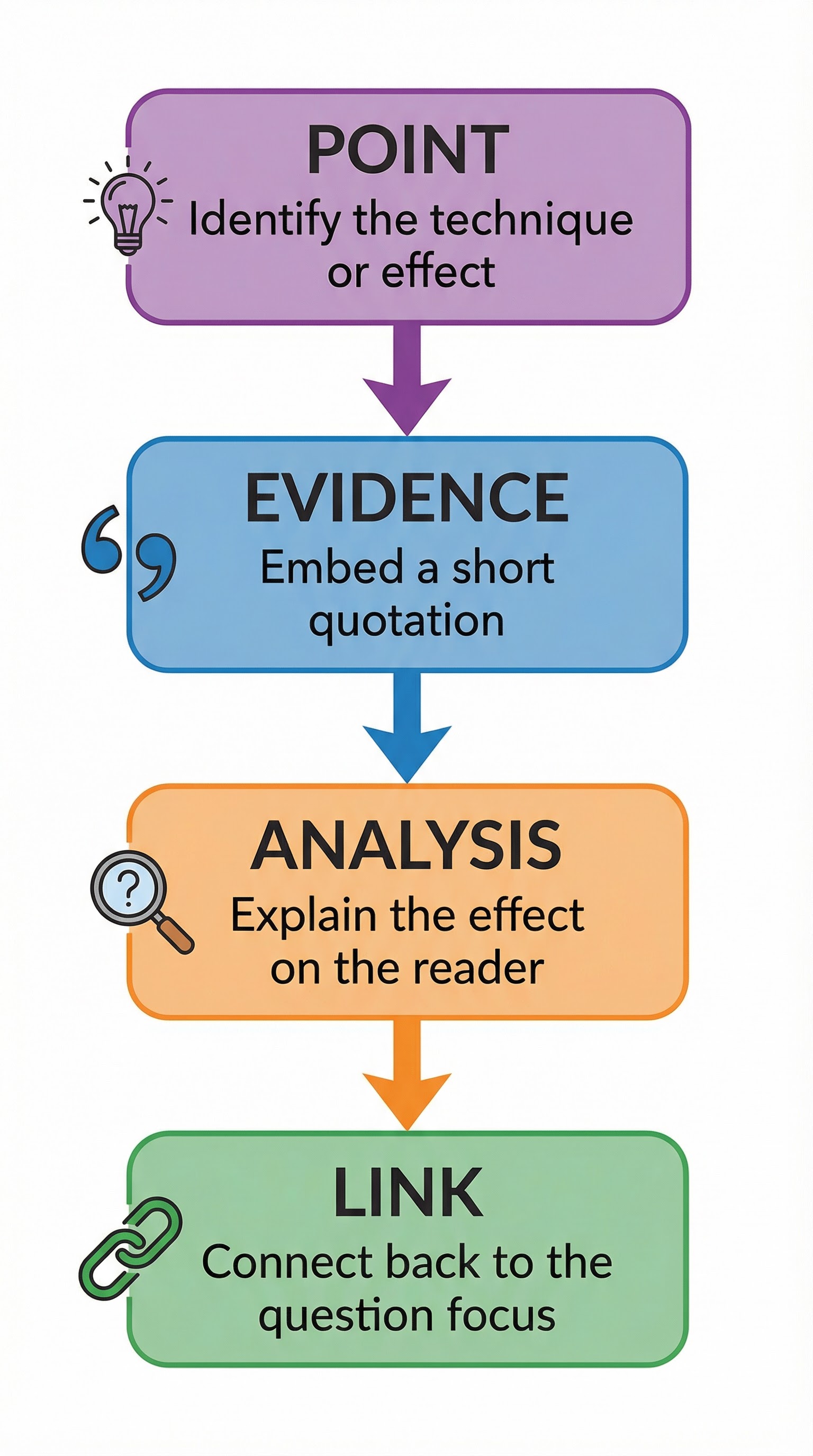
For AO4, you must evaluate a text critically, which means forming a judgement about its effectiveness and supporting it with evidence. A good structure for this is **Statement → Evidence → Analysis → Link**.
> **Statement**: The writer is highly successful in creating a sense of mystery.
> **Evidence**: For instance, they use the vague pronoun "it" to describe the creature: "It was a shadow in the corner of the room."
> **Analysis**: By withholding specific details and using ambiguous language, the writer forces the reader to imagine what the creature could be, tapping into universal fears of the unknown.
> **Link**: This technique is therefore extremely effective in building suspense and engaging the reader's imagination.
### Comparing Writers' Viewpoints
In Paper 2, you will compare how two writers present a similar topic. Avoid discussing Text 1 and then Text 2 separately. A better approach is to integrate your comparison point by point.
1. **Identify Viewpoints**: What is Writer A's attitude to the topic? What is Writer B's? Are they similar or different?
2. **Compare Methods**: How do they use language and structure to convey their viewpoints? (e.g., "Whereas Writer A uses emotive language to create sympathy, Writer B uses statistics to present a more objective argument.")
3. **Evaluate Effectiveness**: Which writer do you find more convincing and why?
## Writing Skills
### Creative Writing
This section (AO5 and AO6) requires you to write a narrative or description. Marks are awarded for content, organisation, and technical accuracy.
- **Show, Don't Tell**: Instead of telling the reader a character is nervous, show it: "He tapped a frantic rhythm on the arm of the chair, his leg bouncing uncontrollably."
- **Sensory Description**: Engage all five senses. What can be seen, heard, smelled, tasted, and touched? This creates an immersive world for the reader.
- **Varied Sentence Structures**: Use a mix of simple, compound, and complex sentences to control pace and rhythm. 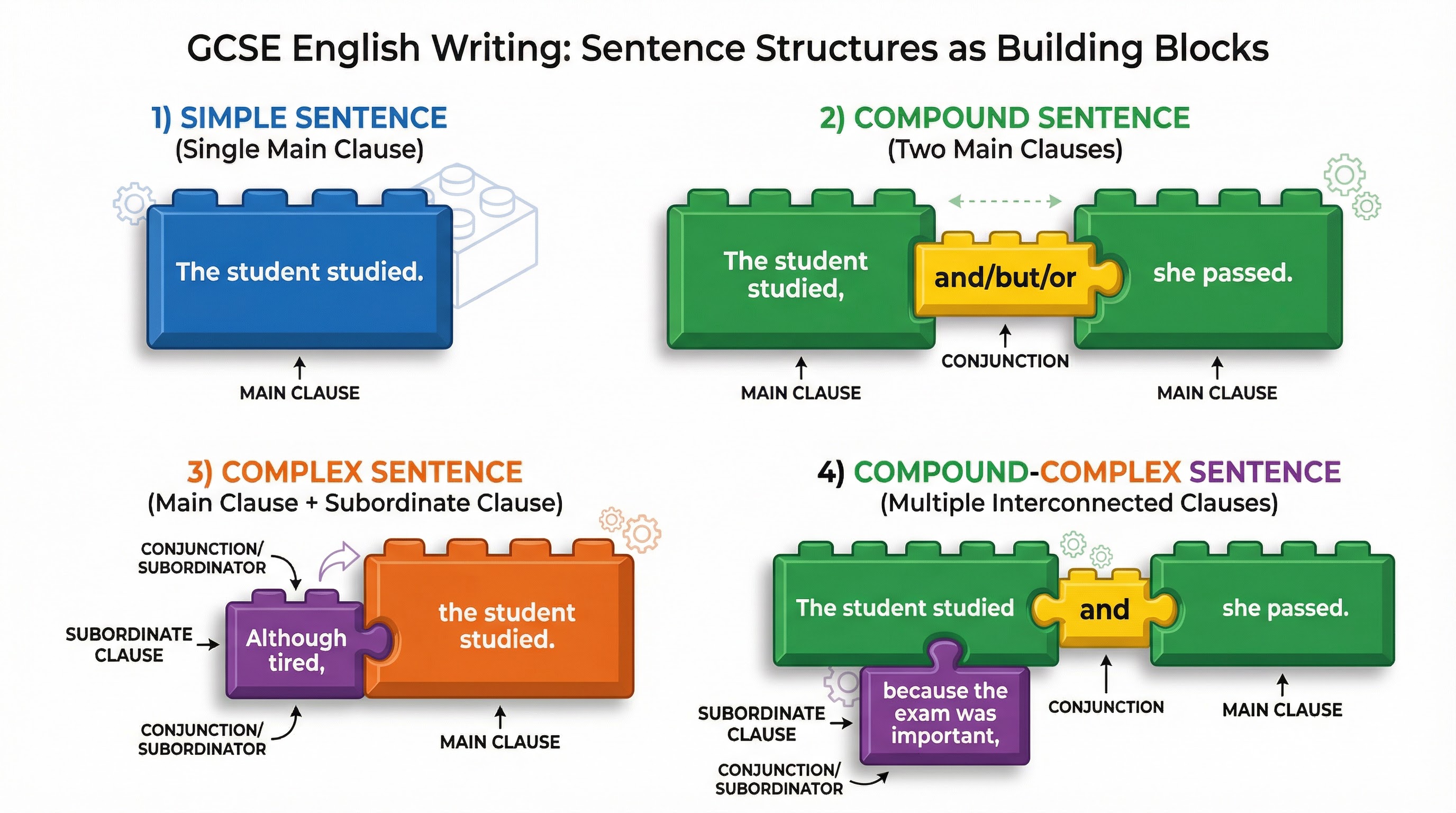
- **Engaging Openings**: Start with action, dialogue, or a mystery to hook the reader.
- **Satisfying Endings**: A good ending provides a sense of closure, even if it's ambiguous. A cyclical structure, returning to the opening image, can be very effective.
- **One-Scene Rule**: For short stories in an exam, it's often best to focus on a single, dramatic scene rather than trying to tell a multi-year epic.
### Transactional/Non-Fiction Writing
Here you will be asked to write for a specific purpose, audience, and form (e.g., a letter, article, speech, or leaflet).
- **Purpose-Form-Audience (PFA)**: Before you write, identify your **P**urpose (to argue, persuade, inform), your **F**orm (letter, speech), and your **A**udience (your headteacher, readers of a magazine). This will determine your tone and register.
- **AFOREST Persuasive Techniques**: Use this acronym to remember key persuasive devices: **A**lliteration, **F**acts, **O**pinions, **R**hetorical questions, **E**motive language, **S**tatistics, **T**hree (rule of).
### Technical Accuracy (SPaG)
Spelling, Punctuation, and Grammar (SPaG) are worth a significant portion of your writing marks (AO6). Perfect spelling and grammar are the baseline; to get top marks, you need to use **ambitious punctuation** correctly.
- **Semicolons (;)**: Used to link two closely related main clauses. It shows a sophisticated connection between ideas. (e.g., "The presentation was a success; the client was delighted.")
- **Colons (:)**: Used to introduce a list, an explanation, or a quotation. (e.g., "He had three options: fight, flee, or surrender.")
- **Dashes (-)**: Can be used to add extra information or create a dramatic pause.
- **Parenthetical Commas**: A pair of commas used to set off extra information in a sentence. (e.g., "The dog, a golden retriever, wagged its tail.")
Paragraphs must be cohesive, with each one focusing on a single idea and linked by discourse markers (e.g., "Furthermore," "In contrast," "Consequently").