AQA · A-Level · English Literature
Course version: 7717 · Version from Sept 2026
In all cases society itself (as represented in the texts), and the…
Full specification wording
Aspects of comedy: In all cases society itself (as represented in the texts), and the behaviour of men and women in it, are ridiculed.
Comedy often targets the social world rather than isolated individuals, exposing folly in manners, hierarchies and gender roles.
Checked against the AQA 7717 specification (opens in a new tab) on .
- Point 3 of 18
Study notes
From the checked teaching notes for this specification point.
The idea
Comedy often targets the social world rather than isolated individuals, exposing folly in manners, hierarchies and gender roles. Ridicule works through exaggeration, inversion and wit: characters embody social types, and their behaviour reveals the absurdity of prevailing norms. In Twelfth Night, Malvolio's puritanism and social ambition are mocked, while Viola's disguise exposes the constraints placed on women. In The Taming of the Shrew, courtship rituals and patriarchal authority are both performed and questioned.
What earns the marks
- Identifies specific social groups, institutions or conventions that the text holds up to ridicule.
- Analyses how language, disguise, exaggeration or inversion produce satirical effect.
- Examines the representation of male and female behaviour and the gender expectations being mocked.
- Considers the role of the audience in recognising and sharing the joke at society's expense.
- Evaluates whether the ridicule ultimately reinforces or challenges the social order represented.
Common mistakes and how to put them right
Claiming the text ridicules society without locating specific targets.
Put it right by naming the convention, character type or institution being mocked.
Confusing ridicule of a character with ridicule of the social values that character embodies.
Put it right by distinguishing individual folly from satirical critique.
Ignoring gender by treating male and female behaviour as interchangeable.
Put it right by analysing how expectations differ and how the text exposes that difference.
Exam tips
- Anchor each point in a short quotation or precise stage moment that demonstrates the ridicule.
- Use critical vocabulary such as satire, parody and dramatic irony accurately and sparingly.
- Keep returning to the question of what the laughter reveals about the society represented.
Try the lesson
The start of the Aspects of comedy: In all cases society itself (as represented in the texts), and the behaviour of men and women in it, are ridiculed. lesson, made from checked teaching notes for this specification point.
Have a go first
How do comedic playwrights and authors typically use the behaviour of men and women to ridicule society itself?
Listen
Comedy often targets the social world rather than isolated individuals, exposing folly in manners, hierarchies and gender roles. Ridicule works through exaggeration, inversion and wit: characters embody social types, and their behaviour reveals the absurdity of prevailing norms. In Twelfth Night, Malvolio's puritanism and social ambition are mocked, while Viola's disguise exposes the constraints placed on women. In The Taming of the Shrew, courtship rituals and patriarchal authority are both performed and questioned. A strong answer earns marks for these points. Identifies specific social groups, institutions or conventions that the text holds up to ridicule. Analyses how language, disguise, exaggeration or inversion produce satirical effect. Examines the representation of male and female behaviour and the gender expectations being mocked. Considers the role of the audience in recognising and sharing the joke at society's expense. A common slip: Claiming the text ridicules society without locating specific targets. Instead, naming the convention, character type or institution being mocked. Exam tip: Anchor each point in a short quotation or precise stage moment that demonstrates the ridicule.
See it
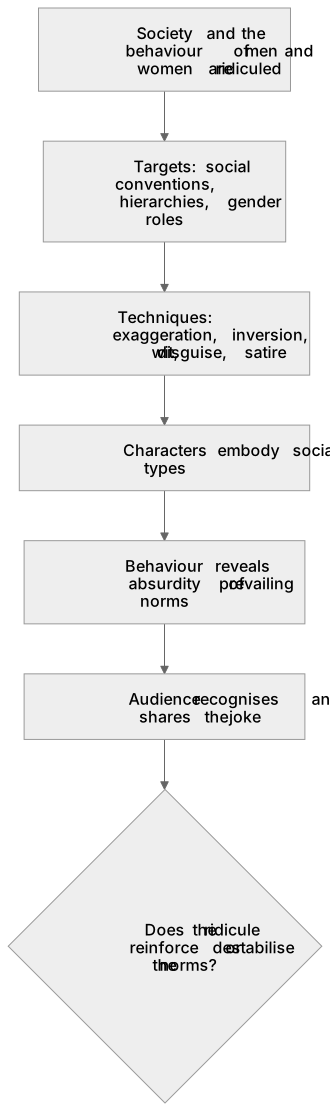
Label the diagram
Some boxes have lost their names. Pick the right name for each number.
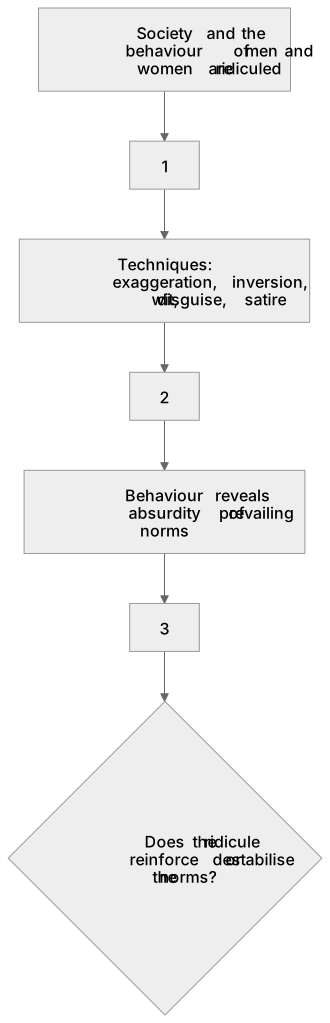
1Box 1
2Box 2
3Box 3
There is more to this lesson
The full lesson goes on to check your understanding and help you earn the marks. Create a free account to carry on, with your progress saved.
A week of Premium from your first lesson · Then the free plan continues · No card, no charge
Test your understanding of Aspects of comedy: In all cases society itself (as represented in the texts), and the behaviour of men and women in it, are ridiculed.
Active recall beats re-reading. Take an instant quiz now to test what you’ve learned and lock it into long-term memory.
A week of Premium from your first lesson · Then the free plan continues · No card, no charge