AQA · A-Level · English Literature
Course version: 7717 · Version from Sept 2026
The texts must be explored in terms of the aspects that are apparent in…
Full specification wording
Aspects of comedy: The texts must be explored in terms of the aspects that are apparent in them. The absence of an aspect might also be of note.
This statement asks you to read comedy through the aspects actually present in the text rather than forcing a fixed checklist onto it.
Checked against the AQA 7717 specification (opens in a new tab) on .
- Point 4 of 18
- 4 key terms
Study notes
From the checked teaching notes for this specification point.
The idea
This statement asks you to read comedy through the aspects actually present in the text rather than forcing a fixed checklist onto it. Begin by identifying which comic aspects are strongly apparent, such as wit, disguise, mistaken identity, festive release, reconciliation or satirical correction. Then consider which expected aspects are strikingly absent: a comedy without marriage, without a resolving reunion, or without a fool changes how the audience experiences the genre. For example, in a play where disguise drives the plot but no character achieves self-knowledge, the absence of recognition is as interpretative as the presence of disguise. Exploring presence and absence together produces a genuinely text-led argument about how comedy works here.
What earns the marks
- Identifies specific comic aspects that are clearly apparent in the chosen text and supports each with close textual reference.
- Explores how those present aspects shape meaning, tone and audience response rather than merely listing them.
- Recognises a notable absence of an expected comic aspect and treats that absence as evidence about the text's comic method.
- Uses genre terminology accurately and integrates it into a coherent argument about the text as a whole.
- Connects observations about presence and absence to the writer's choices, context or dramatic effects where relevant.
Common mistakes and how to put them right
Listing comic features without analysing their effect.
Put it right by explaining what each feature does to meaning or audience response.
Assuming every comedy must contain the same set of aspects.
Put it right by treating the aspects as flexible tools and noting where the text departs from expectation.
Ignoring absence altogether; correct this by asking which expected comic aspect is missing and what that omission reveals.
Exam tips
- Plan your response around two or three aspects that are genuinely central to the text, then add one telling absence.
- Use precise textual moments, including short quotations or close reference, to anchor each claim about an aspect.
- Keep returning to the question of how presence or absence shapes the comedy, not just what the text contains.
Try the lesson
The start of the Aspects of comedy: The texts must be explored in terms of the aspects that are apparent in them. The absence of an aspect might also be of note. lesson, made from checked teaching notes for this specification point.
Have a go first
When analysing a comedic text, a reader notices that a conventional comic feature, such as a fool or clown, is entirely missing. How is this absence best treated in literary exploration?
Listen
This statement asks you to read comedy through the aspects actually present in the text rather than forcing a fixed checklist onto it. Begin by identifying which comic aspects are strongly apparent, such as wit, disguise, mistaken identity, festive release, reconciliation or satirical correction. Then consider which expected aspects are strikingly absent: a comedy without marriage, without a resolving reunion, or without a fool changes how the audience experiences the genre. For example, in a play where disguise drives the plot but no character achieves self-knowledge, the absence of recognition is as interpretative as the presence of disguise. Exploring presence and absence together produces a genuinely text-led argument about how comedy works here. A strong answer earns marks for these points. Identifies specific comic aspects that are clearly apparent in the chosen text and supports each with close textual reference. Explores how those present aspects shape meaning, tone and audience response rather than merely listing them. Recognises a notable absence of an expected comic aspect and treats that absence as evidence about the text's comic method. Uses genre terminology accurately and integrates it into a coherent argument about the text as a whole. A common slip: Listing comic features without analysing their effect. Instead, explaining what each feature does to meaning or audience response. Exam tip: Plan your response around two or three aspects that are genuinely central to the text, then add one telling absence.
See it
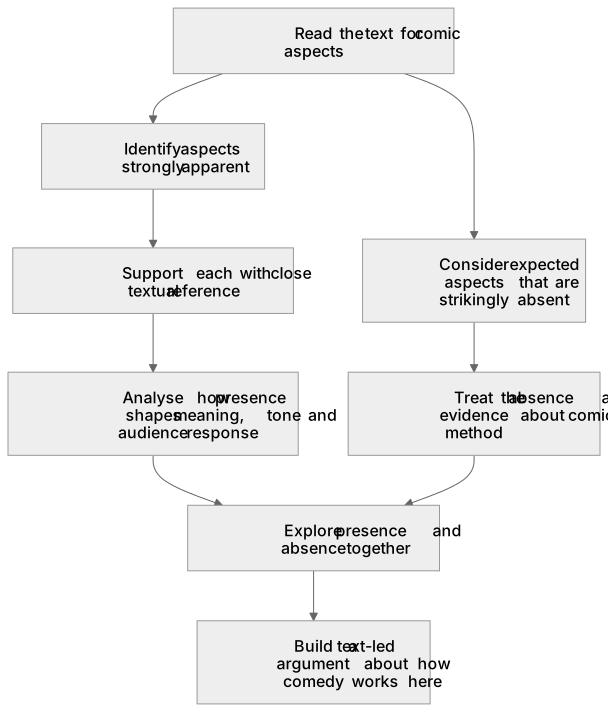
Key words
Say what each word means before you turn the card.
Presence and absence
Try answering aloud or in your head before turning the card.
Comic effect and audience response
Try answering aloud or in your head before turning the card.
Text-led interpretation
Try answering aloud or in your head before turning the card.
Genre and convention
Try answering aloud or in your head before turning the card.
See every definition
- Presence and absence
- Exploring together the comic aspects that are apparent in a text and those expected aspects that are strikingly missing, since an absence is as interpretative as a presence.
- Comic effect and audience response
- How the comic aspects present in a text shape meaning, tone and the way the audience experiences the genre.
- Text-led interpretation
- Reading comedy through the aspects actually present in the text rather than forcing a fixed checklist onto it, producing a genuinely text-led argument about how comedy works here.
- Genre and convention
- Treating expected comic aspects as flexible tools and noting where the text departs from expectation, using genre terminology accurately within a coherent argument.
Label the diagram
Some boxes have lost their names. Pick the right name for each number.
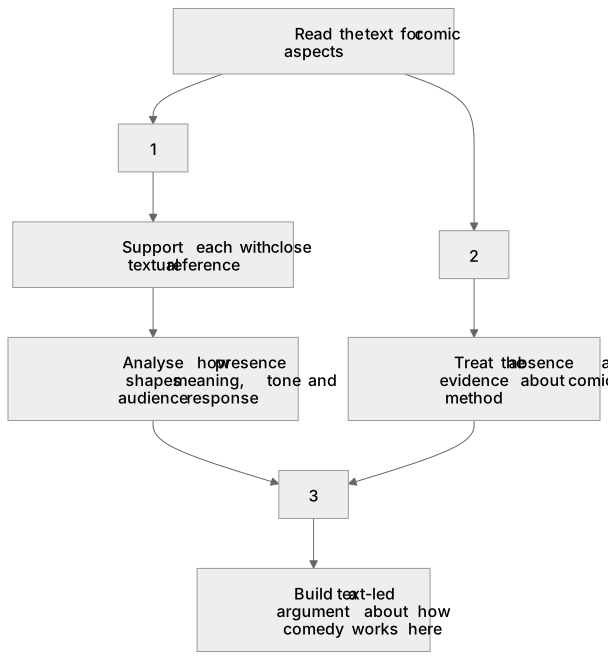
1Box 1
2Box 2
3Box 3
There is more to this lesson
The full lesson goes on to check your understanding and help you earn the marks. Create a free account to carry on, with your progress saved.
A week of Premium from your first lesson · Then the free plan continues · No card, no charge
Test your understanding of Aspects of comedy: The texts must be explored in terms of the aspects that are apparent in them. The absence of an aspect might also be of note.
Active recall beats re-reading. Take an instant quiz now to test what you’ve learned and lock it into long-term memory.
A week of Premium from your first lesson · Then the free plan continues · No card, no charge