AQA · A-Level · English Literature
Course version: 7717 · Version from Sept 2026
The journey towards knowledge and happiness for the protagonists, often in…
Full specification wording
Aspects of comedy: the journey towards knowledge and happiness for the protagonists, often in relation to their love interest, their mistakes and misunderstandings along their journey, moments of unhappiness and ultimate sense of joy
Comedy plots typically move protagonists from ignorance or self-deception towards knowledge and happiness, and that movement is rarely smooth.
Checked against the AQA 7717 specification (opens in a new tab) on .
- Point 7 of 18
- 4 key terms
Study notes
From the checked teaching notes for this specification point.
The idea
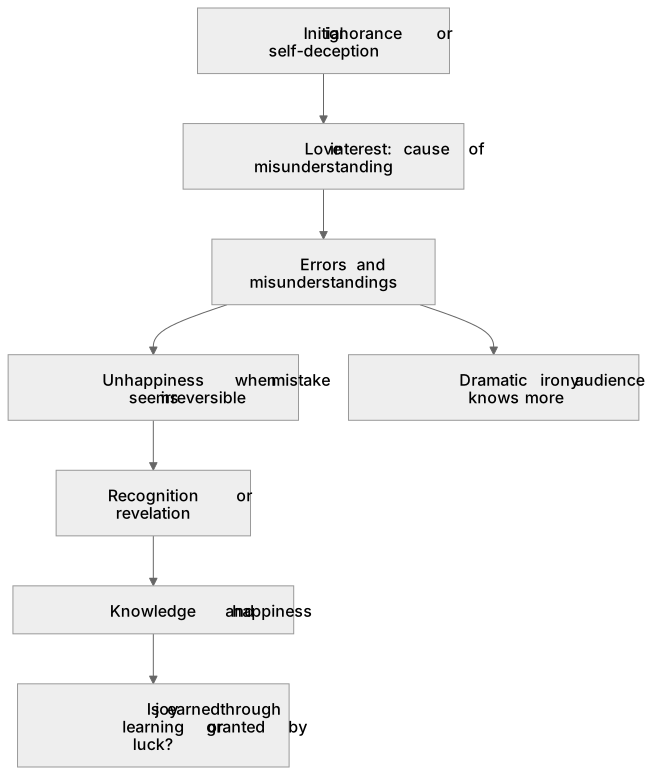
Comedy plots typically move protagonists from ignorance or self-deception towards knowledge and happiness, and that movement is rarely smooth. Track the arc: a young lover begins in confusion, often misreading a beloved or a rival; errors and misunderstandings (mistaken identity, overheard conversation, disguise) generate the middle; unhappiness follows when the mistake seems irreversible; resolution brings knowledge and joy, usually through recognition or revelation. Ask how love interest, mistake and misunderstanding connect: does the error stem from love, or does love survive the error? Note where the audience knows more than the character, creating dramatic irony. Then judge the ending: is joy earned through learning, or granted by luck?
What earns the marks
- Trace a clear trajectory from initial ignorance or self-deception, through error and misunderstanding, to knowledge and happiness, using specific moments from the text.
- Analyse how the love interest functions as both cause of misunderstanding and agent of eventual knowledge, rather than treating romance as decoration.
- Examine at least one moment of unhappiness or apparent disaster and explain how it is reversed or resolved.
- Consider whether the ultimate joy is earned by the protagonist's growth or produced by external accident, and weigh the comic effect of each possibility.
- Use dramatic irony to show how the audience's superior knowledge shapes response to the protagonist's mistakes.
Common mistakes and how to put them right
Retelling the plot in sequence without analysing how knowledge and happiness are connected.
Put it right by selecting two or three pivotal misunderstandings and examining their consequences.
Assuming all comic endings are straightforwardly happy.
Put it right by testing whether the resolution answers the problems the middle section raised.
Treating the love interest as a passive prize.
Put it right by showing how that character's choices or revelations drive the protagonist's learning.
Exam tips
- Anchor each claim in a short quotation and comment on a specific word or image rather than paraphrasing.
- Compare texts by asking whether knowledge is gained through suffering or through revelation, and what that difference implies about each comedy.
- Plan around the arc: opening error, middle confusion, final recognition, so your argument has momentum.
Try the lesson
The start of the Aspects of comedy: the journey towards knowledge and happiness for the protagonists, often in relation to their love interest, their mistakes and misunderstandings along their journey, moments of unhappiness and ultimate sense of joy lesson, made from checked teaching notes for this specification point.
Have a go first
In comedy, what typically happens to the protagonists' mistakes and misunderstandings by the end of the play?
Listen
Comedy plots typically move protagonists from ignorance or self-deception towards knowledge and happiness, and that movement is rarely smooth. Track the arc: a young lover begins in confusion, often misreading a beloved or a rival; errors and misunderstandings (mistaken identity, overheard conversation, disguise) generate the middle; unhappiness follows when the mistake seems irreversible; resolution brings knowledge and joy, usually through recognition or revelation. Ask how love interest, mistake and misunderstanding connect: does the error stem from love, or does love survive the error? Note where the audience knows more than the character, creating dramatic irony. Then judge the ending: is joy earned through learning, or granted by luck? A strong answer earns marks for these points. Trace a clear trajectory from initial ignorance or self-deception, through error and misunderstanding, to knowledge and happiness, using specific moments from the text. Analyse how the love interest functions as both cause of misunderstanding and agent of eventual knowledge, rather than treating romance as decoration. Examine at least one moment of unhappiness or apparent disaster and explain how it is reversed or resolved. Consider whether the ultimate joy is earned by the protagonist's growth or produced by external accident, and weigh the comic effect of each possibility. A common slip: Retelling the plot in sequence without analysing how knowledge and happiness are connected. Instead, selecting two or three pivotal misunderstandings and examining their consequences. Exam tip: Anchor each claim in a short quotation and comment on a specific word or image rather than paraphrasing.
See it
Key words
Say what each word means before you turn the card.
Knowledge and self-knowledge
Try answering aloud or in your head before turning the card.
Love and courtship
Try answering aloud or in your head before turning the card.
Mistake and misunderstanding
Try answering aloud or in your head before turning the card.
Joy and resolution
Try answering aloud or in your head before turning the card.
See every definition
- Knowledge and self-knowledge
- The movement of protagonists from ignorance or self-deception towards knowledge and happiness.
- Love and courtship
- The love interest functions as both cause of misunderstanding and agent of eventual knowledge.
- Mistake and misunderstanding
- Errors such as mistaken identity, overheard conversation and disguise generate the middle of the plot.
- Joy and resolution
- Resolution brings knowledge and joy, usually through recognition or revelation, after unhappiness when the mistake seems irreversible.
Label the diagram
Some boxes have lost their names. Pick the right name for each number.
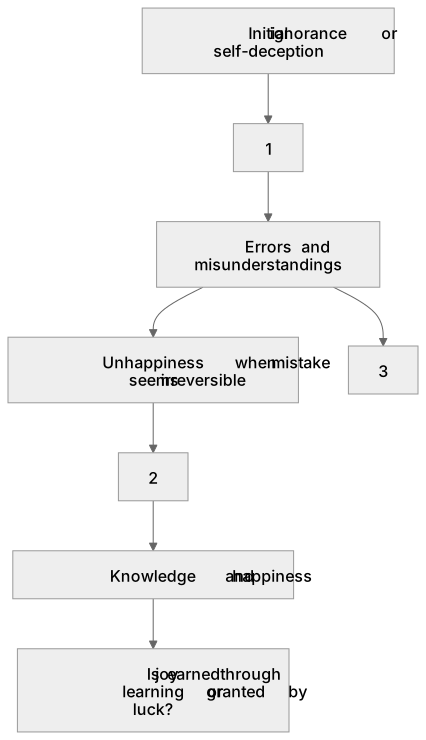
1Box 1
2Box 2
3Box 3
There is more to this lesson
The full lesson goes on to check your understanding and help you earn the marks. Create a free account to carry on, with your progress saved.
A week of Premium from your first lesson · Then the free plan continues · No card, no charge
Test your understanding of Aspects of comedy: the journey towards knowledge and happiness for the protagonists, often in relation to their love interest, their mistakes and misunderstandings along their journey, moments of unhappiness and ultimate sense of joy
Active recall beats re-reading. Take an instant quiz now to test what you’ve learned and lock it into long-term memory.
A week of Premium from your first lesson · Then the free plan continues · No card, no charge