AQA · A-Level · English Literature
Course version: 7717 · Version from Sept 2026
Aspects of comedy: the settings for the comedy, both places and times
Setting in comedy is never a neutral backdrop; place and time actively generate humour, structure and meaning.
Checked against the AQA 7717 specification (opens in a new tab) on .
- Point 6 of 18
- 3 key terms
Study notes
From the checked teaching notes for this specification point.
The idea
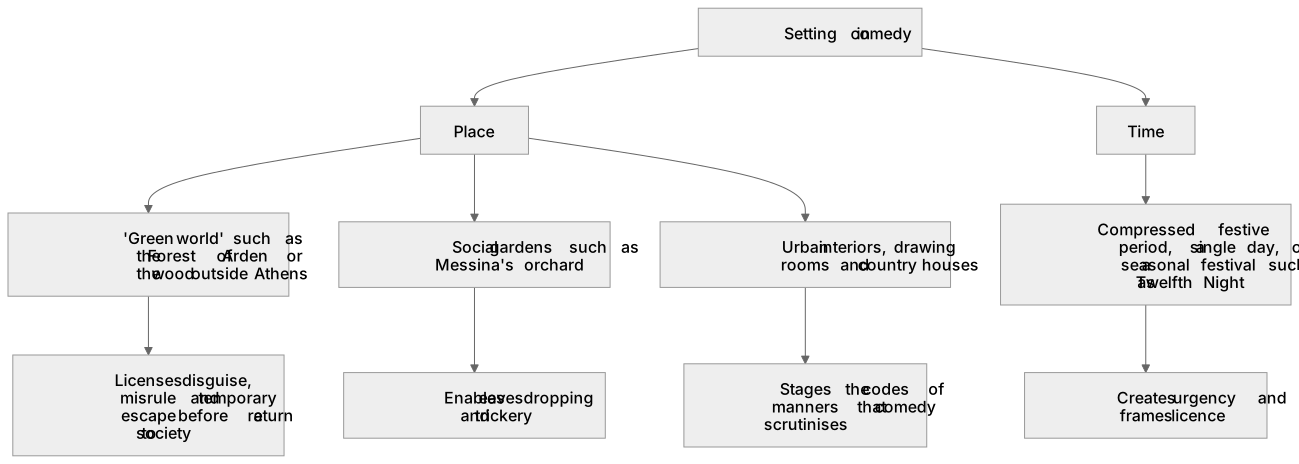
Setting in comedy is never a neutral backdrop; place and time actively generate humour, structure and meaning. A 'green world' such as the Forest of Arden or the wood outside Athens licenses disguise, misrule and temporary escape before a return to society. Conversely, social gardens like Messina's orchard enable eavesdropping and trickery. Urban interiors, drawing rooms and country houses stage the codes of manners that comedy scrutinises. Time matters too: a compressed festive period, a single day, or a seasonal festival such as Twelfth Night creates urgency and frames licence. Ask how the chosen place enables mistaken identity, eavesdropping or reconciliation, and how the period's social expectations shape what counts as comic. Compare locations within a play to show what each one permits or forbids.
What earns the marks
- Locates the comedy precisely in place and time, using textual references to establish setting.
- Explains how setting enables plot devices such as disguise, eavesdropping or mistaken identity.
- Contrasts settings within a play to show shifting freedoms, rules or social pressures.
- Relates period and place to the values the comedy tests, such as courtship codes or class hierarchy.
- Analyses how staging choices, real or imagined, would shape audience response to a scene.
- Connects movement between locations to the play's movement towards resolution.
Common mistakes and how to put them right
Describing setting without analysing its function.
Put it right by linking each place to a comic effect or theme.
Ignoring time and treating only place as setting.
Put it right by discussing period, season or duration of action.
Assuming a single setting is uniform.
Put it right by noting shifts of location, interior and exterior, or public and private.
Exam tips
- Name the specific location and moment rather than generalising about the play's world.
- Use setting as evidence for a wider argument about order, freedom or social codes.
- Consider how a director might stage the setting to sharpen its comic potential.
Try the lesson
The start of the Aspects of comedy: the settings for the comedy, both places and times lesson, made from checked teaching notes for this specification point.
Have a go first
When analysing aspects of comedy, how do the chosen settings (both places and times) typically function within the narrative?
Listen
Setting in comedy is never a neutral backdrop; place and time actively generate humour, structure and meaning. A 'green world' such as the Forest of Arden or the wood outside Athens licenses disguise, misrule and temporary escape before a return to society. Conversely, social gardens like Messina's orchard enable eavesdropping and trickery. Urban interiors, drawing rooms and country houses stage the codes of manners that comedy scrutinises. Time matters too: a compressed festive period, a single day, or a seasonal festival such as Twelfth Night creates urgency and frames licence. Ask how the chosen place enables mistaken identity, eavesdropping or reconciliation, and how the period's social expectations shape what counts as comic. Compare locations within a play to show what each one permits or forbids. A strong answer earns marks for these points. Locates the comedy precisely in place and time, using textual references to establish setting. Explains how setting enables plot devices such as disguise, eavesdropping or mistaken identity. Contrasts settings within a play to show shifting freedoms, rules or social pressures. Relates period and place to the values the comedy tests, such as courtship codes or class hierarchy. A common slip: Describing setting without analysing its function. Instead, linking each place to a comic effect or theme. Exam tip: Name the specific location and moment rather than generalising about the play's world.
See it
Key words
Say what each word means before you turn the card.
Time, festival and licence
Try answering aloud or in your head before turning the card.
Disguise and misrule
Try answering aloud or in your head before turning the card.
Courtship and social codes
Try answering aloud or in your head before turning the card.
See every definition
- Time, festival and licence
- A compressed festive period, a single day or a seasonal festival that creates urgency and frames licence.
- Disguise and misrule
- Comic devices licensed by a 'green world' such as the Forest of Arden or the wood outside Athens, allowing temporary escape before a return to society.
- Courtship and social codes
- The codes of manners staged in urban interiors, drawing rooms and country houses, which comedy scrutinises and which shape what counts as comic.
Label the diagram
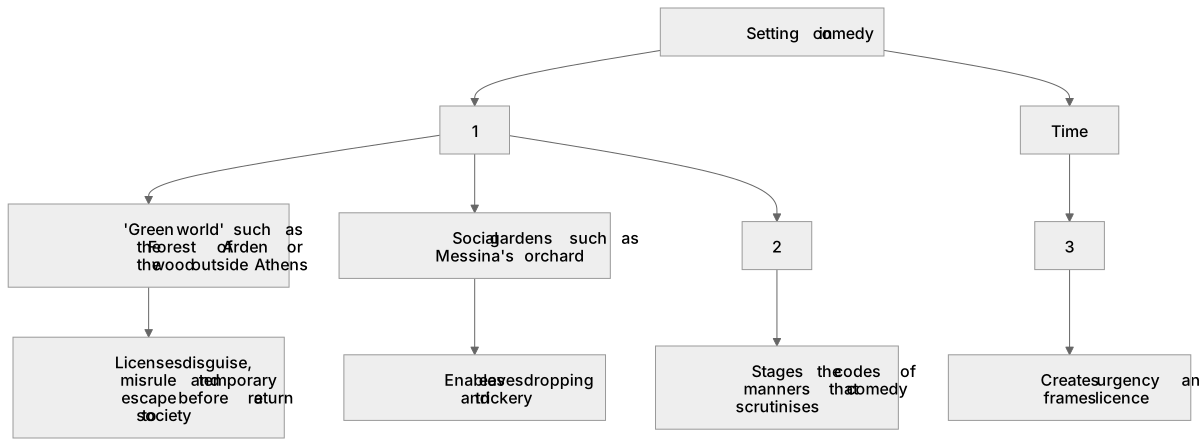
Some boxes have lost their names. Pick the right name for each number.
1Box 1
2Box 2
3Box 3
There is more to this lesson
The full lesson goes on to check your understanding and help you earn the marks. Create a free account to carry on, with your progress saved.
A week of Premium from your first lesson · Then the free plan continues · No card, no charge
Test your understanding of Aspects of comedy: the settings for the comedy, both places and times
Active recall beats re-reading. Take an instant quiz now to test what you’ve learned and lock it into long-term memory.
A week of Premium from your first lesson · Then the free plan continues · No card, no charge