AQA · A-Level · English Literature
Course version: 7717 · Version from Sept 2026
The type of the comedy text itself, whether it is classic romantic drama,…
Full specification wording
Aspects of comedy: the type of the comedy text itself, whether it is classic romantic drama, a satire, a comedy of manners
Genre shapes what a comedy does and how an audience responds, so identifying the type of text is a genuine analytical move, not labelling.
Checked against the AQA 7717 specification (opens in a new tab) on .
- Point 5 of 18
Study notes
From the checked teaching notes for this specification point.
The idea
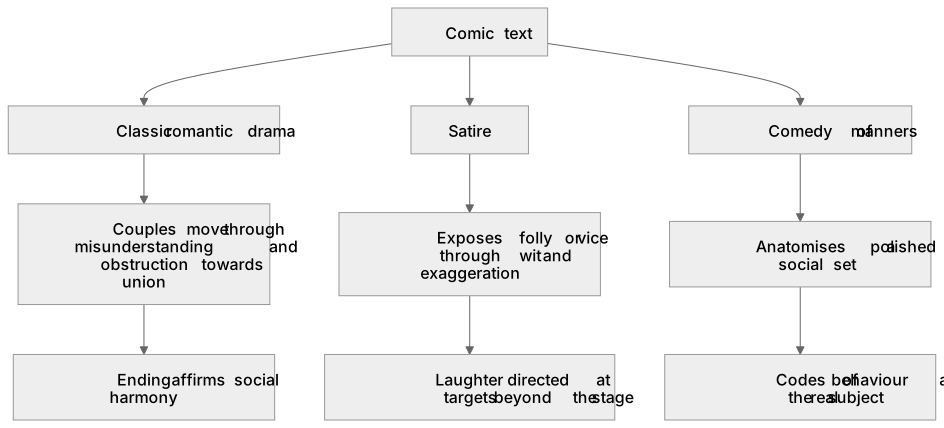
Genre shapes what a comedy does and how an audience responds, so identifying the type of text is a genuine analytical move, not labelling. Classic romantic drama, such as Much Ado About Nothing, moves couples through misunderstanding and obstruction towards union, so the ending affirms social harmony. Satire, as in The Importance of Being Earnest, exposes folly or vice through wit and exaggeration, directing laughter at targets beyond the stage. Comedy of manners, seen in Restoration drama, anatomises a polished social set whose codes of behaviour are the real subject. Ask what the play makes you laugh at, who is corrected, and whether the ending restores or unsettles the world, then test that reading against specific scenes and speeches.
What earns the marks
- Identifies the comic type accurately and justifies the label with textual evidence rather than assertion.
- Explains how structural features such as mistaken identity, disguise, wit or reconciliation generate the chosen type's effects.
- Connects the type to its social or historical context, for example Restoration court culture or Victorian respectability.
- Distinguishes between overlapping modes, showing how a play can be romantic and satirical at once.
- Uses the type to interpret character function, such as the blocking figure, the wit or the gull.
- Evaluates how the ending confirms or complicates the type, for example a marriage that also exposes hypocrisy.
Common mistakes and how to put them right
Treating the label as a conclusion rather than a tool.
Put it right by showing what the classification reveals about the text.
Assuming every comedy ends happily in the same way.
Put it right by examining whether resolution is harmonious, ironic or provisional.
Confusing satire with mere mockery.
Put it right by identifying the target and the corrective purpose behind the laughter.
Exam tips
- Anchor each generic claim to a short quotation or precise moment so the argument stays text-led.
- Use the type comparatively, asking how a romantic resolution differs from a satirical one.
- Keep the focus on dramatic effect and audience response rather than listing genre features.
Try the lesson
The start of the Aspects of comedy: the type of the comedy text itself, whether it is classic romantic drama, a satire, a comedy of manners lesson, made from checked teaching notes for this specification point.
Have a go first
Which of the following best describes a comedy of manners?
Listen
Genre shapes what a comedy does and how an audience responds, so identifying the type of text is a genuine analytical move, not labelling. Classic romantic drama, such as Much Ado About Nothing, moves couples through misunderstanding and obstruction towards union, so the ending affirms social harmony. Satire, as in The Importance of Being Earnest, exposes folly or vice through wit and exaggeration, directing laughter at targets beyond the stage. Comedy of manners, seen in Restoration drama, anatomises a polished social set whose codes of behaviour are the real subject. Ask what the play makes you laugh at, who is corrected, and whether the ending restores or unsettles the world, then test that reading against specific scenes and speeches. A strong answer earns marks for these points. Identifies the comic type accurately and justifies the label with textual evidence rather than assertion. Explains how structural features such as mistaken identity, disguise, wit or reconciliation generate the chosen type's effects. Connects the type to its social or historical context, for example Restoration court culture or Victorian respectability. Distinguishes between overlapping modes, showing how a play can be romantic and satirical at once. A common slip: Treating the label as a conclusion rather than a tool. Instead, showing what the classification reveals about the text. Exam tip: Anchor each generic claim to a short quotation or precise moment so the argument stays text-led.
See it
Label the diagram
Some boxes have lost their names. Pick the right name for each number.
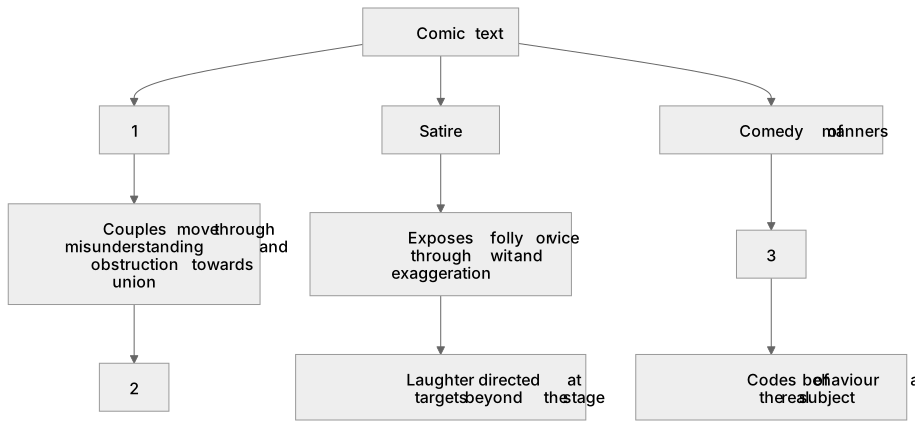
1Box 1
2Box 2
3Box 3
There is more to this lesson
The full lesson goes on to check your understanding and help you earn the marks. Create a free account to carry on, with your progress saved.
A week of Premium from your first lesson · Then the free plan continues · No card, no charge
Test your understanding of Aspects of comedy: the type of the comedy text itself, whether it is classic romantic drama, a satire, a comedy of manners
Active recall beats re-reading. Take an instant quiz now to test what you’ve learned and lock it into long-term memory.
A week of Premium from your first lesson · Then the free plan continues · No card, no charge