AQA · A-Level · English Literature
Course version: 7717 · Version from Sept 2026
Aspects of comedy: the use of complex plotting and sub-plots
Complex plotting in comedy means more than one storyline woven together so that misunderstandings, disguises and coincidences multiply before resolution.
Checked against the AQA 7717 specification (opens in a new tab) on .
- Point 15 of 18
- 2 key terms
Study notes
From the checked teaching notes for this specification point.
The idea
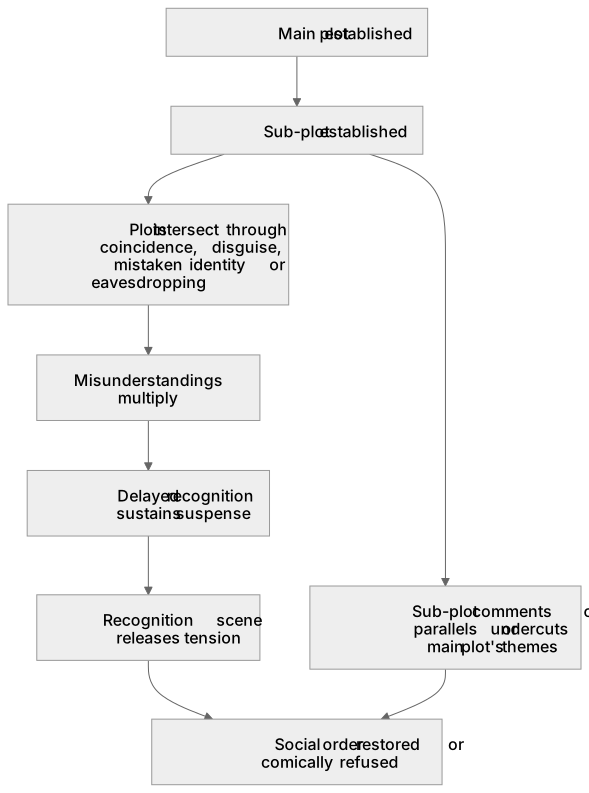
Complex plotting in comedy means more than one storyline woven together so that misunderstandings, disguises and coincidences multiply before resolution. A main plot, often romantic, is echoed or mocked by sub-plots involving servants, rivals or authority figures. For example, in Twelfth Night the Viola–Orsino–Olivia triangle is complicated by Sebastian's arrival, while the Sir Toby–Maria–Malvolio sub-plot satirises ambition and puritanism. The effect is structural: delayed recognition sustains suspense, and the collision of plots exposes folly. When writing, map entrances, exits and revelations, then argue how this architecture shapes comic tone and meaning rather than merely listing events.
What earns the marks
- Explains how a main plot and at least one sub-plot are established and distinguished, using precise textual reference.
- Analyses how plots intersect through coincidence, disguise, mistaken identity or eavesdropping, and comments on the comic effect.
- Discusses how delayed resolution or a recognition scene releases tension and restores social order, or comically refuses to do so.
- Evaluates how sub-plots comment on, parallel or undercut the main plot's themes, such as love, ambition or class.
- Uses dramatic terminology accurately, for example exposition, complication, peripeteia, denouement, aside and soliloquy.
- Connects structural choices to the genre of comedy and to the writer's possible intentions or contextual influences.
Common mistakes and how to put them right
Retelling the plot chronologically instead of analysing how strands are structured.
Put it right: Organise points around structural devices and their effects.
Treating sub-plots as irrelevant filler.
Put it right: Argue how they mirror, parody or deepen the main action's concerns.
Confusing author with narrator or character when discussing plotting.
Put it right: Attribute structural choices to the playwright and effects to the audience.
Exam tips
- Open with a structural claim about how plotting generates comedy, then select two or three pivotal moments to analyse closely.
- Embed short quotations and stage directions that reveal entrances, overheard conversations or revelations, and unpack their placement.
- Use comparative connectives such as 'whereas' and 'similarly' to show how plots parallel or diverge, sharpening your argument.
Try the lesson
The start of the Aspects of comedy: the use of complex plotting and sub-plots lesson, made from checked teaching notes for this specification point.
Have a go first
In comedy, what is the main dramatic effect of a playwright weaving several sub-plots around one central plot?
Listen
Complex plotting in comedy means more than one storyline woven together so that misunderstandings, disguises and coincidences multiply before resolution. A main plot, often romantic, is echoed or mocked by sub-plots involving servants, rivals or authority figures. For example, in Twelfth Night the Viola–Orsino–Olivia triangle is complicated by Sebastian's arrival, while the Sir Toby–Maria–Malvolio sub-plot satirises ambition and puritanism. The effect is structural: delayed recognition sustains suspense, and the collision of plots exposes folly. When writing, map entrances, exits and revelations, then argue how this architecture shapes comic tone and meaning rather than merely listing events. A strong answer earns marks for these points. Explains how a main plot and at least one sub-plot are established and distinguished, using precise textual reference. Analyses how plots intersect through coincidence, disguise, mistaken identity or eavesdropping, and comments on the comic effect. Discusses how delayed resolution or a recognition scene releases tension and restores social order, or comically refuses to do so. Evaluates how sub-plots comment on, parallel or undercut the main plot's themes, such as love, ambition or class. A common slip: Retelling the plot chronologically instead of analysing how strands are structured. Instead, organise points around structural devices and their effects. Exam tip: Open with a structural claim about how plotting generates comedy, then select two or three pivotal moments to analyse closely.
See it
Key words
Say what each word means before you turn the card.
Sub-plot
Try answering aloud or in your head before turning the card.
Complex plotting
Try answering aloud or in your head before turning the card.
See every definition
- Sub-plot
- A secondary storyline that echoes or mocks the main plot, often involving servants, rivals or authority figures.
- Complex plotting
- More than one storyline woven together so that misunderstandings, disguises and coincidences multiply before resolution.
Label the diagram
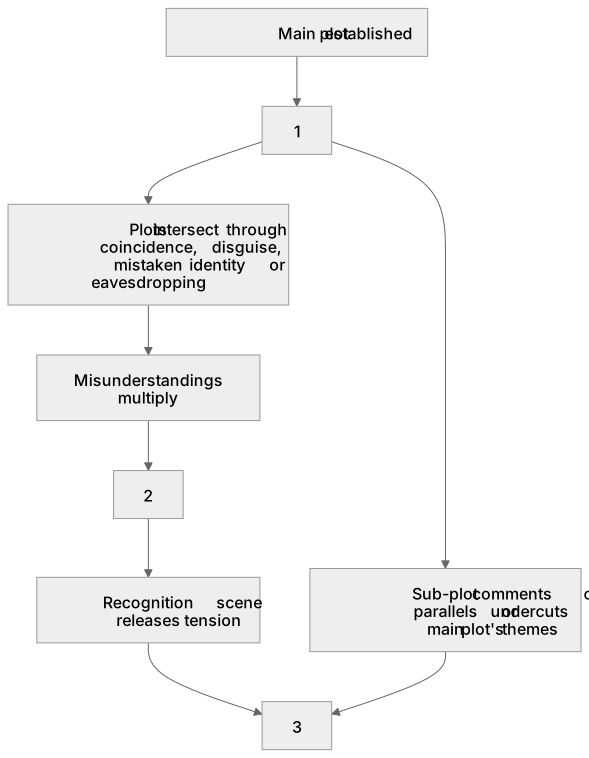
Some boxes have lost their names. Pick the right name for each number.
1Box 1
2Box 2
3Box 3
There is more to this lesson
The full lesson goes on to check your understanding and help you earn the marks. Create a free account to carry on, with your progress saved.
A week of Premium from your first lesson · Then the free plan continues · No card, no charge
Test your understanding of Aspects of comedy: the use of complex plotting and sub-plots
Active recall beats re-reading. Take an instant quiz now to test what you’ve learned and lock it into long-term memory.
A week of Premium from your first lesson · Then the free plan continues · No card, no charge