AQA · A-Level · English Literature
Course version: 7717 · Version from Sept 2026
Aspects of tragedy: the use of plots and sub-plots
Tragic plots are structured around a central action, often a reversal and a recognition, while sub-plots mirror, complicate or delay that action.
Checked against the AQA 7717 specification (opens in a new tab) on .
- Point 12 of 14
Study notes
From the checked teaching notes for this specification point.
The idea
Tragic plots are structured around a central action, often a reversal and a recognition, while sub-plots mirror, complicate or delay that action. In Othello, Iago's manipulation of Cassio and Roderigo forms a sub-plot that parallels the main marriage plot, intensifying Othello's jealousy before the climax. Ask how sub-plots create dramatic irony, provide contrast, or expose a theme such as appearance versus reality. When writing, select moments that show structural patterning, then explain the effect on audience tension and tragic outcome.
What earns the marks
- Identifies the main plot's tragic trajectory, including exposition, rising action, turning point and catastrophe, and locates sub-plot material within that structure.
- Explains how a sub-plot mirrors or contrasts with the main plot, for example by repeating a pattern of deception or jealousy in a lower-status register.
- Analyses how sub-plots create dramatic irony or delay, increasing tension before the tragic climax.
- Uses structural vocabulary such as parallel plot, comic relief, foil and peripeteia accurately when discussing how plots and sub-plots interact.
- Connects the arrangement of plots and sub-plots to the play's tragic effect on the audience rather than merely summarising events.
Common mistakes and how to put them right
Retelling the sub-plot as a separate story instead of analysing its structural relationship to the main plot.
Put it right: Link each sub-plot point back to the central tragic action.
Treating sub-plots as mere filler or comic relief without considering their thematic function.
Put it right: Examine how they reinforce or complicate the main tragic concerns.
Ignoring the order in which plot strands are revealed, so the analysis misses how suspense and irony are built.
Put it right: Comment on sequencing and juxtaposition of scenes.
Exam tips
- Plan responses around structural moments rather than character descriptions, so every paragraph addresses plot arrangement.
- Use precise drama terminology such as peripeteia, anagnorisis and sub-plot when it clarifies your argument.
- Embed short quotations that reveal structural turning points, then analyse how the sub-plot shapes the audience's response.
Try the lesson
The start of the Aspects of tragedy: the use of plots and sub-plots lesson, made from checked teaching notes for this specification point.
Have a go first
In tragedy, what is the main function of a sub-plot that runs alongside the central tragic action?
Listen
Tragic plots are structured around a central action, often a reversal and a recognition, while sub-plots mirror, complicate or delay that action. In Othello, Iago's manipulation of Cassio and Roderigo forms a sub-plot that parallels the main marriage plot, intensifying Othello's jealousy before the climax. Ask how sub-plots create dramatic irony, provide contrast, or expose a theme such as appearance versus reality. When writing, select moments that show structural patterning, then explain the effect on audience tension and tragic outcome. A strong answer earns marks for these points. Identifies the main plot's tragic trajectory, including exposition, rising action, turning point and catastrophe, and locates sub-plot material within that structure. Explains how a sub-plot mirrors or contrasts with the main plot, for example by repeating a pattern of deception or jealousy in a lower-status register. Analyses how sub-plots create dramatic irony or delay, increasing tension before the tragic climax. Uses structural vocabulary such as parallel plot, comic relief, foil and peripeteia accurately when discussing how plots and sub-plots interact. A common slip: Retelling the sub-plot as a separate story instead of analysing its structural relationship to the main plot. Instead, link each sub-plot point back to the central tragic action. Exam tip: Plan responses around structural moments rather than character descriptions, so every paragraph addresses plot arrangement.
See it
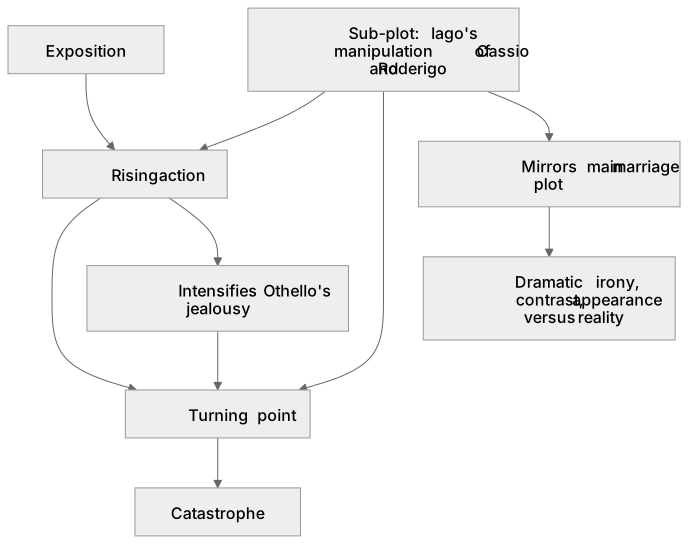
Label the diagram
Some boxes have lost their names. Pick the right name for each number.
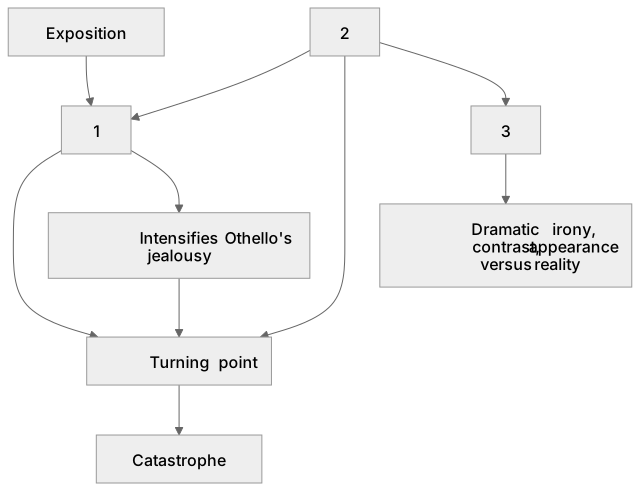
1Box 1
2Box 2
3Box 3
There is more to this lesson
The full lesson goes on to check your understanding and help you earn the marks. Create a free account to carry on, with your progress saved.
A week of Premium from your first lesson · Then the free plan continues · No card, no charge
Test your understanding of Aspects of tragedy: the use of plots and sub-plots
Active recall beats re-reading. Take an instant quiz now to test what you’ve learned and lock it into long-term memory.
A week of Premium from your first lesson · Then the free plan continues · No card, no charge