AQA · A-Level · English Literature
Course version: 7717 · Version from Sept 2026
AO3: Demonstrate understanding of the significance and influence of the…
Full specification wording
Assessment objectives: AO3: Demonstrate understanding of the significance and influence of the contexts in which literary texts are written and received.
AO3 asks you to show how context shapes meaning, not to bolt on biography.
Checked against the AQA 7717 specification (opens in a new tab) on .
- Point 3 of 5
- 4 key terms
Study notes
From the checked teaching notes for this specification point.
The idea
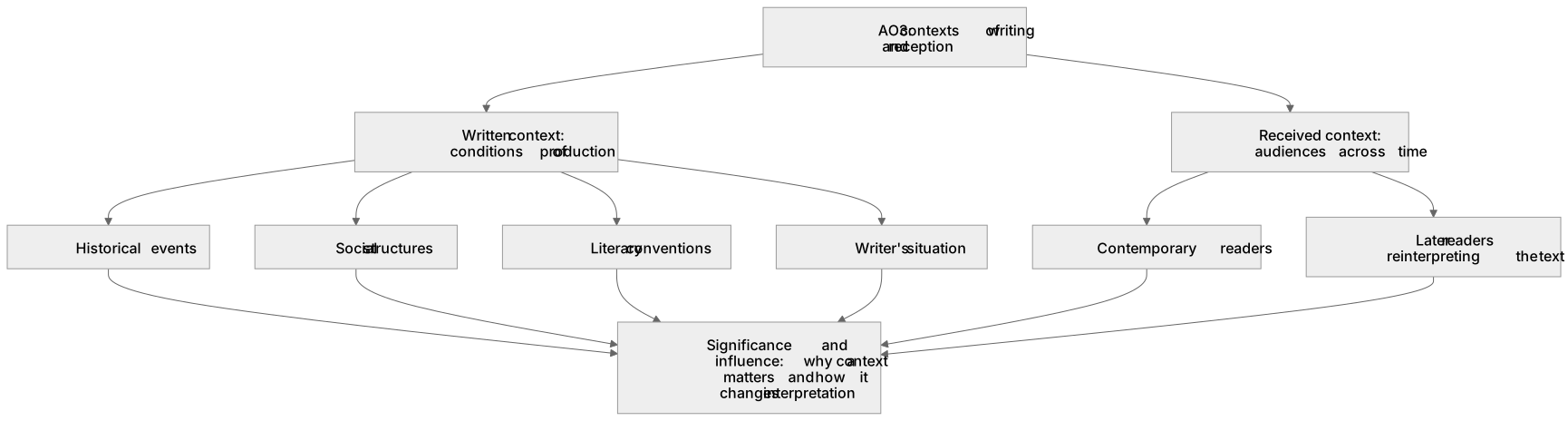
AO3 asks you to show how context shapes meaning, not to bolt on biography. 'Written' context covers the conditions of production: historical events, social structures, literary conventions and the writer's situation. 'Received' context covers how different audiences across time have read and reinterpreted the text. 'Significance and influence' means explaining why a context matters and how it changes interpretation. For example, when studying a text written during a period of religious upheaval, you might show how its imagery of judgement reflects contemporary anxieties, then contrast that with a modern secular reading that foregrounds psychological guilt. The skill is selecting precise contextual detail, integrating it into your argument, and weighing how far it illuminates the text rather than merely decorating it.
What earns the marks
- Selects specific contextual material relevant to the text and task rather than general period knowledge.
- Explains how a context influences the text's production, such as genre conventions, publication conditions or prevailing beliefs.
- Explores how different receiving audiences, including contemporary and later readers, may interpret the text differently.
- Integrates contextual points into the line of argument so they develop interpretation rather than appearing as separate background.
- Weighs the relative importance of contextual factors and acknowledges limits, such as when a text resists a single contextual reading.
Common mistakes and how to put them right
Writing a detached paragraph of historical facts with no link to the text.
Put it right by attaching each fact to a specific quotation or structural choice and explaining its effect.
Treating context as a single fixed meaning, such as assuming all readers in one period responded identically.
Put it right by distinguishing between likely dominant readings and other possible responses.
Confusing the writer's life with the text's meaning, so that biography becomes explanation.
Put it right by treating biographical detail as one contextual factor among several and testing it against the text.
Exam tips
- Plan context around your argument: decide which two or three contextual ideas genuinely sharpen your reading, then place them where they do analytical work.
- Use precise vocabulary such as 'production', 'reception', 'prevailing ideology' and 'literary tradition' to signal contextual thinking economically.
- When you introduce a contextual point, immediately answer 'so what?' by stating how it changes the way a reader understands a specific moment.
Try the lesson
The start of the Assessment objectives: AO3: Demonstrate understanding of the significance and influence of the contexts in which literary texts are written and received. lesson, made from checked teaching notes for this specification point.
Have a go first
Which of the following statements best demonstrates an understanding of the contexts in which a literary text is written and received?
Listen
AO3 asks you to show how context shapes meaning, not to bolt on biography. Written' context covers the conditions of production: historical events, social structures, literary conventions and the writer's situation. Received' context covers how different audiences across time have read and reinterpreted the text. Significance and influence' means explaining why a context matters and how it changes interpretation. For example, when studying a text written during a period of religious upheaval, you might show how its imagery of judgement reflects contemporary anxieties, then contrast that with a modern secular reading that foregrounds psychological guilt. The skill is selecting precise contextual detail, integrating it into your argument, and weighing how far it illuminates the text rather than merely decorating it. A strong answer earns marks for these points. Selects specific contextual material relevant to the text and task rather than general period knowledge. Explains how a context influences the text's production, such as genre conventions, publication conditions or prevailing beliefs. Explores how different receiving audiences, including contemporary and later readers, may interpret the text differently. Integrates contextual points into the line of argument so they develop interpretation rather than appearing as separate background. A common slip: Writing a detached paragraph of historical facts with no link to the text. Instead, attaching each fact to a specific quotation or structural choice and explaining its effect. Exam tip: Plan context around your argument: decide which two or three contextual ideas genuinely sharpen your reading, then place them where they do analytical work.
See it
Key words
Say what each word means before you turn the card.
Historical and social conditions of production
Try answering aloud or in your head before turning the card.
Reception and changing audience responses
Try answering aloud or in your head before turning the card.
Literary conventions and genre expectations
Try answering aloud or in your head before turning the card.
The relationship between text and ideology
Try answering aloud or in your head before turning the card.
See every definition
- Historical and social conditions of production
- The circumstances in which a text is written, covering historical events, social structures, literary conventions and the writer's situation.
- Reception and changing audience responses
- How different audiences across time have read and reinterpreted the text, including contemporary and later readers.
- Literary conventions and genre expectations
- The literary conventions that form part of the conditions of production in which a text is written.
- The relationship between text and ideology
- How prevailing beliefs and ideology influence a text's production, and how far a text resists a single contextual reading.
Label the diagram
Some boxes have lost their names. Pick the right name for each number.
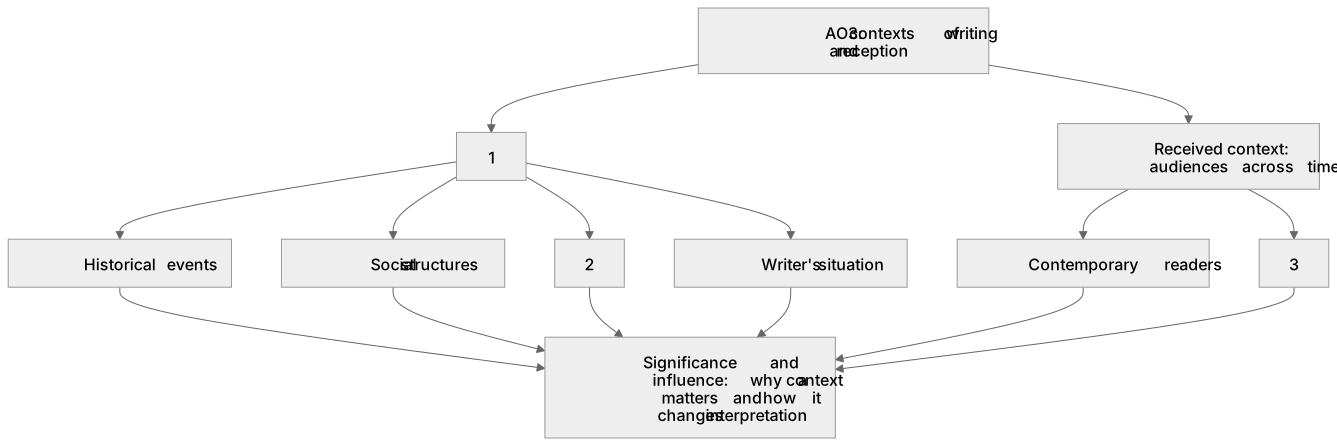
1Box 1
2Box 2
3Box 3
There is more to this lesson
The full lesson goes on to check your understanding and help you earn the marks. Create a free account to carry on, with your progress saved.
A week of Premium from your first lesson · Then the free plan continues · No card, no charge
Test your understanding of Assessment objectives: AO3: Demonstrate understanding of the significance and influence of the contexts in which literary texts are written and received.
Active recall beats re-reading. Take an instant quiz now to test what you’ve learned and lock it into long-term memory.
A week of Premium from your first lesson · Then the free plan continues · No card, no charge