AQA · A-Level · English Literature
Course version: 7717 · Version from Sept 2026
All set texts are narratives which focus on transgressions against…
Full specification wording
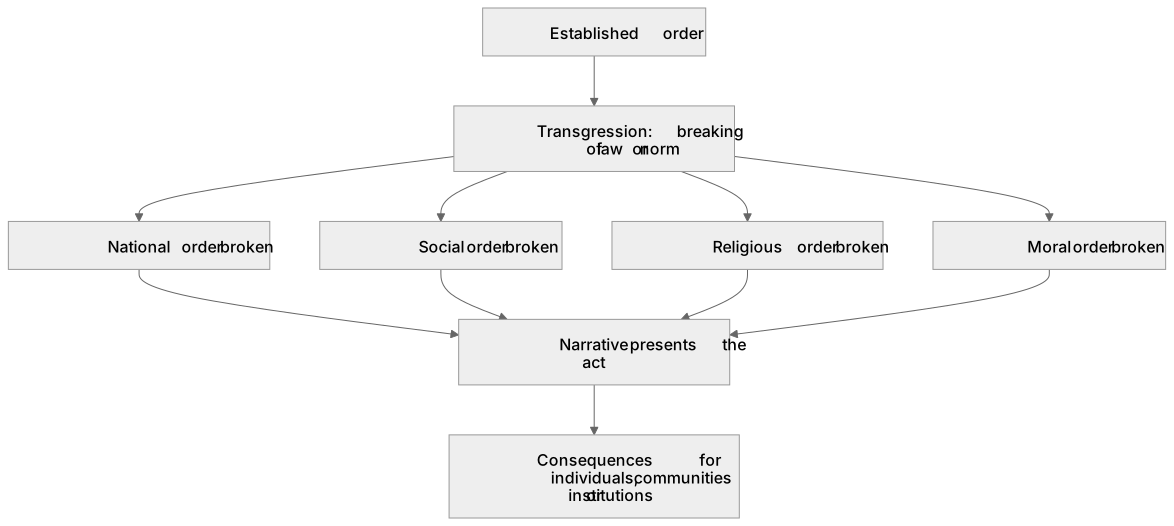
Elements of crime writing: All set texts are narratives which focus on transgressions against established order and the specific breaking of either national, social, religious or moral laws.
Crime writing centres on transgression: a character or group breaches an established order, and the narrative explores the consequences.
Checked against the AQA 7717 specification (opens in a new tab) on .
- Point 3 of 21
Study notes
From the checked teaching notes for this specification point.
The idea
Crime writing centres on transgression: a character or group breaches an established order, and the narrative explores the consequences. The order may be national (treason, espionage, border violation), social (class, gender or community norms), religious (heresy, sacrilege, breaking a vow) or moral (murder, betrayal, exploitation). When analysing a set text, identify the law or norm being broken, who breaks it, how the text presents the act, and what the disruption reveals about power, justice or guilt. For example, in a novel where a detective conceals evidence, the transgression is moral and professional rather than simply criminal, and the narrative tension comes from the conflict between private loyalty and public duty. Treat each text as a narrative shaped by transgression, not merely a puzzle to solve.
What earns the marks
- Identify the specific established order that is transgressed in the text, such as national security, social hierarchy, religious doctrine or moral duty.
- Explain how the narrative presents the act of breaking the law or norm, including the point of view, structure and language used.
- Analyse the consequences of the transgression for individuals, communities or institutions within the narrative.
- Compare how different set texts construct transgression, noting similarities and differences in the type of order broken and the narrative response.
- Use relevant contextual knowledge of law, religion, class or morality to illuminate the transgression without reducing the text to background information.
Common mistakes and how to put them right
Treating every crime as simply murder or theft.
Put it right: Identify the precise category of order broken, which may be national, social, religious or moral, and explain how the text frames it.
Assuming the transgressor is always the villain.
Put it right: Examine how narratives can make transgressors sympathetic, ambiguous or morally complex, and how that shapes meaning.
Ignoring the word established.
Put it right: Explain what makes the order established, such as institutional power, tradition, divine authority or accepted social convention.
Exam tips
- In planning, write the type of order and the specific law or norm at the top of your page, then select evidence that shows both the act and its reception.
- Use precise terms such as national, social, religious and moral to organise your argument, and avoid vague phrases like against society.
- When comparing texts, make the type of transgression the basis of a comparative point rather than listing separate observations.
Try the lesson
The start of the Elements of crime writing: All set texts are narratives which focus on transgressions against established order and the specific breaking of either national, social, religious or moral laws. lesson, made from checked teaching notes for this specification point.
Have a go first
In the 'Elements of crime writing' component, what type of transgression is central to the narratives of the set texts?
Listen
Crime writing centres on transgression: a character or group breaches an established order, and the narrative explores the consequences. The order may be national (treason, espionage, border violation), social (class, gender or community norms), religious (heresy, sacrilege, breaking a vow) or moral (murder, betrayal, exploitation). When analysing a set text, identify the law or norm being broken, who breaks it, how the text presents the act, and what the disruption reveals about power, justice or guilt. For example, in a novel where a detective conceals evidence, the transgression is moral and professional rather than simply criminal, and the narrative tension comes from the conflict between private loyalty and public duty. Treat each text as a narrative shaped by transgression, not merely a puzzle to solve. A strong answer earns marks for these points. Identify the specific established order that is transgressed in the text, such as national security, social hierarchy, religious doctrine or moral duty. Explain how the narrative presents the act of breaking the law or norm, including the point of view, structure and language used. Analyse the consequences of the transgression for individuals, communities or institutions within the narrative. Compare how different set texts construct transgression, noting similarities and differences in the type of order broken and the narrative response. A common slip: Treating every crime as simply murder or theft. Instead, identify the precise category of order broken, which may be national, social, religious or moral, and explain how the text frames it. Exam tip: In planning, write the type of order and the specific law or norm at the top of your page, then select evidence that shows both the act and its reception.
See it
Label the diagram
Some boxes have lost their names. Pick the right name for each number.
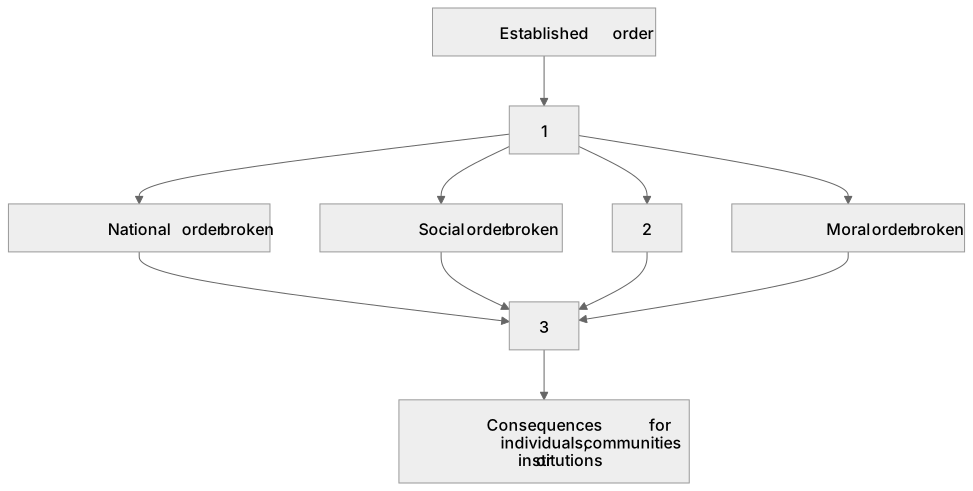
1Box 1
2Box 2
3Box 3
There is more to this lesson
The full lesson goes on to check your understanding and help you earn the marks. Create a free account to carry on, with your progress saved.
A week of Premium from your first lesson · Then the free plan continues · No card, no charge
Test your understanding of Elements of crime writing: All set texts are narratives which focus on transgressions against established order and the specific breaking of either national, social, religious or moral laws.
Active recall beats re-reading. Take an instant quiz now to test what you’ve learned and lock it into long-term memory.
A week of Premium from your first lesson · Then the free plan continues · No card, no charge