AQA · A-Level · English Literature
Course version: 7717 · Version from Sept 2026
The focus in this component must be on ‘Elements’ and students need to…
Full specification wording
Elements of crime writing: The focus in this component must be on ‘Elements’ and students need to consider the elements that exist in each of their texts.
This component asks you to study crime writing through its constituent elements rather than through plot summary or author biography.
Checked against the AQA 7717 specification (opens in a new tab) on .
- Point 4 of 21
- 4 key terms
Study notes
From the checked teaching notes for this specification point.
The idea
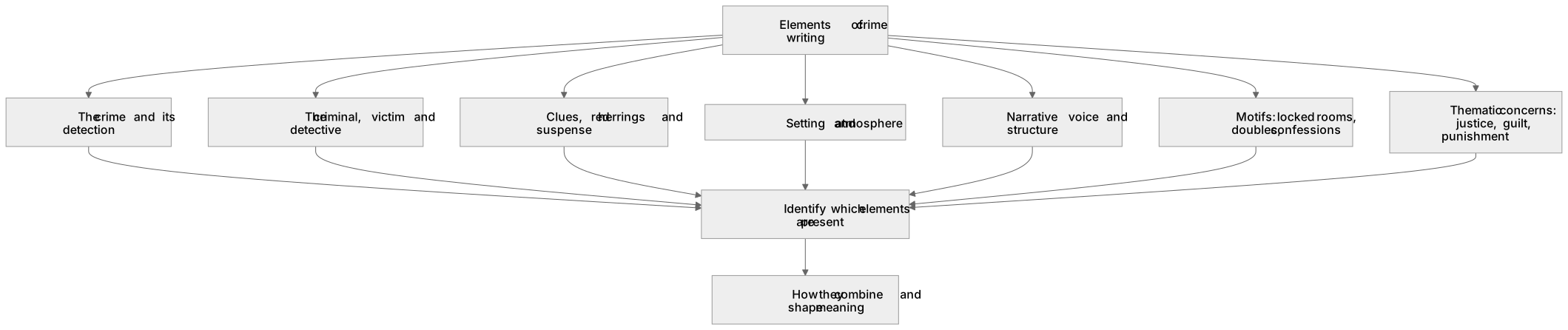
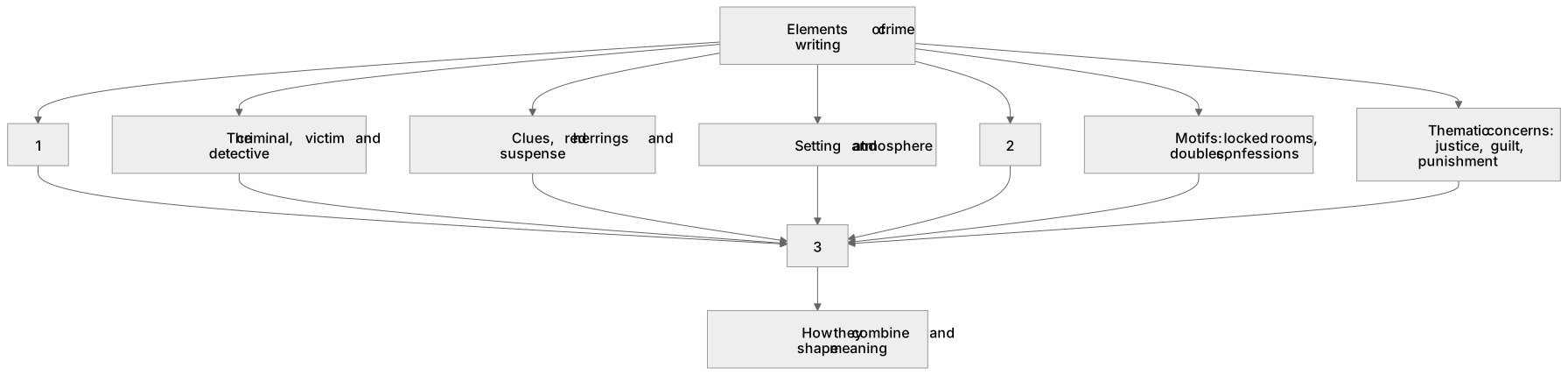
This component asks you to study crime writing through its constituent elements rather than through plot summary or author biography. Elements include: the crime and its detection; the criminal, victim and detective; clues, red herrings and suspense; setting and atmosphere; narrative voice and structure; motifs such as locked rooms, doubles or confessions; and thematic concerns such as justice, guilt and punishment. When studying a set text, identify which elements are present, how they combine, and how they shape meaning. For example, a text may use a first-person confessional narrator to make the reader complicit, or a fragmented timeline to withhold information. The assessment rewards analysis of how these elements work, not merely noting that they appear.
What earns the marks
- Identify specific crime-writing elements in each set text, such as the detective figure, the clue, the red herring, the confession or the locked-room motif.
- Explain how elements interact to create effects such as suspense, surprise, moral uncertainty or social critique.
- Analyse how narrative form, including voice, tense, focalisation and structure, functions as an element of crime writing.
- Compare the presence and function of elements across set texts, showing how conventions are used, adapted or subverted.
- Support analysis with precise textual evidence and relevant critical terminology rather than retelling the plot.
Common mistakes and how to put them right
Retelling the plot instead of analysing elements.
Put it right: Select a specific element, quote briefly, and explain how it creates meaning or effect.
Listing elements without explaining their function.
Put it right: For each element, state what it does in the text and how it shapes the reader's response.
Treating elements as fixed ingredients that must appear.
Put it right: Consider how texts may omit, combine or subvert conventional elements to produce distinctive effects.
Exam tips
- Build a mental checklist of elements before the exam and practise applying it to each set text so you can select the most relevant ones under timed conditions.
- Use element-focused topic sentences, such as the red herring functions to..., rather than character-based descriptions.
- When comparing, choose two or three elements that both texts share or handle differently, and make those the spine of your response.
Try the lesson
The start of the Elements of crime writing: The focus in this component must be on ‘Elements’ and students need to consider the elements that exist in each of their texts. lesson, made from checked teaching notes for this specification point.
Have a go first
A student writes an essay that retells the plot of a crime novel in detail but never discusses recurring features such as the detective figure or the significance of clues. According to the stated focus of this component, what is the main weakness of the essay?
Listen
This component asks you to study crime writing through its constituent elements rather than through plot summary or author biography. Elements include: the crime and its detection; the criminal, victim and detective; clues, red herrings and suspense; setting and atmosphere; narrative voice and structure; motifs such as locked rooms, doubles or confessions; and thematic concerns such as justice, guilt and punishment. When studying a set text, identify which elements are present, how they combine, and how they shape meaning. For example, a text may use a first-person confessional narrator to make the reader complicit, or a fragmented timeline to withhold information. The assessment rewards analysis of how these elements work, not merely noting that they appear. A strong answer earns marks for these points. Identify specific crime-writing elements in each set text, such as the detective figure, the clue, the red herring, the confession or the locked-room motif. Explain how elements interact to create effects such as suspense, surprise, moral uncertainty or social critique. Analyse how narrative form, including voice, tense, focalisation and structure, functions as an element of crime writing. Compare the presence and function of elements across set texts, showing how conventions are used, adapted or subverted. A common slip: Retelling the plot instead of analysing elements. Instead, select a specific element, quote briefly, and explain how it creates meaning or effect. Exam tip: Build a mental checklist of elements before the exam and practise applying it to each set text so you can select the most relevant ones under timed conditions.
See it
Key words
Say what each word means before you turn the card.
Elements
Try answering aloud or in your head before turning the card.
Narrative form
Try answering aloud or in your head before turning the card.
Suspense
Try answering aloud or in your head before turning the card.
Conventions
Try answering aloud or in your head before turning the card.
See every definition
- Elements
- The constituent parts of crime writing, such as the crime and its detection, the criminal, victim and detective, clues, red herrings and suspense, setting and atmosphere, narrative voice and structure, motifs and thematic concerns.
- Narrative form
- An element of crime writing including voice, tense, focalisation and structure, which may be used to make the reader complicit or to withhold information.
- Suspense
- An effect created when elements interact, alongside surprise, moral uncertainty or social critique.
- Conventions
- Elements that texts may use, adapt or subvert, rather than fixed ingredients that must appear.
Label the diagram
Some boxes have lost their names. Pick the right name for each number.
1Box 1
2Box 2
3Box 3
There is more to this lesson
The full lesson goes on to check your understanding and help you earn the marks. Create a free account to carry on, with your progress saved.
A week of Premium from your first lesson · Then the free plan continues · No card, no charge
Test your understanding of Elements of crime writing: The focus in this component must be on ‘Elements’ and students need to consider the elements that exist in each of their texts.
Active recall beats re-reading. Take an instant quiz now to test what you’ve learned and lock it into long-term memory.
A week of Premium from your first lesson · Then the free plan continues · No card, no charge