AQA · A-Level · English Literature
Course version: 7717 · Version from Sept 2026
The type of the crime text itself, whether it is detective fiction, a…
Full specification wording
Elements of crime writing: the type of the crime text itself, whether it is detective fiction, a post-modern novel, a revenge tragedy, an account of a life lost to crime
Genre type shapes what a crime text can do and how readers respond.
Checked against the AQA 7717 specification (opens in a new tab) on .
- Point 5 of 21
- 4 key terms
Study notes
From the checked teaching notes for this specification point.
The idea
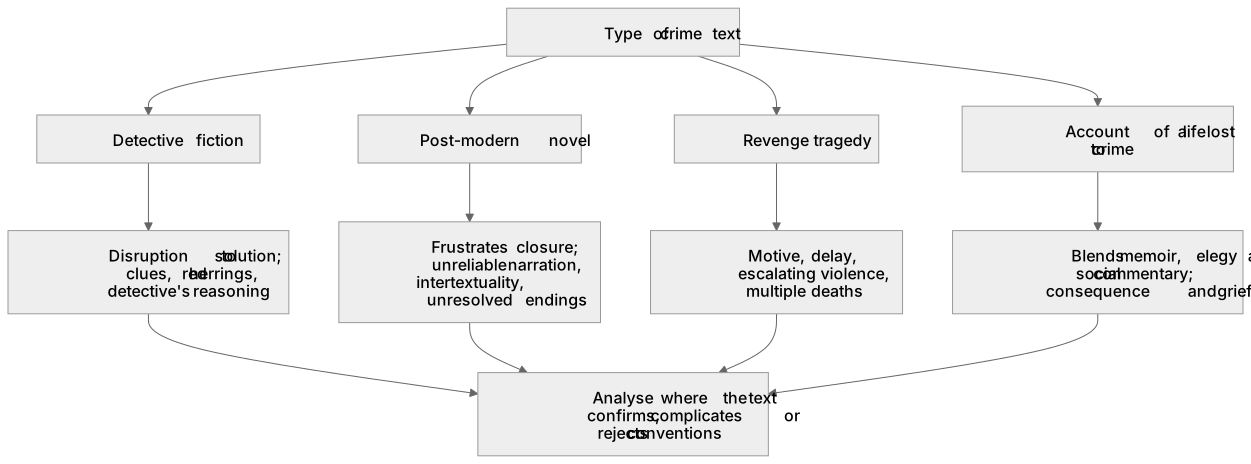
Genre type shapes what a crime text can do and how readers respond. Detective fiction typically moves from disruption to solution, so clues, red herrings and the detective's reasoning organise meaning. A post-modern novel may frustrate that closure, playing with unreliable narration, intertextuality or unresolved endings. Revenge tragedy foregrounds motive, delay and escalating violence, often ending in multiple deaths. An account of a life lost to crime may blend memoir, elegy and social commentary, shifting focus from detection to consequence and grief. Identifying the type is not labelling for its own sake: it predicts conventions, then lets you analyse where the text confirms, complicates or rejects them.
What earns the marks
- Identifies the type or subgenre of the crime text accurately and uses appropriate terminology.
- Explains the conventions associated with that type, such as clue and solution in detective fiction or delay in revenge tragedy.
- Analyses how the text confirms, complicates or subverts those conventions with specific evidence.
- Connects generic features to the text's structure, narrative voice or treatment of justice and consequence.
- Uses genre as a springboard for interpretation rather than as a substitute for close reading.
Common mistakes and how to put them right
Naming a genre without explaining its conventions.
Put it right: State two or three conventions and show where the text uses them.
Assuming a text belongs neatly to one type when it blends modes.
Put it right: Discuss hybridity and the effects of that blending.
Treating genre as a fixed label that settles meaning.
Put it right: Analyse how the text manipulates or resists generic expectations.
Exam tips
- Establish the text's type early, then return to it when discussing structure or ending.
- Use precise generic vocabulary such as closure, red herring, peripeteia or unreliable narrator where it genuinely fits.
- When a text mixes types, make that mixture part of your argument rather than an obstacle to it.
Try the lesson
The start of the Elements of crime writing: the type of the crime text itself, whether it is detective fiction, a post-modern novel, a revenge tragedy, an account of a life lost to crime lesson, made from checked teaching notes for this specification point.
Have a go first
According to the specification, which of the following is explicitly listed as a type of crime text?
Listen
Genre type shapes what a crime text can do and how readers respond. Detective fiction typically moves from disruption to solution, so clues, red herrings and the detective's reasoning organise meaning. A post-modern novel may frustrate that closure, playing with unreliable narration, intertextuality or unresolved endings. Revenge tragedy foregrounds motive, delay and escalating violence, often ending in multiple deaths. An account of a life lost to crime may blend memoir, elegy and social commentary, shifting focus from detection to consequence and grief. Identifying the type is not labelling for its own sake: it predicts conventions, then lets you analyse where the text confirms, complicates or rejects them. A strong answer earns marks for these points. Identifies the type or subgenre of the crime text accurately and uses appropriate terminology. Explains the conventions associated with that type, such as clue and solution in detective fiction or delay in revenge tragedy. Analyses how the text confirms, complicates or subverts those conventions with specific evidence. Connects generic features to the text's structure, narrative voice or treatment of justice and consequence. A common slip: Naming a genre without explaining its conventions. Instead, state two or three conventions and show where the text uses them. Exam tip: Establish the text's type early, then return to it when discussing structure or ending.
See it
Key words
Say what each word means before you turn the card.
Generic convention and innovation
Try answering aloud or in your head before turning the card.
Closure and resolution
Try answering aloud or in your head before turning the card.
Narrative voice and reliability
Try answering aloud or in your head before turning the card.
Justice, consequence and grief
Try answering aloud or in your head before turning the card.
See every definition
- Generic convention and innovation
- The conventions associated with a type, such as clue and solution in detective fiction or delay in revenge tragedy, and how the text confirms, complicates or rejects them.
- Closure and resolution
- Detective fiction typically moves from disruption to solution, while a post-modern novel may frustrate that closure with unresolved endings.
- Narrative voice and reliability
- A post-modern novel may play with unreliable narration, and generic features connect to the text's narrative voice.
- Justice, consequence and grief
- An account of a life lost to crime may shift focus from detection to consequence and grief, blending memoir, elegy and social commentary.
Label the diagram
Some boxes have lost their names. Pick the right name for each number.
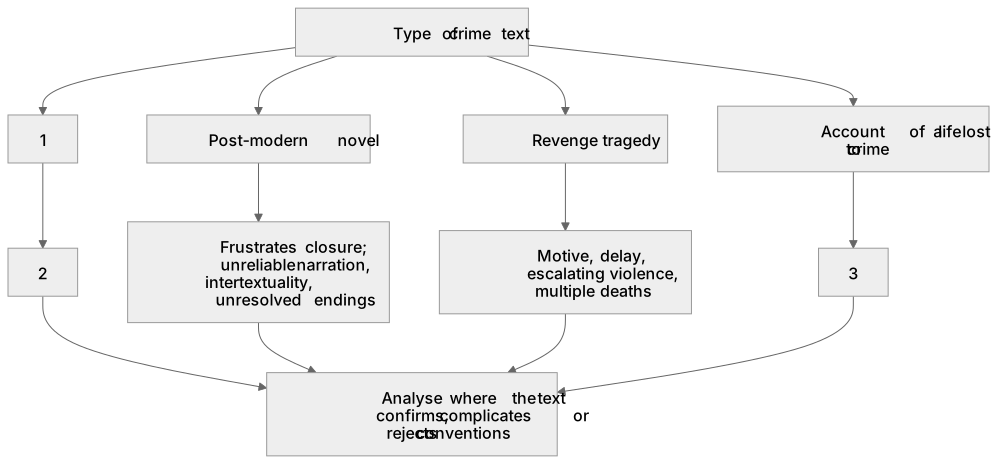
1Box 1
2Box 2
3Box 3
There is more to this lesson
The full lesson goes on to check your understanding and help you earn the marks. Create a free account to carry on, with your progress saved.
A week of Premium from your first lesson · Then the free plan continues · No card, no charge
Test your understanding of Elements of crime writing: the type of the crime text itself, whether it is detective fiction, a post-modern novel, a revenge tragedy, an account of a life lost to crime
Active recall beats re-reading. Take an instant quiz now to test what you’ve learned and lock it into long-term memory.
A week of Premium from your first lesson · Then the free plan continues · No card, no charge