AQA · A-Level · English Literature
Course version: 7717 · Version from Sept 2026
Gender politics and issues of social class
Full specification wording
Elements of political and social protest writing: gender politics and issues of social class
Gender politics concerns how texts dramatise the distribution of power between men and women: who speaks, who is silenced, who owns property, who is confined to domestic space and who may act…
Checked against the AQA 7717 specification (opens in a new tab) on .
- Point 13 of 17
- 4 key terms
Study notes
From the checked teaching notes for this specification point.
The idea
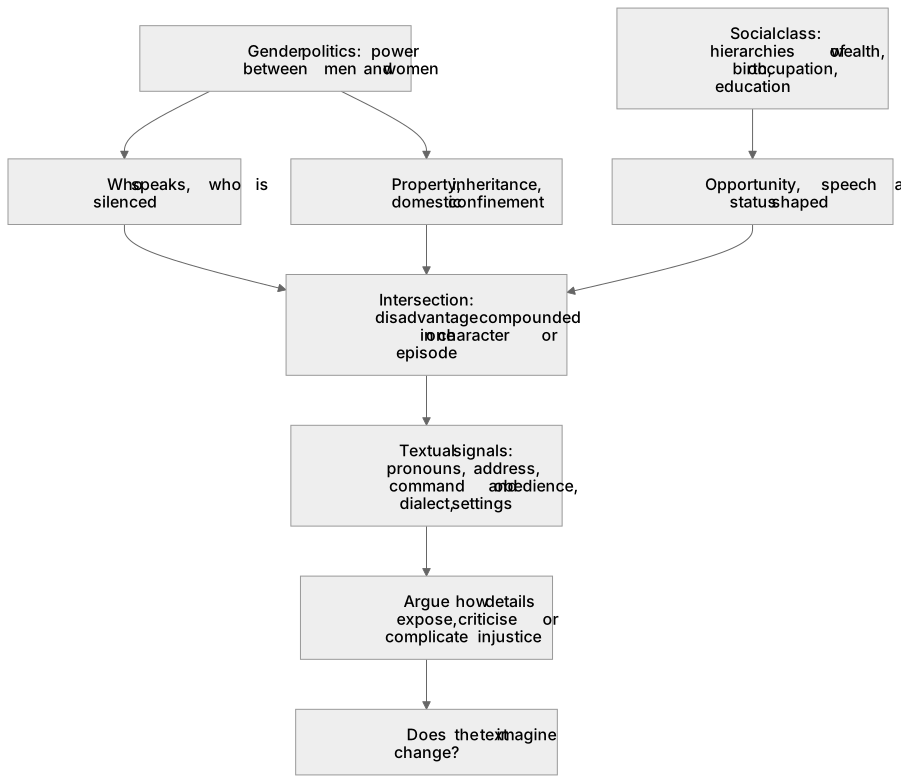
Gender politics concerns how texts dramatise the distribution of power between men and women: who speaks, who is silenced, who owns property, who is confined to domestic space and who may act publicly. Social class concerns hierarchies of wealth, birth, occupation and education, and how these shape opportunity, speech and status. In protest writing the two often intersect: a woman denied an education because of her sex may also be trapped by poverty, while a servant or worker may be doubly disadvantaged by class and gender. When you analyse, track concrete textual signals: pronouns and forms of address, who commands and who obeys, property and inheritance, dress and mobility, dialect against standard English, and settings such as drawing room, factory or street. Then argue how these details expose, criticise or complicate injustice, and whether the text imagines change.
What earns the marks
- Accurate use of the terms gender politics and social class, with each term defined through textual evidence rather than asserted.
- Analysis of how power is distributed between characters, for example through command verbs, forms of address, interruptions or silence.
- Exploration of intersection, showing how gender disadvantage and class disadvantage compound one another in a particular character or episode.
- Reference to relevant contextual pressures, such as marriage law, property ownership, education, employment or suffrage, used to illuminate rather than replace close reading.
- Consideration of the text's attitude: whether it exposes, satirises, mourns or endorses the inequalities it depicts.
- Coherent argument sustained across a whole response, with each paragraph advancing the line of thought rather than listing observations.
Common mistakes and how to put them right
Treating gender and class as separate checklists and never showing how they interact.
Put it right by choosing one moment where both operate and analysing the overlap.
Paraphrasing plot and labelling it protest without analysing language, form or structure.
Put it right by anchoring every claim to a quotation or structural feature.
Importing context as a history lesson detached from the text.
Put it right by linking each contextual point to a specific word, image or pattern in the extract or whole text.
Assuming all female characters share one viewpoint or all working-class characters share another.
Put it right by distinguishing individual attitudes and noting internal disagreement.
Exam tips
- Plan around an argument, not a character list: decide what the text is protesting about and how gender and class shape that protest.
- Embed short quotations and analyse individual words, then widen to patterns across the text.
- When context is relevant, integrate it into the sentence that analyses the quotation rather than adding a separate paragraph of background.
- Keep the assessment objectives in balance: close analysis, contextual understanding and informed argument should all be visible.
Try the lesson
The start of the Elements of political and social protest writing: gender politics and issues of social class lesson, made from checked teaching notes for this specification point.
Have a go first
When analysing 'gender politics' in a political and social protest text, which approach best reflects the demands of the genre?
Listen
Gender politics concerns how texts dramatise the distribution of power between men and women: who speaks, who is silenced, who owns property, who is confined to domestic space and who may act publicly. Social class concerns hierarchies of wealth, birth, occupation and education, and how these shape opportunity, speech and status. In protest writing the two often intersect: a woman denied an education because of her sex may also be trapped by poverty, while a servant or worker may be doubly disadvantaged by class and gender. When you analyse, track concrete textual signals: pronouns and forms of address, who commands and who obeys, property and inheritance, dress and mobility, dialect against standard English, and settings such as drawing room, factory or street. Then argue how these details expose, criticise or complicate injustice, and whether the text imagines change. A strong answer earns marks for these points. Accurate use of the terms gender politics and social class, with each term defined through textual evidence rather than asserted. Analysis of how power is distributed between characters, for example through command verbs, forms of address, interruptions or silence. Exploration of intersection, showing how gender disadvantage and class disadvantage compound one another in a particular character or episode. Reference to relevant contextual pressures, such as marriage law, property ownership, education, employment or suffrage, used to illuminate rather than replace close reading. A common slip: Treating gender and class as separate checklists and never showing how they interact. Instead, choosing one moment where both operate and analysing the overlap. Exam tip: Plan around an argument, not a character list: decide what the text is protesting about and how gender and class shape that protest.
See it
Key words
Say what each word means before you turn the card.
Gender politics
Try answering aloud or in your head before turning the card.
Social class
Try answering aloud or in your head before turning the card.
Intersection
Try answering aloud or in your head before turning the card.
Protest writing
Try answering aloud or in your head before turning the card.
See every definition
- Gender politics
- How texts dramatise the distribution of power between men and women: who speaks, who is silenced, who owns property, who is confined to domestic space and who may act publicly.
- Social class
- Hierarchies of wealth, birth, occupation and education, and how these shape opportunity, speech and status.
- Intersection
- How gender disadvantage and class disadvantage compound one another in a particular character or episode, such as a woman denied an education because of her sex who is also trapped by poverty.
- Protest writing
- Writing in which gender politics and social class often intersect, and which may expose, criticise or complicate injustice and imagine change.
Label the diagram
Some boxes have lost their names. Pick the right name for each number.
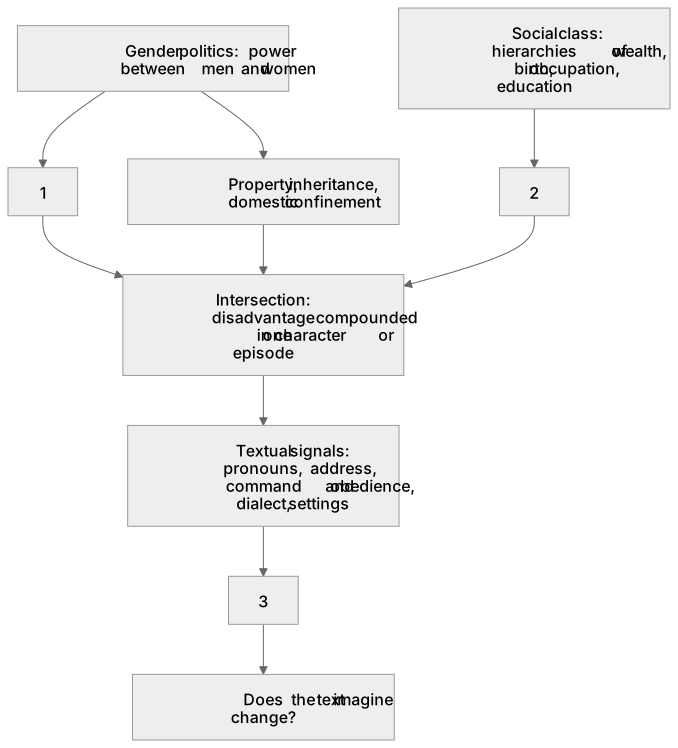
1Box 1
2Box 2
3Box 3
There is more to this lesson
The full lesson goes on to check your understanding and help you earn the marks. Create a free account to carry on, with your progress saved.
A week of Premium from your first lesson · Then the free plan continues · No card, no charge
Test your understanding of Elements of political and social protest writing: gender politics and issues of social class
Active recall beats re-reading. Take an instant quiz now to test what you’ve learned and lock it into long-term memory.
A week of Premium from your first lesson · Then the free plan continues · No card, no charge