AQA · A-Level · English Literature
Course version: 7717 · Version from Sept 2026
The structural patterning of the text, how political tensions are…
Full specification wording
Elements of political and social protest writing: the structural patterning of the text, how political tensions are heightened and perhaps resolved
Structural patterning means the deliberate arrangement of a text's parts: chapters, acts, scenes, stanzas, narrative frames, repetitions, parallels, contrasts and shifts in time or voice.
Checked against the AQA 7717 specification (opens in a new tab) on .
- Point 14 of 17
Study notes
From the checked teaching notes for this specification point.
The idea
Structural patterning means the deliberate arrangement of a text's parts: chapters, acts, scenes, stanzas, narrative frames, repetitions, parallels, contrasts and shifts in time or voice. In protest writing, structure is argumentative. A writer may alternate scenes of privilege and deprivation so the contrast sharpens indignation, delay a revelation until tension peaks, repeat a motif until it becomes an accusation, or place a quiet ending after a climax so resolution feels ambiguous. To analyse this, map the text's shape, note where tension rises, and ask what each structural choice makes a reader feel or notice. Resolution need not mean harmony: an unresolved ending can itself protest by refusing comfort. Always connect pattern to political meaning rather than describing layout alone.
What earns the marks
- Identification of specific structural features such as chapter or act division, framing, juxtaposition, repetition, cyclical return or shifts in time and voice.
- Explanation of how a structural choice shapes the reader's response, for example by building tension, delaying judgement or forcing comparison.
- Analysis of how political tension is heightened at particular points, with reference to pace, sequence or withheld information.
- Consideration of endings and whether tensions are resolved, partially resolved or deliberately left open, and what that implies politically.
- Use of accurate terminology for narrative and dramatic structure, applied to evidence rather than listed.
- A line of argument showing how structure contributes to the text's protest, integrated with analysis of language and context.
Common mistakes and how to put them right
Retelling the plot in order and calling it structure.
Put it right by commenting on why events are arranged in that order and what the arrangement achieves.
Naming a device such as juxtaposition without explaining its effect.
Put it right by stating what the reader compares and what judgement the comparison invites.
Assuming every ending resolves the text's tensions.
Put it right by testing whether the close offers closure, compromise or continued unease.
Ignoring the extract's place in the whole text.
Put it right by relating the passage to the wider pattern of the work.
Exam tips
- Sketch the text's shape quickly in planning: beginning, turning point, climax, ending, and note where tension peaks.
- Use precise structural vocabulary such as foreshadowing, framing, cyclical structure, juxtaposition or delayed revelation, always tied to effect.
- When analysing an extract, comment on its position and function within the whole text as well as its internal movement.
- Link structural observations to the political argument so analysis serves interpretation rather than becoming a feature hunt.
Try the lesson
The start of the Elements of political and social protest writing: the structural patterning of the text, how political tensions are heightened and perhaps resolved lesson, made from checked teaching notes for this specification point.
Have a go first
In a protest novel, a writer alternates chapters set in a wealthy landowner's house with chapters set in the workers' cottages. What does this alternating structural pattern most directly achieve?
Listen
Structural patterning means the deliberate arrangement of a text's parts: chapters, acts, scenes, stanzas, narrative frames, repetitions, parallels, contrasts and shifts in time or voice. In protest writing, structure is argumentative. A writer may alternate scenes of privilege and deprivation so the contrast sharpens indignation, delay a revelation until tension peaks, repeat a motif until it becomes an accusation, or place a quiet ending after a climax so resolution feels ambiguous. To analyse this, map the text's shape, note where tension rises, and ask what each structural choice makes a reader feel or notice. Resolution need not mean harmony: an unresolved ending can itself protest by refusing comfort. Always connect pattern to political meaning rather than describing layout alone. A strong answer earns marks for these points. Identification of specific structural features such as chapter or act division, framing, juxtaposition, repetition, cyclical return or shifts in time and voice. Explanation of how a structural choice shapes the reader's response, for example by building tension, delaying judgement or forcing comparison. Analysis of how political tension is heightened at particular points, with reference to pace, sequence or withheld information. Consideration of endings and whether tensions are resolved, partially resolved or deliberately left open, and what that implies politically. A common slip: Retelling the plot in order and calling it structure. Instead, commenting on why events are arranged in that order and what the arrangement achieves. Exam tip: Sketch the text's shape quickly in planning: beginning, turning point, climax, ending, and note where tension peaks.
See it
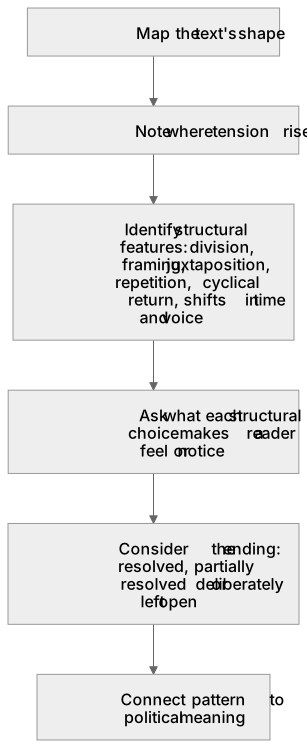
Put it in order
Put these steps in the order they happen.
- 1. Identify structural features: division, framing, juxtaposition, repetition, cyclical return, shifts in time and voice
- 2. Note where tension rises
- 3. Map the text's shape
- 4. Connect pattern to political meaning
- 5. Consider the ending: resolved, partially resolved or deliberately left open
- 6. Ask what each structural choice makes a reader feel or notice
Label the diagram
Some boxes have lost their names. Pick the right name for each number.
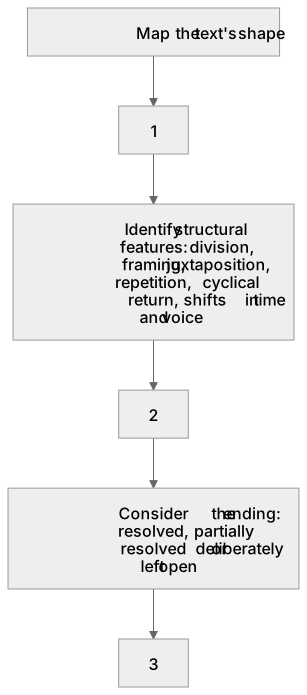
1Box 1
2Box 2
3Box 3
There is more to this lesson
The full lesson goes on to check your understanding and help you earn the marks. Create a free account to carry on, with your progress saved.
A week of Premium from your first lesson · Then the free plan continues · No card, no charge
Test your understanding of Elements of political and social protest writing: the structural patterning of the text, how political tensions are heightened and perhaps resolved
Active recall beats re-reading. Take an instant quiz now to test what you’ve learned and lock it into long-term memory.
A week of Premium from your first lesson · Then the free plan continues · No card, no charge