AQA · A-Level · English Literature
Course version: 7717 · Version from Sept 2026
The political and social protest genre covers representations of both…
Full specification wording
Elements of political and social protest writing: The political and social protest genre covers representations of both public and private settings.
Protest writing does not confine itself to parliaments, courts or streets.
Checked against the AQA 7717 specification (opens in a new tab) on .
- Point 2 of 17
- 4 key terms
Study notes
From the checked teaching notes for this specification point.
The idea
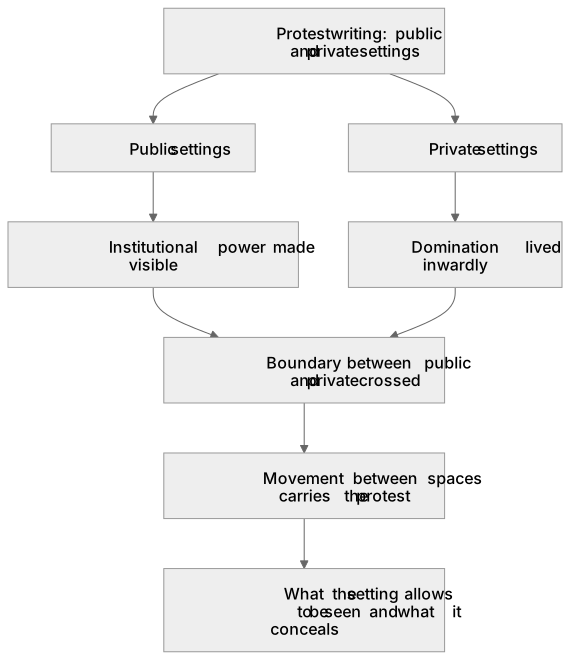
Protest writing does not confine itself to parliaments, courts or streets. It also enters drawing rooms, kitchens, bedrooms and minds. Public settings stage power visibly: a courtroom where justice is skewed, a plantation, a factory floor or a broadcast studio. Private settings expose how domination is lived inwardly: a marriage, a family meal, a letter never sent, a locked room. The two are connected. A private space can be made political when an imbalance of power shapes who speaks, who obeys and who is silenced. A public setting can become intimate when a single consciousness narrates it. When you analyse, ask what the setting allows to be seen and what it conceals, then track how movement between public and private spaces carries the protest.
What earns the marks
- Explains that public settings make institutional power visible, for example courts, assemblies, workplaces or colonial administrations, and shows how the text exposes their workings.
- Explains that private settings such as homes, marriages and interior monologues reveal the internalised effects of oppression on individuals and relationships.
- Analyses how the boundary between public and private is crossed, for example when domestic life is policed by law or when personal testimony enters public discourse.
- Uses precise textual evidence of setting, including description, staging, narrative voice and shifts of place, to support the argument.
- Connects observations about setting to the genre's wider concern with power, resistance and the reader's political awareness.
Common mistakes and how to put them right
Treating setting as mere background.
Put it right: Analyse setting as a structure that enables or suppresses speech, movement and resistance.
Assuming private settings are automatically apolitical.
Put it right: Show how domestic arrangements can embody and reproduce public power relations.
Listing public and private locations without linking them.
Put it right: Argue how the text moves between them and what that movement reveals about oppression.
Exam tips
- In planning, map each text's settings and label what each one exposes or hides about power.
- When quoting, choose details of place, such as a locked door or an open square, and analyse their political force.
- Use comparative connectives to show how two texts treat public and private space differently, rather than describing them separately.
Try the lesson
The start of the Elements of political and social protest writing: The political and social protest genre covers representations of both public and private settings. lesson, made from checked teaching notes for this specification point.
Have a go first
Which of the following best describes the typical scope of settings explored in political and social protest writing?
Listen
Protest writing does not confine itself to parliaments, courts or streets. It also enters drawing rooms, kitchens, bedrooms and minds. Public settings stage power visibly: a courtroom where justice is skewed, a plantation, a factory floor or a broadcast studio. Private settings expose how domination is lived inwardly: a marriage, a family meal, a letter never sent, a locked room. The two are connected. A private space can be made political when an imbalance of power shapes who speaks, who obeys and who is silenced. A public setting can become intimate when a single consciousness narrates it. When you analyse, ask what the setting allows to be seen and what it conceals, then track how movement between public and private spaces carries the protest. A strong answer earns marks for these points. Explains that public settings make institutional power visible, for example courts, assemblies, workplaces or colonial administrations, and shows how the text exposes their workings. Explains that private settings such as homes, marriages and interior monologues reveal the internalised effects of oppression on individuals and relationships. Analyses how the boundary between public and private is crossed, for example when domestic life is policed by law or when personal testimony enters public discourse. Uses precise textual evidence of setting, including description, staging, narrative voice and shifts of place, to support the argument. A common slip: Treating setting as mere background. Instead, analyse setting as a structure that enables or suppresses speech, movement and resistance. Exam tip: In planning, map each text's settings and label what each one exposes or hides about power.
See it
Key words
Say what each word means before you turn the card.
Public institutions and visible power
Try answering aloud or in your head before turning the card.
Domestic and interior life under oppression
Try answering aloud or in your head before turning the card.
The politics of speech, silence and space
Try answering aloud or in your head before turning the card.
Movement between private experience and public testimony
Try answering aloud or in your head before turning the card.
See every definition
- Public institutions and visible power
- Settings such as courts, assemblies, workplaces or colonial administrations that make institutional power visible and expose its workings.
- Domestic and interior life under oppression
- Private settings such as homes, marriages and interior monologues that reveal the internalised effects of oppression on individuals and relationships.
- The politics of speech, silence and space
- A private space made political when an imbalance of power shapes who speaks, who obeys and who is silenced.
- Movement between private experience and public testimony
- The crossing of the boundary between public and private, for example when domestic life is policed by law or when personal testimony enters public discourse.
Label the diagram
Some boxes have lost their names. Pick the right name for each number.
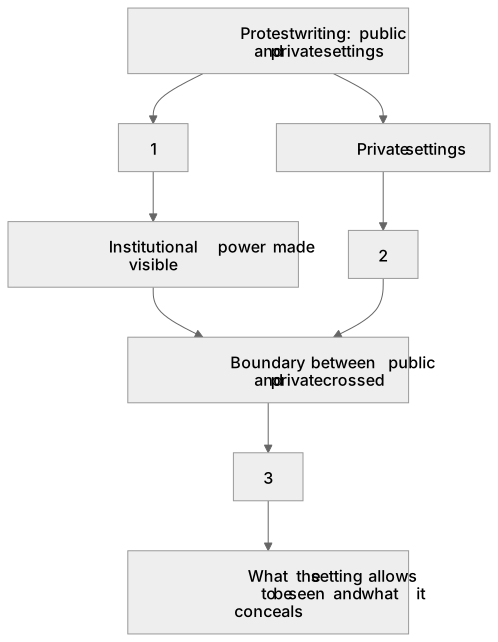
1Box 1
2Box 2
3Box 3
There is more to this lesson
The full lesson goes on to check your understanding and help you earn the marks. Create a free account to carry on, with your progress saved.
A week of Premium from your first lesson · Then the free plan continues · No card, no charge
Test your understanding of Elements of political and social protest writing: The political and social protest genre covers representations of both public and private settings.
Active recall beats re-reading. Take an instant quiz now to test what you’ve learned and lock it into long-term memory.
A week of Premium from your first lesson · Then the free plan continues · No card, no charge