AQA · A-Level · English Literature
Course version: 7717 · Version from Sept 2026
The way that language is used in the worlds that are created
Full specification wording
Elements of political and social protest writing: the way that language is used in the worlds that are created
This element asks you to analyse how a writer's language choices build the fictional world of a protest text, and how that world shapes the reader's political response.
Checked against the AQA 7717 specification (opens in a new tab) on .
- Point 15 of 17
- 4 key terms
Study notes
From the checked teaching notes for this specification point.
The idea
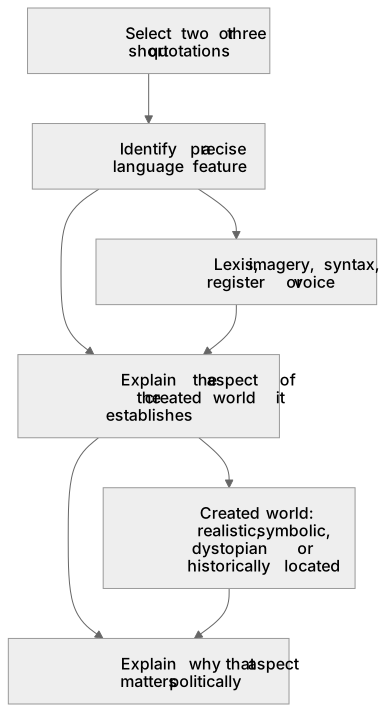
This element asks you to analyse how a writer's language choices build the fictional world of a protest text, and how that world shapes the reader's political response. World-building works through lexis, imagery, syntax, register and voice: a novel may name real streets and institutions to anchor its setting, or use symbolic landscapes to generalise a critique. Consider how description of place, work, housing or authority creates a believable society, and how dialogue and idiolect reveal power relations. A useful method is to select two or three short quotations, identify a precise language feature, then explain what aspect of the created world it establishes and why that matters politically.
What earns the marks
- Identifies precise language features, such as lexical fields, semantic fields, metaphor, simile, personification, register, dialect, idiolect, sentence length or punctuation, rather than labelling language vaguely.
- Explains how chosen features construct specific aspects of the created world, for example a stratified city, a repressive institution, a rural community or a commercial metropolis.
- Connects the created world to the text's political or social concerns, showing how setting and language position the reader to judge a society.
- Uses short, accurately quoted evidence and integrates it into a grammatical sentence rather than dropping quotations in isolation.
- Analyses patterns across a passage or whole text, such as recurring imagery of confinement or decay, instead of treating one quotation as representative of everything.
- Shows awareness that the created world may be realistic, symbolic, dystopian or historically located, and that this choice affects meaning.
Common mistakes and how to put them right
Retelling the plot of the created world instead of analysing the language that builds it.
Put it right: Keep the focus on named language features and their effects.
Using feature-spotting labels such as 'metaphor' or 'emotive language' without explaining how the feature constructs the world.
Put it right: Link each feature to a specific aspect of setting, society or power.
Treating the created world as a neutral backdrop rather than a political construction.
Put it right: Explain how the world's details invite the reader to criticise or sympathise.
Exam tips
- Plan around two or three precise language features and their world-building effects, so each paragraph has a clear analytical focus.
- Choose quotations that are short enough to analyse word by word, and embed them within your own sentence.
- Use subject terminology only when it sharpens your point; define the effect of the feature rather than listing it.
- Link each point back to the question's focus on created worlds, avoiding drift into character summary or biography.
Try the lesson
The start of the Elements of political and social protest writing: the way that language is used in the worlds that are created lesson, made from checked teaching notes for this specification point.
Have a go first
In a political and social protest text, a writer repeatedly uses mechanistic and sterile language to describe a city's architecture. How does this language choice most likely shape the created world?
Listen
This element asks you to analyse how a writer's language choices build the fictional world of a protest text, and how that world shapes the reader's political response. World-building works through lexis, imagery, syntax, register and voice: a novel may name real streets and institutions to anchor its setting, or use symbolic landscapes to generalise a critique. Consider how description of place, work, housing or authority creates a believable society, and how dialogue and idiolect reveal power relations. A useful method is to select two or three short quotations, identify a precise language feature, then explain what aspect of the created world it establishes and why that matters politically. A strong answer earns marks for these points. Identifies precise language features, such as lexical fields, semantic fields, metaphor, simile, personification, register, dialect, idiolect, sentence length or punctuation, rather than labelling language vaguely. Explains how chosen features construct specific aspects of the created world, for example a stratified city, a repressive institution, a rural community or a commercial metropolis. Connects the created world to the text's political or social concerns, showing how setting and language position the reader to judge a society. Uses short, accurately quoted evidence and integrates it into a grammatical sentence rather than dropping quotations in isolation. A common slip: Retelling the plot of the created world instead of analysing the language that builds it. Instead, keep the focus on named language features and their effects. Exam tip: Plan around two or three precise language features and their world-building effects, so each paragraph has a clear analytical focus.
See it
Key words
Say what each word means before you turn the card.
Language and power
Try answering aloud or in your head before turning the card.
Setting and society
Try answering aloud or in your head before turning the card.
Voice and perspective
Try answering aloud or in your head before turning the card.
Political critique through world-building
Try answering aloud or in your head before turning the card.
See every definition
- Language and power
- The way dialogue and idiolect reveal power relations within the society a text creates.
- Setting and society
- How description of place, work, housing or authority creates a believable society that shapes the reader's political response.
- Voice and perspective
- A language element, alongside lexis, imagery, syntax and register, through which world-building works.
- Political critique through world-building
- Using a created world, whether realistic, symbolic, dystopian or historically located, to position the reader to judge a society.
Label the diagram
Some boxes have lost their names. Pick the right name for each number.
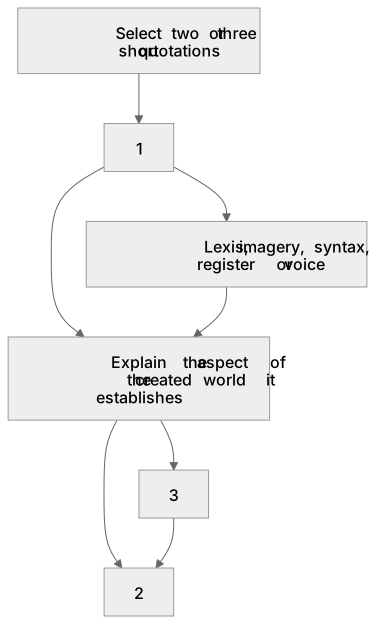
1Box 1
2Box 2
3Box 3
There is more to this lesson
The full lesson goes on to check your understanding and help you earn the marks. Create a free account to carry on, with your progress saved.
A week of Premium from your first lesson · Then the free plan continues · No card, no charge
Test your understanding of Elements of political and social protest writing: the way that language is used in the worlds that are created
Active recall beats re-reading. Take an instant quiz now to test what you’ve learned and lock it into long-term memory.
A week of Premium from your first lesson · Then the free plan continues · No card, no charge