AQA · A-Level · English Literature
Course version: 7717 · Version from Sept 2026
The way that political and social protest writing is used to comment on…
Full specification wording
Elements of political and social protest writing: the way that political and social protest writing is used to comment on society, particularly the representation of society at particular historical periods
This element requires you to examine how protest writing critiques society and how its representation reflects the historical period in which it was produced or set.
Checked against the AQA 7717 specification (opens in a new tab) on .
- Point 16 of 17
Study notes
From the checked teaching notes for this specification point.
The idea
This element requires you to examine how protest writing critiques society and how its representation reflects the historical period in which it was produced or set. You should connect textual detail to social structures such as class, gender, race, labour, empire or governance, and consider the writer's purpose and intended audience. Historical context is not decoration: it should explain why a text attacks particular injustices and how its methods, from satire to documentary realism, respond to its moment. A strong approach selects a specific social issue, shows how the text represents it through language and form, and evaluates the comment being made.
What earns the marks
- Identifies a specific social issue or institution being criticised, such as poor working conditions, colonial power, gender inequality or political corruption.
- Uses accurate historical context about the period of production or setting to explain the text's targets and methods.
- Analyses how representation works through language, form and structure, for example satire, irony, allegory, narrative perspective or juxtaposition.
- Evaluates the nature of the comment, considering whether the text exposes, warns, mourns, satirises or calls for change.
- Connects the text's representation of society to its likely audience and purpose, showing how the protest is designed to affect readers.
- Supports points with precise textual evidence and avoids reducing the text to a simple historical report.
Common mistakes and how to put them right
Writing historical background as a separate block without linking it to textual analysis.
Put it right: Weave context into the discussion of specific language and form choices.
Assuming a text reflects its period straightforwardly rather than shaping or challenging it.
Put it right: Analyse the writer's selective representation and its purpose.
Treating protest as a single attitude, so every text is said to 'criticise society' in the same way.
Put it right: Distinguish the specific target, tone and method of each text.
Exam tips
- Anchor each paragraph in a specific social issue and a precise piece of textual evidence, then bring in context to explain it.
- Use context to illuminate the text, not to replace analysis; aim for a balance of textual detail and historical explanation.
- Compare texts by their methods of protest as well as their messages, noting differences in form, tone and audience.
- Keep the question's focus on comment and representation, and avoid drifting into biography or general history.
Try the lesson
The start of the Elements of political and social protest writing: the way that political and social protest writing is used to comment on society, particularly the representation of society at particular historical periods lesson, made from checked teaching notes for this specification point.
Have a go first
In political and social protest writing, what is the main purpose of representing society as it existed at a particular historical period?
Listen
This element requires you to examine how protest writing critiques society and how its representation reflects the historical period in which it was produced or set. You should connect textual detail to social structures such as class, gender, race, labour, empire or governance, and consider the writer's purpose and intended audience. Historical context is not decoration: it should explain why a text attacks particular injustices and how its methods, from satire to documentary realism, respond to its moment. A strong approach selects a specific social issue, shows how the text represents it through language and form, and evaluates the comment being made. A strong answer earns marks for these points. Identifies a specific social issue or institution being criticised, such as poor working conditions, colonial power, gender inequality or political corruption. Uses accurate historical context about the period of production or setting to explain the text's targets and methods. Analyses how representation works through language, form and structure, for example satire, irony, allegory, narrative perspective or juxtaposition. Evaluates the nature of the comment, considering whether the text exposes, warns, mourns, satirises or calls for change. A common slip: Writing historical background as a separate block without linking it to textual analysis. Instead, weave context into the discussion of specific language and form choices. Exam tip: Anchor each paragraph in a specific social issue and a precise piece of textual evidence, then bring in context to explain it.
See it
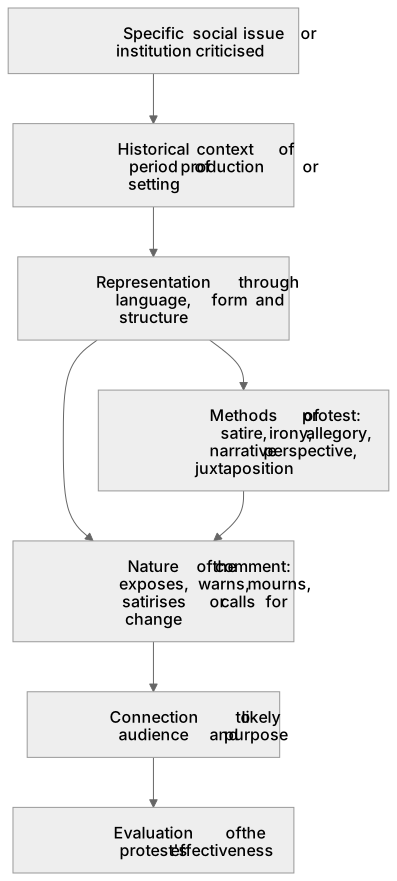
Label the diagram
Some boxes have lost their names. Pick the right name for each number.
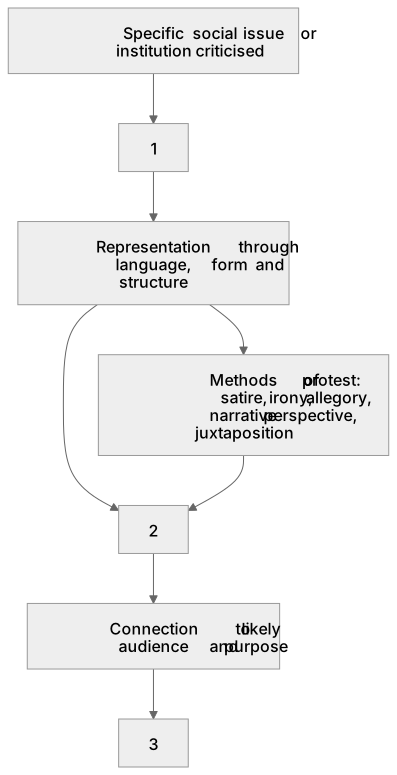
1Box 1
2Box 2
3Box 3
There is more to this lesson
The full lesson goes on to check your understanding and help you earn the marks. Create a free account to carry on, with your progress saved.
A week of Premium from your first lesson · Then the free plan continues · No card, no charge
Test your understanding of Elements of political and social protest writing: the way that political and social protest writing is used to comment on society, particularly the representation of society at particular historical periods
Active recall beats re-reading. Take an instant quiz now to test what you’ve learned and lock it into long-term memory.
A week of Premium from your first lesson · Then the free plan continues · No card, no charge