AQA · A-Level · English Literature
Course version: 7717 · Version from Sept 2026
Its use here derives from semiotics and involves understanding the idea of…
Full specification wording
Subject content – A-level: Its use here derives from semiotics and involves understanding the idea of 'signification'.
In this specification, 'significance' means meaning produced through signs, not just importance.
Checked against the AQA 7717 specification (opens in a new tab) on .
- Point 8 of 9
- 4 key terms
Study notes
From the checked teaching notes for this specification point.
The idea
In this specification, 'significance' means meaning produced through signs, not just importance. Semiotics, rooted in Saussure's dyadic model, treats a sign as a signifier (the form: a word, image, or costume) joined to a signified (the concept it evokes). Signification is relational: a sign means what it does through differences from other signs in a system. For example, a red dress in a novel signifies through contrast with other colours and contexts, not by an inherent property. When analysing significance, read textual details as signifiers and ask what concepts they generate. Interpretation becomes a reasoned activity: select a detail, identify its signification, and justify this with textual evidence.
What earns the marks
- Defines signification as the process by which signs produce meaning, not merely as a text's importance or message.
- Distinguishes signifier (form) from signified (concept) and explains that their relationship is conventional rather than natural.
- Explains that meaning is relational and differential: a sign gains meaning through contrast with other signs in the same system.
- Applies semiotic reading to a concrete textual detail, such as costume, colour, setting or repeated word, and states what it may signify.
- Links signification to interpretation by showing how a chosen detail supports a reading of the text as a whole.
- Uses accurate terminology (sign, signifier, signified, code, connotation) without treating it as decoration.
Common mistakes and how to put them right
Treating 'significance' as a synonym for importance or theme, which loses the semiotic sense.
Put it right by explaining meaning as produced through signs.
Assuming a signifier has a fixed, natural meaning, which ignores convention.
Put it right by showing how meaning shifts with context and contrast.
Listing semiotic terms without applying them to a quotation or detail.
Put it right by anchoring each term to specific textual evidence.
Exam tips
- When a question asks about significance, choose two or three precise details and analyse what each signifies rather than summarising plot.
- Use the signifier/signified distinction explicitly to show conceptual understanding, then move quickly to textual evidence.
- Show relational meaning by comparing a sign with a contrasting sign in the same text, such as one setting against another.
Try the lesson
The start of the Subject content – A-level: Its use here derives from semiotics and involves understanding the idea of 'signification'. lesson, made from checked teaching notes for this specification point.
Have a go first
The specification notes that the term 'significance' derives from semiotics and involves understanding 'signification'. In this context, what does 'signification' refer to?
Listen
In this specification, 'significance' means meaning produced through signs, not just importance. Semiotics, rooted in Saussure's dyadic model, treats a sign as a signifier (the form: a word, image, or costume) joined to a signified (the concept it evokes). Signification is relational: a sign means what it does through differences from other signs in a system. For example, a red dress in a novel signifies through contrast with other colours and contexts, not by an inherent property. When analysing significance, read textual details as signifiers and ask what concepts they generate. Interpretation becomes a reasoned activity: select a detail, identify its signification, and justify this with textual evidence. A strong answer earns marks for these points. Defines signification as the process by which signs produce meaning, not merely as a text's importance or message. Distinguishes signifier (form) from signified (concept) and explains that their relationship is conventional rather than natural. Explains that meaning is relational and differential: a sign gains meaning through contrast with other signs in the same system. Applies semiotic reading to a concrete textual detail, such as costume, colour, setting or repeated word, and states what it may signify. A common slip: Treating 'significance' as a synonym for importance or theme, which loses the semiotic sense. Instead, explaining meaning as produced through signs. Exam tip: When a question asks about significance, choose two or three precise details and analyse what each signifies rather than summarising plot.
See it
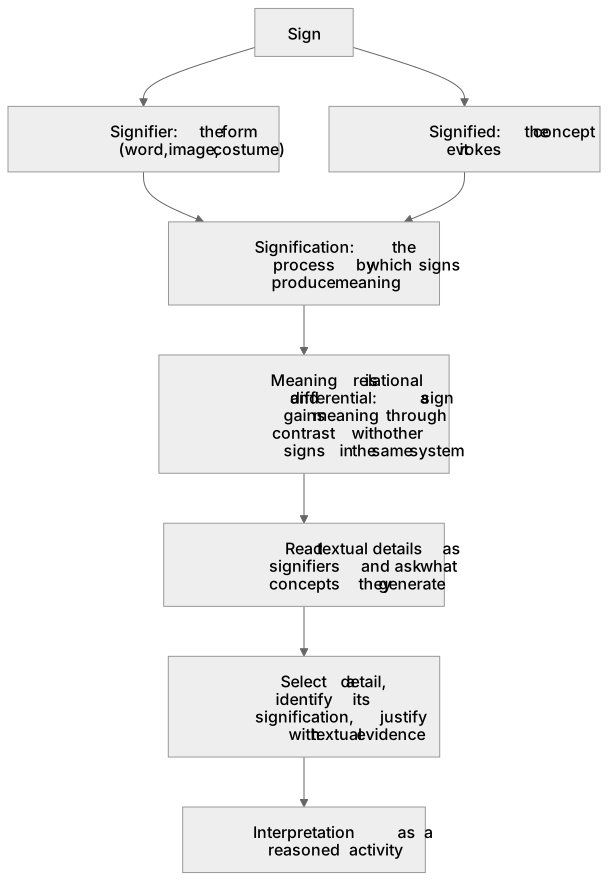
Key words
Say what each word means before you turn the card.
Signification
Try answering aloud or in your head before turning the card.
Signifier
Try answering aloud or in your head before turning the card.
Signified
Try answering aloud or in your head before turning the card.
Interpretation
Try answering aloud or in your head before turning the card.
See every definition
- Signification
- The process by which signs produce meaning, rather than a text's importance or message.
- Signifier
- The form of a sign, such as a word, image, or costume.
- Signified
- The concept that a signifier evokes.
- Interpretation
- A reasoned activity in which a detail is selected, its signification identified, and this justified with textual evidence.
Label the diagram
Some boxes have lost their names. Pick the right name for each number.
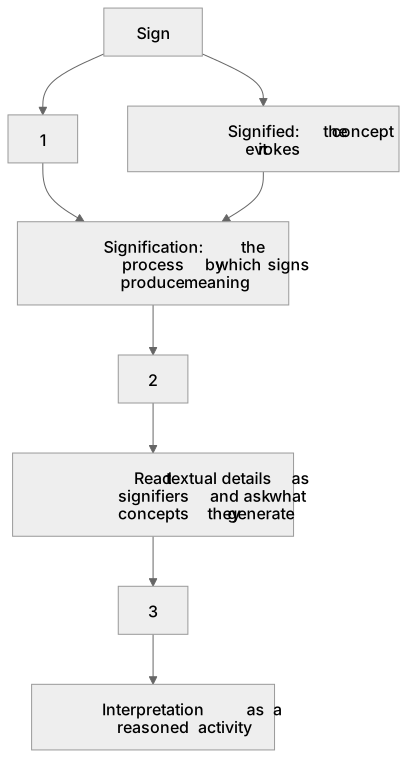
1Box 1
2Box 2
3Box 3
There is more to this lesson
The full lesson goes on to check your understanding and help you earn the marks. Create a free account to carry on, with your progress saved.
A week of Premium from your first lesson · Then the free plan continues · No card, no charge
Test your understanding of Subject content – A-level: Its use here derives from semiotics and involves understanding the idea of 'signification'.
Active recall beats re-reading. Take an instant quiz now to test what you’ve learned and lock it into long-term memory.
A week of Premium from your first lesson · Then the free plan continues · No card, no charge