Pearson Edexcel · A-Level · English Literature
Course version: 9ET0 · Version from Sept 2015
Poetry – Section B: Specified Poetry Pre- or Post-1900 – Post-1900 – The…
Full specification wording
Component 3: Poetry – Section B: Specified Poetry Pre- or Post-1900 – Post-1900 – The Modernist Period – The Great Modern Poets, editor Michael Schmidt (Quercus, 2014): La Figlia Che Piange T S Eliot
T.S. Eliot’s ‘La Figlia Che Piange’ examines the complex relationship between lived experience and artistic creation.
Checked against the Pearson Edexcel 9ET0 specification (opens in a new tab) on .
- Point 12 of 21
- 4 key terms
Study notes
From the checked teaching notes for this specification point.
The idea
T.S. Eliot’s ‘La Figlia Che Piange’ examines the complex relationship between lived experience and artistic creation. The title, translating to ‘The Weeping Girl’, introduces a scene of parting that the speaker attempts to stage-manage like a theatrical director. Eliot uses imperative verbs such as ‘Stand’ and ‘Weave’ to highlight the speaker’s desire to control memory and aestheticise grief, distancing himself from genuine emotional pain. The poem exemplifies Modernist fragmentation, revealing how artists manipulate memory to construct artificial, yet compelling, emotional landscapes.
What earns the marks
- Examine the speaker's use of imperative verbs to establish a directorial, controlling tone over the memory.
- Analyse the tension between genuine emotional experience and the aestheticisation of grief.
- Evaluate the significance of the poem's shifting perspectives and how they reflect Modernist concerns with subjective reality.
- Discuss the repeated imperative 'Weave, weave the sunlight in your hair' and the girl's posed posture in creating a romanticised, artificial tableau.
Common mistakes and how to put them right
Reading the poem as a straightforward, autobiographical account of a breakup.
Put it right: Approach the poem as a meta-theatrical exploration of how the mind constructs and edits memories.
Overlooking the significance of the Italian title.
Put it right: Acknowledge that the title references a specific piece of art (a stele), reinforcing the theme of life imitating art.
Ignoring the shift in tense in the final stanza.
Put it right: Analyse how the transition to the past tense reflects the speaker's lingering, unresolved feelings despite his attempts at detachment.
Exam tips
- Focus on the speaker's internal conflict between wanting to feel genuine emotion and wanting to control it for artistic purposes.
- Link the poem's themes of alienation and fragmented memory to other Eliot poems or Modernist works in the anthology.
- Use the term 'aesthetic distance' when discussing how the speaker separates himself from the pain of the parting.
Try the lesson
The start of the Component 3: Poetry – Section B: Specified Poetry Pre- or Post-1900 – Post-1900 – The Modernist Period – The Great Modern Poets, editor Michael Schmidt (Quercus, 2014): La Figlia Che Piange T S Eliot lesson, made from checked teaching notes for this specification point.
Have a go first
In the opening stanza of T.S. Eliot's 'La Figlia Che Piange', how does the speaker primarily position himself in relation to the scene of the parting lovers?
Listen
T.S. Eliot’s ‘La Figlia Che Piange’ examines the complex relationship between lived experience and artistic creation. The title, translating to ‘The Weeping Girl’, introduces a scene of parting that the speaker attempts to stage-manage like a theatrical director. Eliot uses imperative verbs such as ‘Stand’ and ‘Weave’ to highlight the speaker’s desire to control memory and aestheticise grief, distancing himself from genuine emotional pain. The poem exemplifies Modernist fragmentation, revealing how artists manipulate memory to construct artificial, yet compelling, emotional landscapes. A strong answer earns marks for these points. Examine the speaker's use of imperative verbs to establish a directorial, controlling tone over the memory. Analyse the tension between genuine emotional experience and the aestheticisation of grief. Evaluate the significance of the poem's shifting perspectives and how they reflect Modernist concerns with subjective reality. Discuss the repeated imperative 'Weave, weave the sunlight in your hair' and the girl's posed posture in creating a romanticised, artificial tableau. A common slip: Reading the poem as a straightforward, autobiographical account of a breakup. Instead, Approach the poem as a meta-theatrical exploration of how the mind constructs and edits memories. Exam tip: Focus on the speaker's internal conflict between wanting to feel genuine emotion and wanting to control it for artistic purposes.
See it
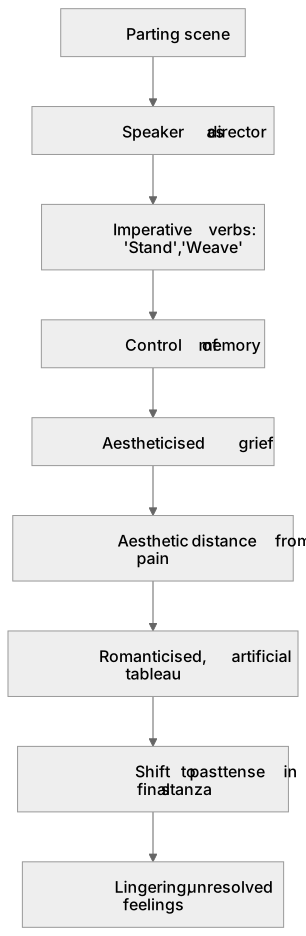
Key words
Say what each word means before you turn the card.
Art versus Reality
Try answering aloud or in your head before turning the card.
Memory and Regret
Try answering aloud or in your head before turning the card.
Control and Manipulation
Try answering aloud or in your head before turning the card.
Aesthetic Distance
Try answering aloud or in your head before turning the card.
See every definition
- Art versus Reality
- The tension between the romanticised image of the girl and the speaker's detached commentary, as lived experience is set against artistic creation.
- Memory and Regret
- The speaker's desire to control memory and aestheticise grief, with the final stanza's shift to the past tense reflecting lingering, unresolved feelings despite attempts at detachment.
- Control and Manipulation
- The speaker's attempt to stage-manage a scene of parting like a theatrical director, using imperative verbs such as 'Stand' and 'Weave' to distance himself from genuine emotional pain.
- Aesthetic Distance
- The separation the speaker creates between himself and the pain of the parting, distancing himself from genuine emotional pain by aestheticising grief.
Label the diagram
Some boxes have lost their names. Pick the right name for each number.
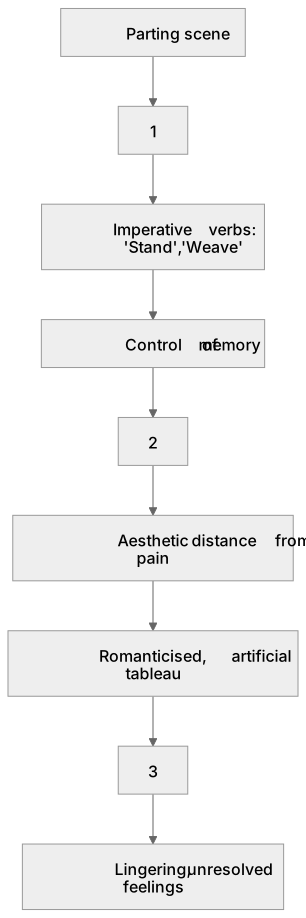
1Box 1
2Box 2
3Box 3
There is more to this lesson
The full lesson goes on to check your understanding and help you earn the marks. Create a free account to carry on, with your progress saved.
A week of Premium from your first lesson · Then the free plan continues · No card, no charge
Test your understanding of Component 3: Poetry – Section B: Specified Poetry Pre- or Post-1900 – Post-1900 – The Modernist Period – The Great Modern Poets, editor Michael Schmidt (Quercus, 2014): La Figlia Che Piange T S Eliot
Active recall beats re-reading. Take an instant quiz now to test what you’ve learned and lock it into long-term memory.
A week of Premium from your first lesson · Then the free plan continues · No card, no charge