Pearson Edexcel · A-Level · English Literature
Course version: 9ET0 · Version from Sept 2015
Poetry – Section B: Specified Poetry Pre- or Post-1900 – Post-1900 – The…
Full specification wording
Component 3: Poetry – Section B: Specified Poetry Pre- or Post-1900 – Post-1900 – The Modernist Period – The Great Modern Poets, editor Michael Schmidt (Quercus, 2014): Lullaby
W.H. Auden's 'Lullaby' ('Lay your sleeping head, my love') is a profound meditation on the transient nature of love, human imperfection, and mortality.
Checked against the Pearson Edexcel 9ET0 specification (opens in a new tab) on .
- Point 19 of 21
- 4 key terms
Study notes
From the checked teaching notes for this specification point.
The idea
W.H. Auden's 'Lullaby' ('Lay your sleeping head, my love') is a profound meditation on the transient nature of love, human imperfection, and mortality. Unlike traditional romantic poetry, Auden acknowledges the flaws of the beloved, describing them as 'human on my faithless arm'. This realism heightens the tenderness of the moment, as the speaker cherishes a fleeting connection against the backdrop of inevitable decay and time. The poem's structure, with its trochaic meter and complex rhyme scheme, creates a soothing yet melancholic rhythm.
What earns the marks
- Analyse the juxtaposition of romantic tenderness with the harsh realities of human imperfection and mortality.
- Evaluate the use of trochaic meter in establishing a rhythm that mimics a traditional lullaby while conveying underlying melancholy.
- Explore the significance of time and transience as central motifs threatening the lovers' intimacy.
- Discuss the speaker's acceptance of the beloved's flaws, contrasting this with idealised romantic conventions.
Common mistakes and how to put them right
Treating the poem as a conventional, idealised love poem.
Put it right: Focus on Auden's deliberate inclusion of human flaws and 'faithlessness'.
Overlooking the metrical choices.
Put it right: Analyse how the trochaic meter creates a falling rhythm that reflects both a lullaby and the inevitability of death.
Ignoring the broader contextual threats.
Put it right: Acknowledge how the poem contrasts the private sphere of the lovers with the encroaching public world and time.
Exam tips
- Focus on the phrase 'human on my faithless arm' to discuss Auden's realistic, anti-romantic view of love.
- Contrast the peaceful imagery of sleep with the vocabulary of decay and time to highlight the poem's central tension.
- Use the poem to discuss Modernist themes of anxiety, impermanence, and the search for meaning in a fractured world.
Try the lesson
The start of the Component 3: Poetry – Section B: Specified Poetry Pre- or Post-1900 – Post-1900 – The Modernist Period – The Great Modern Poets, editor Michael Schmidt (Quercus, 2014): Lullaby lesson, made from checked teaching notes for this specification point.
Have a go first
In W.H. Auden's poem 'Lullaby', what is the primary situation described in the opening stanza?
Listen
W.H. Auden's 'Lullaby' ('Lay your sleeping head, my love') is a profound meditation on the transient nature of love, human imperfection, and mortality. Unlike traditional romantic poetry, Auden acknowledges the flaws of the beloved, describing them as 'human on my faithless arm'. This realism heightens the tenderness of the moment, as the speaker cherishes a fleeting connection against the backdrop of inevitable decay and time. The poem's structure, with its trochaic meter and complex rhyme scheme, creates a soothing yet melancholic rhythm. A strong answer earns marks for these points. Analyse the juxtaposition of romantic tenderness with the harsh realities of human imperfection and mortality. Evaluate the use of trochaic meter in establishing a rhythm that mimics a traditional lullaby while conveying underlying melancholy. Explore the significance of time and transience as central motifs threatening the lovers' intimacy. Discuss the speaker's acceptance of the beloved's flaws, contrasting this with idealised romantic conventions. A common slip: Treating the poem as a conventional, idealised love poem. Instead, focus on Auden's deliberate inclusion of human flaws and 'faithlessness'. Exam tip: Focus on the phrase 'human on my faithless arm' to discuss Auden's realistic, anti-romantic view of love.
See it
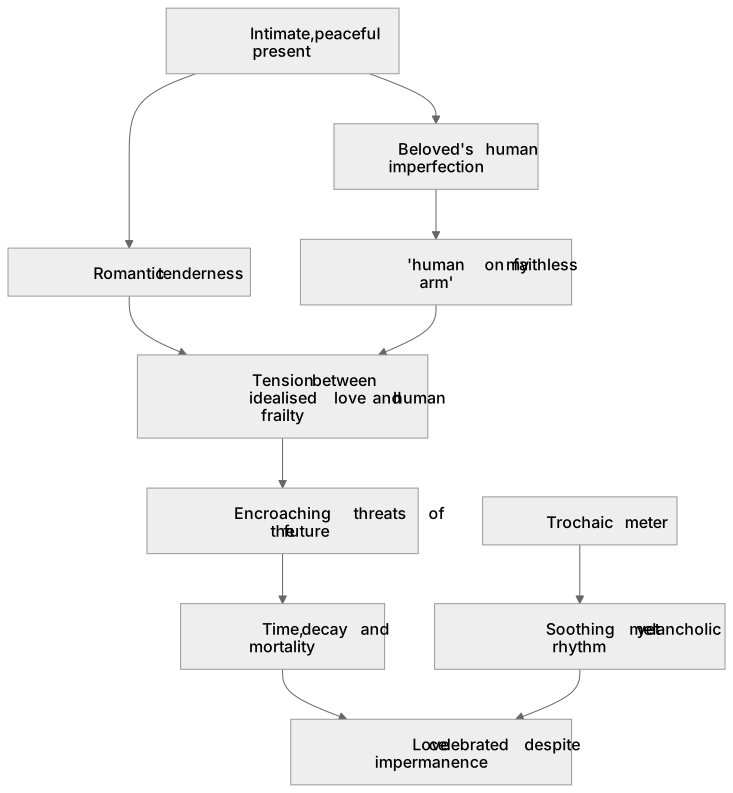
Key words
Say what each word means before you turn the card.
Transience of Love
Try answering aloud or in your head before turning the card.
Mortality and Time
Try answering aloud or in your head before turning the card.
Human Imperfection
Try answering aloud or in your head before turning the card.
Intimacy versus the Outside World
Try answering aloud or in your head before turning the card.
See every definition
- Transience of Love
- The fleeting nature of love, which the speaker cherishes as a temporary connection set against inevitable decay and time.
- Mortality and Time
- Central motifs that threaten the lovers' intimacy, set against the backdrop of inevitable decay.
- Human Imperfection
- The flaws of the beloved, acknowledged by Auden and described as 'human on my faithless arm'.
- Intimacy versus the Outside World
- The contrast between the private sphere of the lovers and the encroaching public world and time.
Label the diagram
Some boxes have lost their names. Pick the right name for each number.
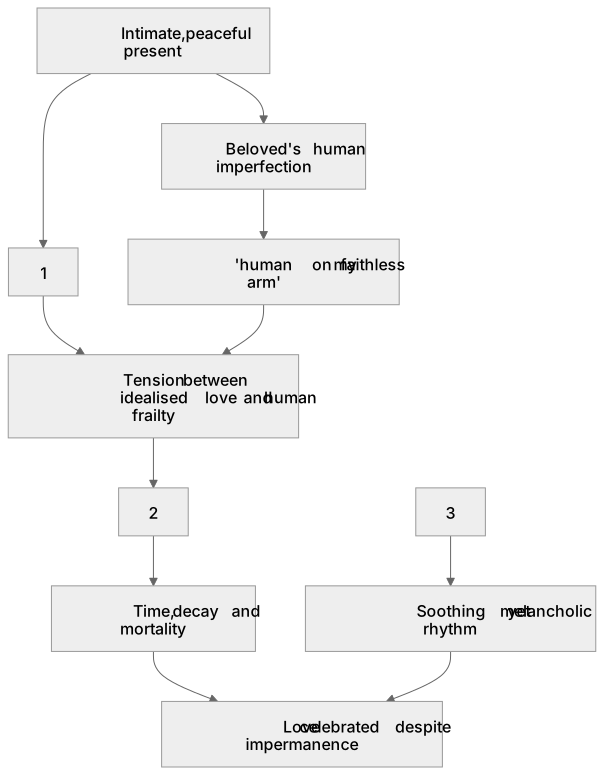
1Box 1
2Box 2
3Box 3
There is more to this lesson
The full lesson goes on to check your understanding and help you earn the marks. Create a free account to carry on, with your progress saved.
A week of Premium from your first lesson · Then the free plan continues · No card, no charge
Test your understanding of Component 3: Poetry – Section B: Specified Poetry Pre- or Post-1900 – Post-1900 – The Modernist Period – The Great Modern Poets, editor Michael Schmidt (Quercus, 2014): Lullaby
Active recall beats re-reading. Take an instant quiz now to test what you’ve learned and lock it into long-term memory.
A week of Premium from your first lesson · Then the free plan continues · No card, no charge