Pearson Edexcel · A-Level · English Literature
Course version: 9ET0 · Version from Sept 2015
Poetry – Section B: Specified Poetry Pre- or Post-1900 – Post-1900 – The…
Full specification wording
Component 3: Poetry – Section B: Specified Poetry Pre- or Post-1900 – Post-1900 – The Modernist Period – The Great Modern Poets, editor Michael Schmidt (Quercus, 2014): Stop all the Clocks W H Auden
W.H. Auden's 'Stop all the Clocks' (also known as 'Funeral Blues') is a poignant elegy exploring the devastating, all-consuming nature of grief.
Checked against the Pearson Edexcel 9ET0 specification (opens in a new tab) on .
- Point 18 of 21
- 4 key terms
Study notes
From the checked teaching notes for this specification point.
The idea
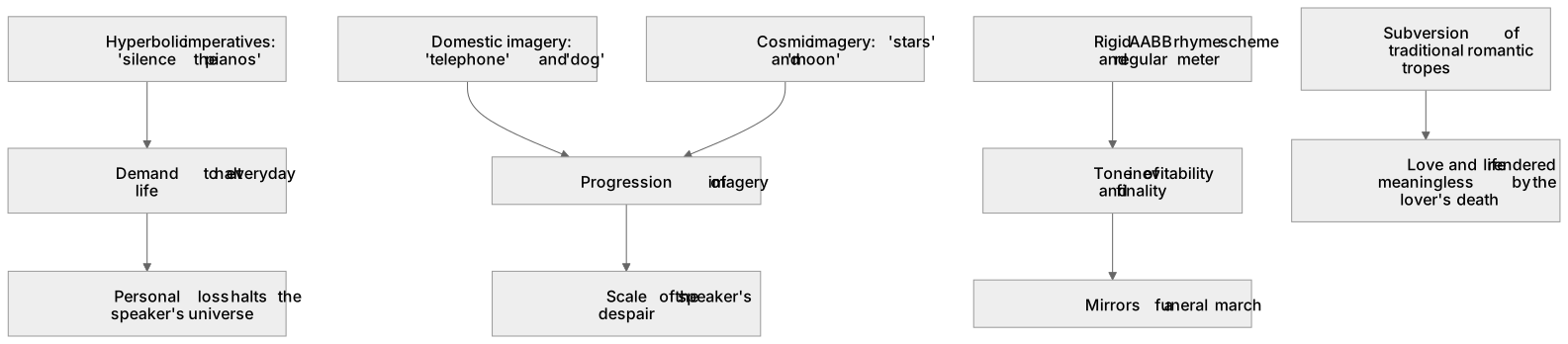
W.H. Auden's 'Stop all the Clocks' (also known as 'Funeral Blues') is a poignant elegy exploring the devastating, all-consuming nature of grief. The speaker demands the cessation of everyday life, using hyperbolic imperatives like 'silence the pianos' to reflect how personal loss halts their universe. Auden contrasts mundane domesticity with cosmic imagery, moving from 'telephone' and 'dog' to 'stars' and 'moon', illustrating the scale of the speaker's despair. The rigid AABB rhyme scheme and regular meter create a sense of inevitability and finality, mirroring a funeral march.
What earns the marks
- Analyse the use of hyperbolic imperatives to convey the overwhelming and all-consuming nature of grief.
- Evaluate the progression from domestic, earthly imagery to vast, cosmic metaphors to illustrate the scale of loss.
- Explore the effect of the AABB rhyme scheme in creating a tone of finality, inevitability, and despair.
- Discuss the subversion of romantic conventions to emphasise the absolute devastation and nihilism following the lover's death.
Common mistakes and how to put them right
Assuming the poem is purely a traditional elegy.
Put it right: Recognise its origins as a satirical song in a play before it was adapted into a sincere expression of grief.
Ignoring the structural elements.
Put it right: Explicitly link the rigid AABB rhyme scheme and regular meter to the inescapable reality of death.
Misinterpreting the final stanza as hopeful or peaceful.
Put it right: Identify the dismantling of the cosmos as the ultimate expression of nihilistic despair.
Exam tips
- Compare the domestic imagery in the first stanza with the cosmic imagery in the final stanza to show the expanding scale of the speaker's grief.
- Link the use of imperatives to the speaker's desperate, yet futile, attempt to control a world fundamentally altered by death.
- Consider the poem's context within the Modernist period, noting its blend of colloquial language and profound existential angst.
Try the lesson
The start of the Component 3: Poetry – Section B: Specified Poetry Pre- or Post-1900 – Post-1900 – The Modernist Period – The Great Modern Poets, editor Michael Schmidt (Quercus, 2014): Stop all the Clocks W H Auden lesson, made from checked teaching notes for this specification point.
Have a go first
In the opening stanza of W. H. Auden's 'Stop all the clocks', what is the primary purpose of the speaker's commands to silence everyday noises?
Listen
W.H. Auden's 'Stop all the Clocks' (also known as 'Funeral Blues') is a poignant elegy exploring the devastating, all-consuming nature of grief. The speaker demands the cessation of everyday life, using hyperbolic imperatives like 'silence the pianos' to reflect how personal loss halts their universe. Auden contrasts mundane domesticity with cosmic imagery, moving from 'telephone' and 'dog' to 'stars' and 'moon', illustrating the scale of the speaker's despair. The rigid AABB rhyme scheme and regular meter create a sense of inevitability and finality, mirroring a funeral march. A strong answer earns marks for these points. Analyse the use of hyperbolic imperatives to convey the overwhelming and all-consuming nature of grief. Evaluate the progression from domestic, earthly imagery to vast, cosmic metaphors to illustrate the scale of loss. Explore the effect of the AABB rhyme scheme in creating a tone of finality, inevitability, and despair. Discuss the subversion of romantic conventions to emphasise the absolute devastation and nihilism following the lover's death. A common slip: Assuming the poem is purely a traditional elegy. Instead, recognise its origins as a satirical song in a play before it was adapted into a sincere expression of grief. Exam tip: Compare the domestic imagery in the first stanza with the cosmic imagery in the final stanza to show the expanding scale of the speaker's grief.
See it
Key words
Say what each word means before you turn the card.
Grief and Loss
Try answering aloud or in your head before turning the card.
Love and Devotion
Try answering aloud or in your head before turning the card.
The Finality of Death
Try answering aloud or in your head before turning the card.
Isolation and Despair
Try answering aloud or in your head before turning the card.
See every definition
- Grief and Loss
- The devastating, all-consuming nature of grief that halts the speaker's universe and renders love and life itself meaningless.
- Love and Devotion
- A love that, following the lover's death, is shown to be so absolute that life itself has been rendered meaningless.
- The Finality of Death
- A sense of inevitability and finality created by the rigid AABB rhyme scheme and regular meter, mirroring a funeral march.
- Isolation and Despair
- The scale of the speaker's despair, illustrated through the progression from domestic, earthly imagery to vast, cosmic metaphors.
Label the diagram
Some boxes have lost their names. Pick the right name for each number.

1Box 1
2Box 2
3Box 3
There is more to this lesson
The full lesson goes on to check your understanding and help you earn the marks. Create a free account to carry on, with your progress saved.
A week of Premium from your first lesson · Then the free plan continues · No card, no charge
Test your understanding of Component 3: Poetry – Section B: Specified Poetry Pre- or Post-1900 – Post-1900 – The Modernist Period – The Great Modern Poets, editor Michael Schmidt (Quercus, 2014): Stop all the Clocks W H Auden
Active recall beats re-reading. Take an instant quiz now to test what you’ve learned and lock it into long-term memory.
A week of Premium from your first lesson · Then the free plan continues · No card, no charge