Pearson Edexcel · A-Level · English Literature
Course version: 9ET0 · Version from Sept 2015
Poetry – Section B: Specified Poetry Pre- or Post-1900 – Post-1900 – The…
Full specification wording
Component 3: Poetry – Section B: Specified Poetry Pre- or Post-1900 – Post-1900 – The Movement – Philip Larkin: The Less Deceived (Faber, 2011): Dry-Point
'Dry-Point' uses the metaphor of a sharp etching technique to explore the abrasive and unfulfilling nature of sexual desire.
Checked against the Pearson Edexcel 9ET0 specification (opens in a new tab) on .
- Point 6 of 9
- 4 key terms
Study notes
From the checked teaching notes for this specification point.
The idea
'Dry-Point' uses the metaphor of a sharp etching technique to explore the abrasive and unfulfilling nature of sexual desire. Larkin characterises lust as a 'time-honoured irritant', a compulsion that traps individuals in a cycle of anticipation and disappointment. The imagery is deliberately harsh and claustrophobic, employing words like 'padlock' to convey the inescapable drive of sexuality. In the final stanza, the speaker yearns for an escape from this cycle, visualising a 'bare and sunscrubbed room' representing a state of pure, asexual tranquility and emotional detachment. This stark contrast highlights Larkin's profound pessimism regarding physical intimacy and his recurring desire for an impossible, undisturbed isolation.
What earns the marks
- Analyse the title 'Dry-Point' as a metaphor for the sharp, scratching, and permanent irritation of sexual desire.
- Evaluate the use of claustrophobic and mechanical diction to present lust as an oppressive, inescapable force rather than a romantic ideal.
- Discuss the structural shift in the final stanza from the chaotic imagery of desire to the serene, empty imagery of the 'sunscrubbed room'.
- Explore how the poem subverts traditional romantic poetry by presenting physical intimacy as a frustrating, rather than fulfilling, experience.
Common mistakes and how to put them right
Reading the poem as a celebration of physical intimacy.
Put it right: Identify the deeply cynical tone that frames sexual desire as a frustrating, cyclical trap.
Misunderstanding the 'bare and sunscrubbed room' as a literal physical location.
Put it right: Interpret the room as a symbolic, unattainable mental space free from the demands of human desire.
Overlooking the significance of the title.
Put it right: Explain how dry-point etching, which creates a burr and a harsh line, mirrors the abrasive emotional landscape of the poem.
Exam tips
- Contrast the cynical view of sexuality in 'Dry-Point' with the more ambivalent or romanticised views found in other Movement poets.
- Examine how Larkin's use of enjambment mimics the relentless, uncontrollable build-up of the desires he describes.
- Link the poem's yearning for emptiness to Larkin's broader philosophical preoccupation with absence and nothingness.
Try the lesson
The start of the Component 3: Poetry – Section B: Specified Poetry Pre- or Post-1900 – Post-1900 – The Movement – Philip Larkin: The Less Deceived (Faber, 2011): Dry-Point lesson, made from checked teaching notes for this specification point.
Have a go first
What is the central "time-honoured irritant" that Philip Larkin explores in the poem 'Dry-Point'?
Listen
Dry-Point' uses the metaphor of a sharp etching technique to explore the abrasive and unfulfilling nature of sexual desire. Larkin characterises lust as a 'time-honoured irritant', a compulsion that traps individuals in a cycle of anticipation and disappointment. The imagery is deliberately harsh and claustrophobic, employing words like 'padlock' to convey the inescapable drive of sexuality. In the final stanza, the speaker yearns for an escape from this cycle, visualising a 'bare and sunscrubbed room' representing a state of pure, asexual tranquility and emotional detachment. This stark contrast highlights Larkin's profound pessimism regarding physical intimacy and his recurring desire for an impossible, undisturbed isolation. A strong answer earns marks for these points. Analyse the title 'Dry-Point' as a metaphor for the sharp, scratching, and permanent irritation of sexual desire. Evaluate the use of claustrophobic and mechanical diction to present lust as an oppressive, inescapable force rather than a romantic ideal. Discuss the structural shift in the final stanza from the chaotic imagery of desire to the serene, empty imagery of the 'sunscrubbed room'. Explore how the poem subverts traditional romantic poetry by presenting physical intimacy as a frustrating, rather than fulfilling, experience. A common slip: Reading the poem as a celebration of physical intimacy. Instead, Identify the deeply cynical tone that frames sexual desire as a frustrating, cyclical trap. Exam tip: Contrast the cynical view of sexuality in 'Dry-Point' with the more ambivalent or romanticised views found in other Movement poets.
See it
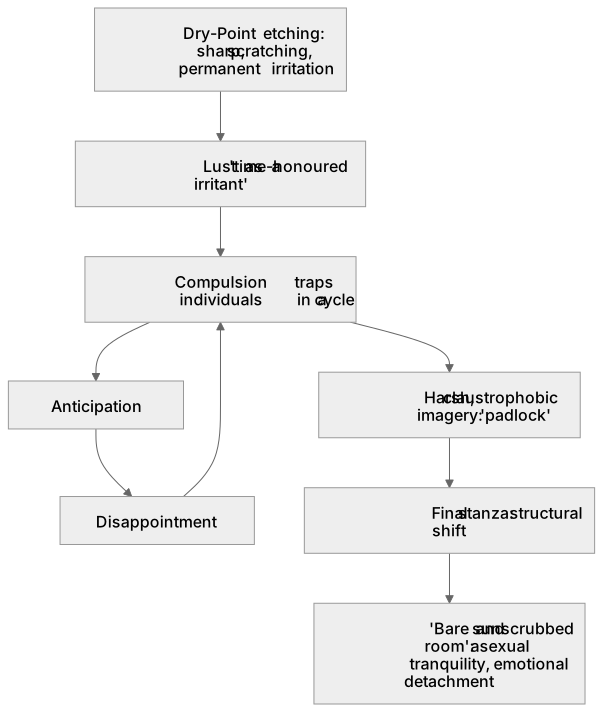
Key words
Say what each word means before you turn the card.
Sexual Desire and Frustration
Try answering aloud or in your head before turning the card.
Isolation and Detachment
Try answering aloud or in your head before turning the card.
The Ideal versus The Real
Try answering aloud or in your head before turning the card.
Entrapment
Try answering aloud or in your head before turning the card.
See every definition
- Sexual Desire and Frustration
- Larkin presents lust as a 'time-honoured irritant', a compulsion trapping individuals in a cycle of anticipation and disappointment rather than fulfilment.
- Isolation and Detachment
- The speaker yearns for escape into a state of pure, asexual tranquility and emotional detachment, an impossible, undisturbed isolation.
- The Ideal versus The Real
- The final stanza's serene, empty imagery contrasts with the chaotic imagery of desire, highlighting pessimism regarding physical intimacy.
- Entrapment
- Claustrophobic and mechanical diction conveys lust as an oppressive, inescapable force, with words like 'padlock' showing the inescapable drive of sexuality.
Label the diagram
Some boxes have lost their names. Pick the right name for each number.
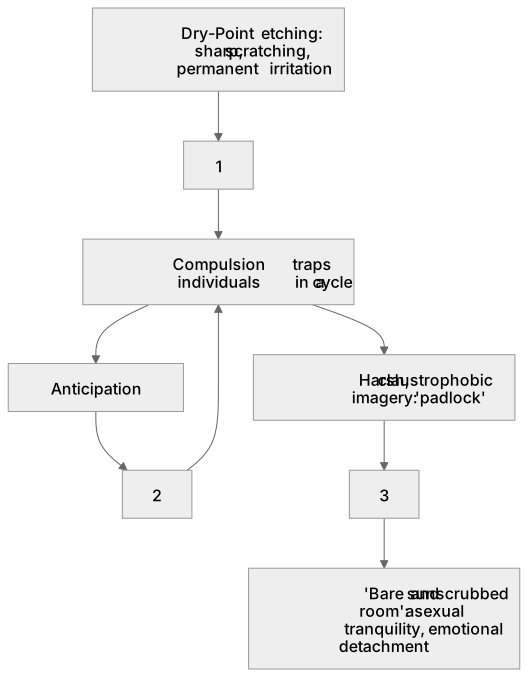
1Box 1
2Box 2
3Box 3
There is more to this lesson
The full lesson goes on to check your understanding and help you earn the marks. Create a free account to carry on, with your progress saved.
A week of Premium from your first lesson · Then the free plan continues · No card, no charge
Test your understanding of Component 3: Poetry – Section B: Specified Poetry Pre- or Post-1900 – Post-1900 – The Movement – Philip Larkin: The Less Deceived (Faber, 2011): Dry-Point
Active recall beats re-reading. Take an instant quiz now to test what you’ve learned and lock it into long-term memory.
A week of Premium from your first lesson · Then the free plan continues · No card, no charge