Pearson Edexcel · A-Level · English Literature
Course version: 9ET0 · Version from Sept 2015
Poetry – Section B: Specified Poetry Pre- or Post-1900 – Post-1900 – The…
Full specification wording
Component 3: Poetry – Section B: Specified Poetry Pre- or Post-1900 – Post-1900 – The Movement – Philip Larkin: The Less Deceived (Faber, 2011): Next, Please
"Next, Please" explores the human tendency to look towards the future with false hope, waiting for a 'ship' of good fortune that never arrives.
Checked against the Pearson Edexcel 9ET0 specification (opens in a new tab) on .
- Point 7 of 9
- 4 key terms
Study notes
From the checked teaching notes for this specification point.
The idea
"Next, Please" explores the human tendency to look towards the future with false hope, waiting for a 'ship' of good fortune that never arrives. Larkin uses the extended metaphor of watching ships from a bluff to represent this anticipation. The poem shifts from the collective, colloquial illusion of waiting for a sparkling future to the stark, inevitable reality of death, symbolised by the black-sailed ship.
What earns the marks
- Analyse the extended metaphor of the armada of promises versus the single black-sailed ship of death.
- Evaluate the use of collective pronouns ('we') to establish a universal human experience of false anticipation.
- Examine the structural shift in the final stanza, where the rhythm breaks to reflect the suddenness and inevitability of mortality.
- Discuss the significance of the title 'Next, Please' as a colloquial, dismissive phrase contrasting with the profound existential theme.
Common mistakes and how to put them right
Assuming the poem is purely pessimistic without acknowledging the critique of human self-deception.
Put it right: Focus on how Larkin critiques the active choice to live in the future rather than just presenting a bleak view of death.
Misinterpreting the 'black-sailed unfamiliar' as a literal ship.
Put it right: Identify the 'black-sailed unfamiliar' as a mythological allusion to death, drawing on the story of Theseus or the River Styx.
Ignoring the poem's form and focusing only on meaning.
Put it right: Analyse how the AABB rhyme scheme and varying metre create a sense of relentless, ticking time.
Exam tips
- Compare the theme of time and mortality in 'Next, Please' with other Larkin poems like 'Going' or 'Ambulances'.
- Quote specific structural devices, such as the enjambment across stanzas, to demonstrate how Larkin mimics the endless waiting process.
- Connect the poem's cynical tone regarding grand promises to the broader literary context of The Movement's rejection of romanticism.
Try the lesson
The start of the Component 3: Poetry – Section B: Specified Poetry Pre- or Post-1900 – Post-1900 – The Movement – Philip Larkin: The Less Deceived (Faber, 2011): Next, Please lesson, made from checked teaching notes for this specification point.
Have a go first
In Philip Larkin's poem 'Next, Please', what central metaphor is used to represent humanity's habit of waiting for a better future?
Listen
Next, Please" explores the human tendency to look towards the future with false hope, waiting for a 'ship' of good fortune that never arrives. Larkin uses the extended metaphor of watching ships from a bluff to represent this anticipation. The poem shifts from the collective, colloquial illusion of waiting for a sparkling future to the stark, inevitable reality of death, symbolised by the black-sailed ship. A strong answer earns marks for these points. Analyse the extended metaphor of the armada of promises versus the single black-sailed ship of death. Evaluate the use of collective pronouns ('we') to establish a universal human experience of false anticipation. Examine the structural shift in the final stanza, where the rhythm breaks to reflect the suddenness and inevitability of mortality. Discuss the significance of the title 'Next, Please' as a colloquial, dismissive phrase contrasting with the profound existential theme. A common slip: Assuming the poem is purely pessimistic without acknowledging the critique of human self-deception. Instead, Focus on how Larkin critiques the active choice to live in the future rather than just presenting a bleak view of death. Exam tip: Compare the theme of time and mortality in 'Next, Please' with other Larkin poems like 'Going' or 'Ambulances'.
See it
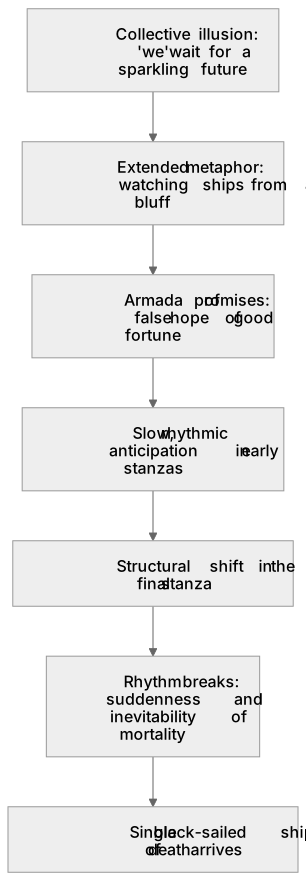
Put it in order
Put these steps in the order they happen.
- 1. Single black-sailed ship of death arrives
- 2. Rhythm breaks: suddenness and inevitability of mortality
- 3. Armada of promises: false hope of good fortune
- 4. Structural shift in the final stanza
- 5. Collective illusion: 'we' wait for a sparkling future
- 6. Extended metaphor: watching ships from a bluff
- 7. Slow, rhythmic anticipation in early stanzas
Key words
Say what each word means before you turn the card.
Time and anticipation
Try answering aloud or in your head before turning the card.
Mortality and death
Try answering aloud or in your head before turning the card.
Illusion versus reality
Try answering aloud or in your head before turning the card.
The human condition
Try answering aloud or in your head before turning the card.
See every definition
- Time and anticipation
- The poem contrasts slow, rhythmic anticipation in the early stanzas with the abrupt, chilling finality of the last stanza, manipulating time and expectation.
- Mortality and death
- The stark, inevitable reality of death is symbolised by the single black-sailed ship, which the poem treats as a mythological allusion.
- Illusion versus reality
- The poem shifts from the collective, colloquial illusion of waiting for a sparkling future to the stark, inevitable reality of death.
- The human condition
- Larkin critiques the active choice to live in the future, using collective pronouns to establish a universal human experience of false anticipation.
Label the diagram
Some boxes have lost their names. Pick the right name for each number.
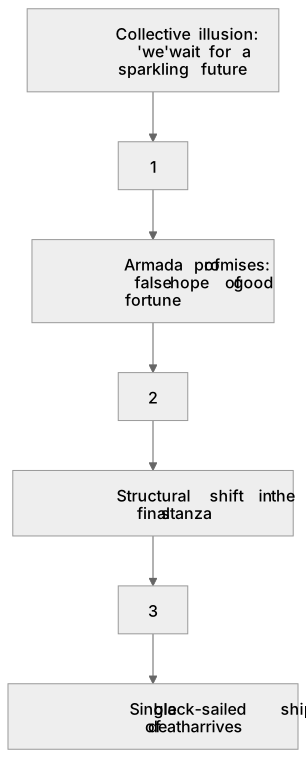
1Box 1
2Box 2
3Box 3
There is more to this lesson
The full lesson goes on to check your understanding and help you earn the marks. Create a free account to carry on, with your progress saved.
A week of Premium from your first lesson · Then the free plan continues · No card, no charge
Test your understanding of Component 3: Poetry – Section B: Specified Poetry Pre- or Post-1900 – Post-1900 – The Movement – Philip Larkin: The Less Deceived (Faber, 2011): Next, Please
Active recall beats re-reading. Take an instant quiz now to test what you’ve learned and lock it into long-term memory.
A week of Premium from your first lesson · Then the free plan continues · No card, no charge