Pearson Edexcel · A-Level · English Literature
Course version: 9ET0 · Version from Sept 2015
Poetry – Section B: Specified Poetry Pre- or Post-1900 – Post-1900 – The…
Full specification wording
Component 3: Poetry – Section B: Specified Poetry Pre- or Post-1900 – Post-1900 – The Movement – Philip Larkin: The Less Deceived (Faber, 2011): Going
"Going" is a short, free-verse poem that captures the creeping, intangible approach of death, conceptualised as an unprecedented evening.
Checked against the Pearson Edexcel 9ET0 specification (opens in a new tab) on .
- Point 8 of 9
- 4 key terms
Study notes
From the checked teaching notes for this specification point.
The idea
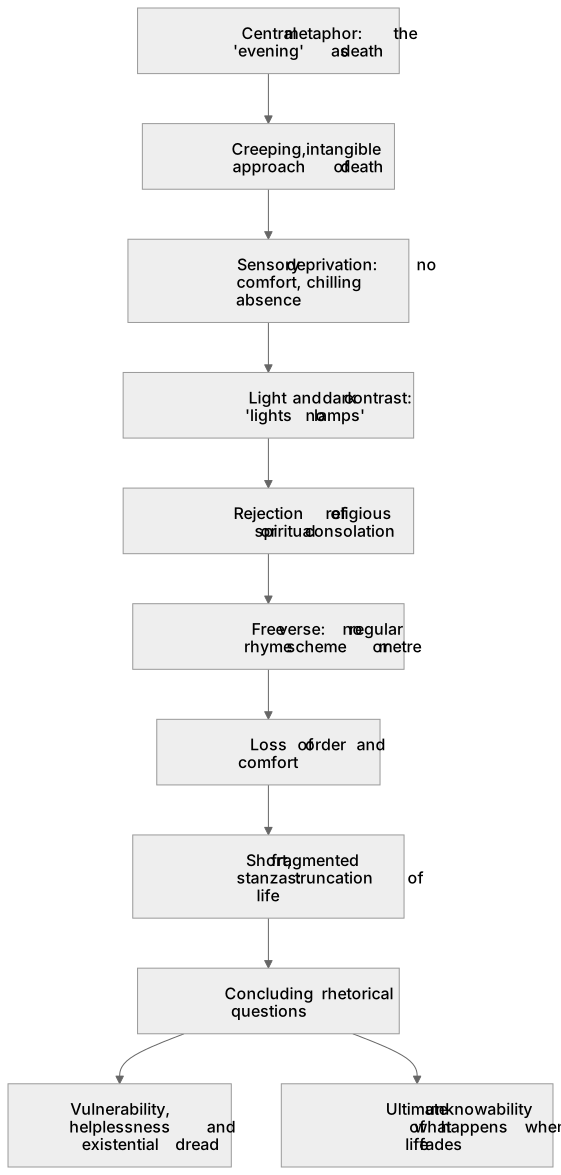
"Going" is a short, free-verse poem that captures the creeping, intangible approach of death, conceptualised as an unprecedented evening. Unlike traditional elegies, Larkin strips away religious comfort, presenting mortality as a bleak, isolating force that extinguishes light and connection. The lack of a regular rhyme scheme or metre reflects the unpredictable, formless nature of death. Analysis should focus on the rhetorical questions in the final stanza, which highlight the speaker's vulnerability and the ultimate unknowability of what happens when life fades.
What earns the marks
- Analyse the central metaphor of the 'evening' as an inevitable, suffocating force representing death.
- Evaluate the impact of the poem's free verse structure, noting how the absence of rhyme mirrors the loss of order and comfort.
- Examine the use of sensory imagery, particularly the contrast between light and dark, to convey the physical sensation of dying.
- Discuss the effect of the concluding rhetorical questions in creating a tone of helplessness and existential dread.
Common mistakes and how to put them right
Treating the 'evening' as a literal time of day rather than a metaphor.
Put it right: Explicitly identify the 'evening' as a symbol for the end of life and the onset of death.
Claiming the poem offers a peaceful view of death due to the word 'evening'.
Put it right: Contrast traditional associations of evening with Larkin's depiction of it as a hostile, isolating force that 'lights no lamps'.
Overlooking the significance of the poem's brevity.
Put it right: Discuss how the short, fragmented stanzas visually and structurally represent the sudden truncation of life.
Exam tips
- Link the stark, unromanticised depiction of death in 'Going' to the defining characteristics of The Movement poetry.
- Contrast the formless, creeping death in 'Going' with the sudden, personified arrival of death in 'Next, Please'.
- Use the phrase 'lights no lamps' to discuss Larkin's rejection of spiritual or religious consolation in the face of mortality.
Try the lesson
The start of the Component 3: Poetry – Section B: Specified Poetry Pre- or Post-1900 – Post-1900 – The Movement – Philip Larkin: The Less Deceived (Faber, 2011): Going lesson, made from checked teaching notes for this specification point.
Have a go first
In Philip Larkin's poem 'Going', what does the 'evening coming in / Across the fields' primarily symbolise?
Listen
Going" is a short, free-verse poem that captures the creeping, intangible approach of death, conceptualised as an unprecedented evening. Unlike traditional elegies, Larkin strips away religious comfort, presenting mortality as a bleak, isolating force that extinguishes light and connection. The lack of a regular rhyme scheme or metre reflects the unpredictable, formless nature of death. Analysis should focus on the rhetorical questions in the final stanza, which highlight the speaker's vulnerability and the ultimate unknowability of what happens when life fades. A strong answer earns marks for these points. Analyse the central metaphor of the 'evening' as an inevitable, suffocating force representing death. Evaluate the impact of the poem's free verse structure, noting how the absence of rhyme mirrors the loss of order and comfort. Examine the use of sensory imagery, particularly the contrast between light and dark, to convey the physical sensation of dying. Discuss the effect of the concluding rhetorical questions in creating a tone of helplessness and existential dread. A common slip: Treating the 'evening' as a literal time of day rather than a metaphor. Instead, Explicitly identify the 'evening' as a symbol for the end of life and the onset of death. Exam tip: Link the stark, unromanticised depiction of death in 'Going' to the defining characteristics of The Movement poetry.
See it
Key words
Say what each word means before you turn the card.
Mortality and the unknown
Try answering aloud or in your head before turning the card.
Isolation and vulnerability
Try answering aloud or in your head before turning the card.
The absence of comfort
Try answering aloud or in your head before turning the card.
Light versus darkness
Try answering aloud or in your head before turning the card.
See every definition
- Mortality and the unknown
- Mortality is presented as a bleak, isolating force, and the ultimate unknowability of what happens when life fades is highlighted by the rhetorical questions in the final stanza.
- Isolation and vulnerability
- The poem presents mortality as an isolating force, and the concluding rhetorical questions highlight the speaker's vulnerability.
- The absence of comfort
- Larkin strips away religious comfort, and the 'evening' brings no comfort, only a chilling absence.
- Light versus darkness
- Sensory imagery, particularly the contrast between light and dark, is used to convey the physical sensation of dying.
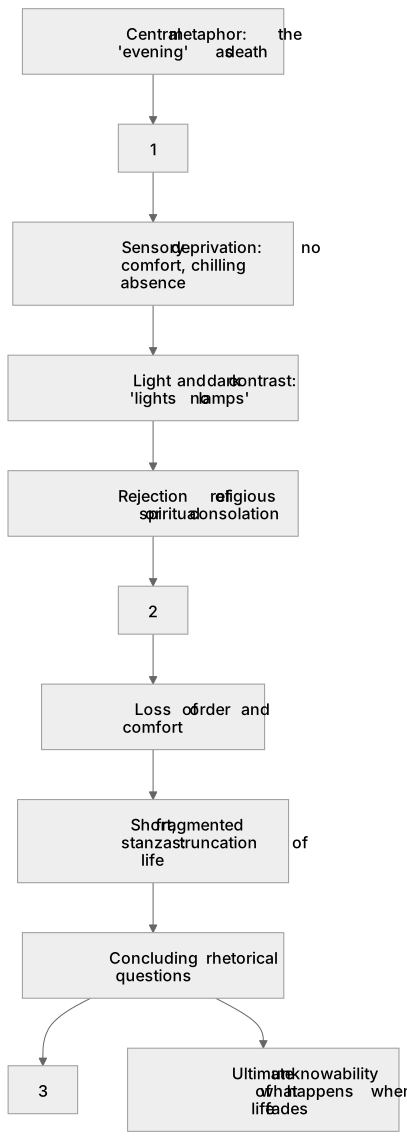
Label the diagram
Some boxes have lost their names. Pick the right name for each number.
1Box 1
2Box 2
3Box 3
There is more to this lesson
The full lesson goes on to check your understanding and help you earn the marks. Create a free account to carry on, with your progress saved.
A week of Premium from your first lesson · Then the free plan continues · No card, no charge
Test your understanding of Component 3: Poetry – Section B: Specified Poetry Pre- or Post-1900 – Post-1900 – The Movement – Philip Larkin: The Less Deceived (Faber, 2011): Going
Active recall beats re-reading. Take an instant quiz now to test what you’ve learned and lock it into long-term memory.
A week of Premium from your first lesson · Then the free plan continues · No card, no charge