Pearson Edexcel · A-Level · English Literature
Course version: 9ET0 · Version from Sept 2015
Poetry – Section B: Specified Poetry Pre- or Post-1900 – Post-1900 – The…
Full specification wording
Component 3: Poetry – Section B: Specified Poetry Pre- or Post-1900 – Post-1900 – The Movement – The Oxford Book of Twentieth Century English Verse, editor Philip Larkin with foreword by Andrew Motion (OUP, 1973): London is full of chickens on electric spits
This poem, often identified by its striking opening line (from Peter Porter's 'John Marston Advises Anger'), offers a biting satirical critique of post-war consumerism and urban superficiality in…
Checked against the Pearson Edexcel 9ET0 specification (opens in a new tab) on .
- Point 15 of 18
- 4 key terms
Study notes
From the checked teaching notes for this specification point.
The idea
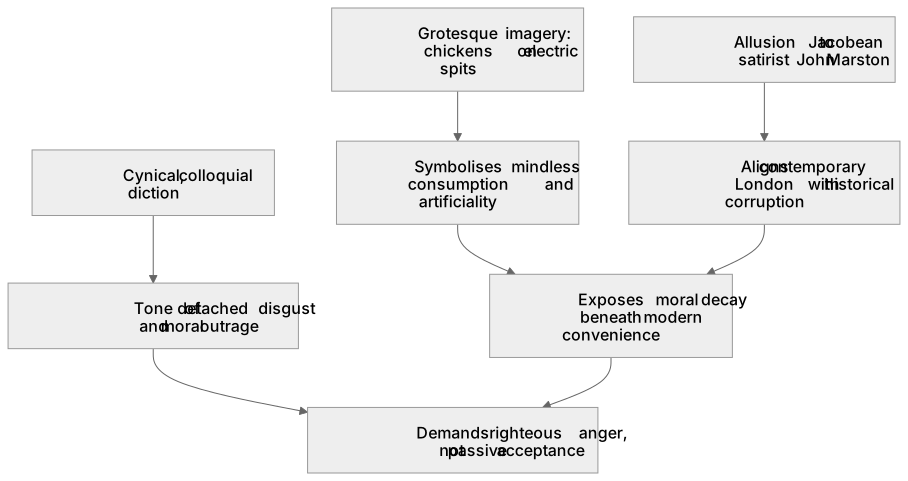
This poem, often identified by its striking opening line (from Peter Porter's 'John Marston Advises Anger'), offers a biting satirical critique of post-war consumerism and urban superficiality in London. Porter uses the grotesque imagery of roasting chickens to symbolise a society trapped in mindless consumption and artificiality. By referencing the Jacobean satirist John Marston, Porter aligns contemporary London with historical corruption, demanding that readers respond with righteous anger rather than passive acceptance of this hollow, materialistic existence.
What earns the marks
- Analyse the use of grotesque consumer imagery, such as the 'electric spits', to represent the artificiality of modern urban life.
- Evaluate the significance of the Jacobean satirical framework and how it elevates the critique of contemporary London.
- Explore the poet's use of cynical, colloquial diction to create a tone of detached disgust and moral outrage.
- Discuss the structural choices, noting how the pacing reflects the relentless, mechanical nature of the consumer society being criticised.
Common mistakes and how to put them right
Mistaking the poem for a literal description of London.
Put it right: Recognise the roasting chickens as a metaphor for a trapped, consumer-driven society.
Ignoring the literary allusion to John Marston.
Put it right: Explicitly connect the poem's anger to the tradition of Jacobean satire and moral decay.
Overlooking the tone of the speaker.
Put it right: Identify the speaker's voice as deliberately cynical and provocative rather than merely observant.
Exam tips
- Compare the poem's cynical view of urban life with other Movement poets' treatments of post-war British society.
- Quote specific jarring images, like the 'electric spits', to demonstrate Porter's use of modern, unromantic diction.
- Link the theme of moral decay to the broader context of 1950s and 1960s consumerism and the rejection of romanticism.
Try the lesson
The start of the Component 3: Poetry – Section B: Specified Poetry Pre- or Post-1900 – Post-1900 – The Movement – The Oxford Book of Twentieth Century English Verse, editor Philip Larkin with foreword by Andrew Motion (OUP, 1973): London is full of chickens on electric spits lesson, made from checked teaching notes for this specification point.
Have a go first
What aspect of modern life is most directly highlighted by the imagery in the line 'London is full of chickens on electric spits'?
Listen
This poem, often identified by its striking opening line (from Peter Porter's 'John Marston Advises Anger'), offers a biting satirical critique of post-war consumerism and urban superficiality in London. Porter uses the grotesque imagery of roasting chickens to symbolise a society trapped in mindless consumption and artificiality. By referencing the Jacobean satirist John Marston, Porter aligns contemporary London with historical corruption, demanding that readers respond with righteous anger rather than passive acceptance of this hollow, materialistic existence. A strong answer earns marks for these points. Analyse the use of grotesque consumer imagery, such as the 'electric spits', to represent the artificiality of modern urban life. Evaluate the significance of the Jacobean satirical framework and how it elevates the critique of contemporary London. Explore the poet's use of cynical, colloquial diction to create a tone of detached disgust and moral outrage. Discuss the structural choices, noting how the pacing reflects the relentless, mechanical nature of the consumer society being criticised. A common slip: Mistaking the poem for a literal description of London. Instead, recognise the roasting chickens as a metaphor for a trapped, consumer-driven society. Exam tip: Compare the poem's cynical view of urban life with other Movement poets' treatments of post-war British society.
See it
Key words
Say what each word means before you turn the card.
Consumerism
Try answering aloud or in your head before turning the card.
Urban decay
Try answering aloud or in your head before turning the card.
Moral corruption
Try answering aloud or in your head before turning the card.
Satire and anger
Try answering aloud or in your head before turning the card.
See every definition
- Consumerism
- A post-war condition of mindless consumption and artificiality that the poem satirises through grotesque imagery such as roasting chickens on electric spits.
- Urban decay
- The moral decay beneath the veneer of modern convenience in London, which the poet exposes through jarring urban imagery and cynical language.
- Moral corruption
- The historical corruption with which Porter aligns contemporary London by referencing the Jacobean satirist John Marston.
- Satire and anger
- A biting satirical critique demanding that readers respond with righteous anger rather than passive acceptance of a hollow, materialistic existence.
Label the diagram
Some boxes have lost their names. Pick the right name for each number.
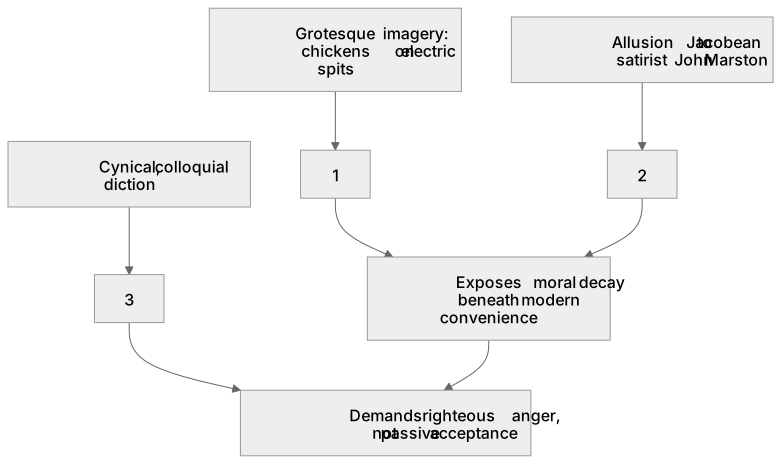
1Box 1
2Box 2
3Box 3
There is more to this lesson
The full lesson goes on to check your understanding and help you earn the marks. Create a free account to carry on, with your progress saved.
A week of Premium from your first lesson · Then the free plan continues · No card, no charge
Test your understanding of Component 3: Poetry – Section B: Specified Poetry Pre- or Post-1900 – Post-1900 – The Movement – The Oxford Book of Twentieth Century English Verse, editor Philip Larkin with foreword by Andrew Motion (OUP, 1973): London is full of chickens on electric spits
Active recall beats re-reading. Take an instant quiz now to test what you’ve learned and lock it into long-term memory.
A week of Premium from your first lesson · Then the free plan continues · No card, no charge